
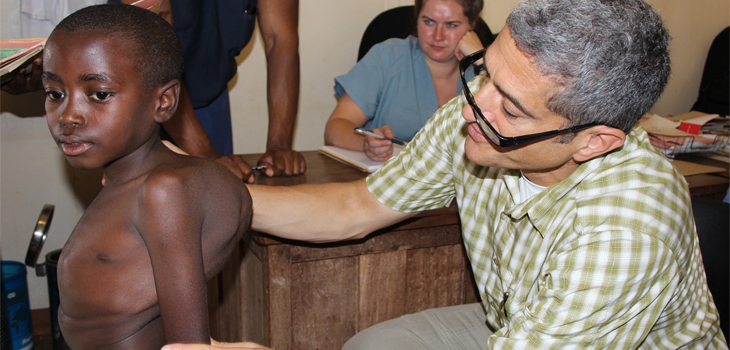
Every year, for the last 15, Isador Liebermann, M.D., an award-winning fellowship trained orthopedic and spinal surgeon and clinical researcher based at the Texas Back Institute in Plano, Texas, packs up what he can, boards a plane and literally moves his practice to Mbarara, Uganda.
Izzy Lieberman’s 15-Year Old Ugandan Spine Surgery Mission
6 min read Premium comments
#texasbackinstitute#isadorlieberman#ugandaspinemission
The first time Izzy (as he is called by his friends and colleagues) made the trip, in 2006, he was a busy 45-year old surgeon, with a very active clinical research program and dozens of research papers published and precious little time to leave his practice at the famous Cleveland Clinic.
And yet, enthusiastically, he put his American career on hold to travel half-way around the world into rural Uganda. “The 250-kilometer trip from the airport was life threatening. We had to navigate an all-gravel single-lane road that was often muddy and included animals and overcrowded buses.”
While difficult, he was in good hands and it was the start of something very special—the Uganda Charitable Spine Surgery Mission, part of Health Volunteers Overseas.
“That first mission, in 2006, was organized by Dr. Mark Kayanja, a Ugandan spine surgeon who was the driving force behind all of our work. While it’s true that I experienced a bit of anxiety when I stepped off the plane, I was confident in the knowledge that we had a plan, equipment, people, drivers, and patients who were ready for surgery. My primary concern was, ‘Am I going to be able to do what I set out to do?’ I didn’t want the expectations to be set so high that we would not be able care for people the way we wanted to. And of course, we were concerned about the possibility of complications.”
Getting Back to Basics by Leaving Your Comfort Zone
As is the case in most of the 3rd and 4th world countries, Dr. Lieberman’s patients in rural Uganda had disease and deformity patterns that are unlike those in most Western countries. The patients he saw, recalls Liebermann, presented with spinal pathologies that were predominantly congenital deformity, infectious spinal collapse (due to tuberculosis or Pott’s disease), and more recently industrial and farming trauma. “In Uganda most do not live long enough to develop the progressive degenerative spinal pathology we treat in North America.”
And yet, despite those complex cases, “The Ugandans, regardless of how severe their pathology is are amazingly appreciative of anything you can do, they have absolutely no sense of entitlement and will persevere regardless of pain and disability. I suspect this is because they all realize that there is no infrastructure to support them if they can’t find a way to care for themselves”
Building an Infrastructure for Spine Healing Far, Far From Plano Texas

After that first memorable year, the team moved the program to the capital, Kampala. “We operated from the Mulago Hospital for the next six years. While things went well overall, there was a fair amount of internal bureaucracy and politics that obstructed our progress. We were considering taking the team to work on the U.S. Mercy ship when I learned that the Ugandan government was building a new hospital in Mbarara—and that they had paved the road from Entebbe to Mbarara.”
In 2012 the Ugandan government opened a new hospital in Mbarara. Dr. Lieberman and his team touched down at Entebbe and made their way (safely) to Mbarara. “It was a festive atmosphere. We arrived a week after the ribbon cutting and essentially opened the ORs for them, unpacking their C-arm, etc.”
Over time, the hospital became affiliated with the Mbarara University of Science and Technology, one of two medical schools in the country. “On one occasion” recalls Dr. Liebermann, “we had lectured to over 300 medical students, fellows, and residents from all disciplines of medicine!”
As the educational effort grew, Dr. Stanley Kisinde, a general surgeon in Uganda, took on a broader role. “We met Stanley in Mbarara, and he indicated a desire to expand spine education in their hospital. He became the educational liaison for the program and organized seminars and lectures. In addition, for the past two years he has been working in Dallas as my research associate.”
And the fruits of their efforts are emerging. “In summer 2019 I delivered a basic spine anatomy and physiology lectures to 3rd and 4th year medical students, as well as a surgical lecture to surgery residents. They asked very astute and pertinent questions stemming from their observations of the spine pathology they encountered in friends and family. It was all very structured, and the students had to report on the lectures to their instructors, which counted as educational credits.”
“We have been extremely fortunate to have Health Volunteers Overseas (HVO) administer our program. They are right on target as far as logistics, grant writing, and fund management. In addition, their help has been invaluable when it comes to setting up teams and licensing for medical professionals. I really want to acknowledge the work of Barbara Edwards, who was my right and left hands at HVO. Tragically, she recently passed away. Her legacy lives on through the spine mission.”
Paying for the Uganda Mission
The Ugandan mission exists on donations—whether financial, donated time or equipment. And there have been lean times. “In the last two years there has been some deterioration in the physical plant, I think things are looking up, in part because the hospital is generating interest teaching and we’ve done numerous lectures.”
Notably, says Dr. Lieberman, the medical device companies have stood by his side. “Although it took three years to achieve a regular flow of funds, by year three we had steady method of generating enough funds from medical device companies and from ‘friends and family.’”
COVID-19’s Impact
While funds are typically the biggest hurdle for mission work, these days there is another more difficult obstacle.
“For 3-6 months we had been mobilizing to do a trip this March. It was incredibly disappointing to have to cancel. We have been closely watching the COVID-19 case numbers Sub-Saharan Africa, but frankly, we have no idea what is happening there. Historically with H1N1 and Ebola you learn about the devastation after the fact. The two doctors I have been communicating with in Uganda haven’t been doing elective surgeries either. There are certainly no N95masks available. I will say that with their experience with Ebola they do know how to quarantine effectively.”
When We Give, We Receive
Dr. Lieberman emphasizes one vital and organic aspect of the Uganda Spine Mission. “It has been a wonderful, meaningful surprise to see the extent to which our project has been a catalyst for our volunteers. So many of our people have gone on to start their own efforts. Dr. Kris Siemionow has started a program in Poland for spine surgery and Dr. Selvon St. Clair conducts a medical mission on his home island of Trinidad. And then there are my children, who have each started their own volunteer efforts at home and abroad. In addition, some previous volunteers have started programs to collect and ship medications and hospital equipment.”
And although their growth plans have been curtailed in the short term, Dr. Lieberman isn’t slowing down much. “I have been doing some work with Mark Slaughter of OnBelay Medical, a company that that is structured to convert revenue streams into philanthropy. Mark and I have found at least 10 surgeons, some of which are native Ugandans, with a strong interest in building a hospital in Uganda. We are working with On Belay to channel resources from implant sales into a newly formed yet to be named international spine care consortium.”
This zeitgeist is the future, says Dr. Lieberman.
“Part of our ongoing growth is the cultivation of collaborative efforts by like-minded people. The future lies in taking our expertise and embedding it into local healthcare communities so they can serve and teach better than is currently possible. At this point our overarching goal is to build and outfit a hospital and train the local healthcare community to be increasingly self-sufficient.”
So not only has Izzy Lieberman seen great need every year for the last 15 years…he has—and is—doing something about it.
For additional information on the work of the Uganda Charitable Spine Surgery Mission, please visit: http://www.ugandaspinesurgerymission.com/
Author
React:
Discussion
This is a fascinating development. In my practice we've seen similar outcomes with the revised protocol. The key differentiator seems to be patient selection criteria. Has anyone else noticed the correlation with BMI thresholds?
Great point. I'd push back slightly on the conclusion, the sample size in the cited study is too small to draw population-level inferences. That said, the directional signal is compelling and worth a larger RCT.
We implemented a similar approach last year. Early results are promising but we're still gathering 12-month follow-up data. Happy to share our protocol if anyone is interested.
Join the conversation
Orthopedic professionals are discussing this. Sign in and upgrade to read every comment and add your voice.