
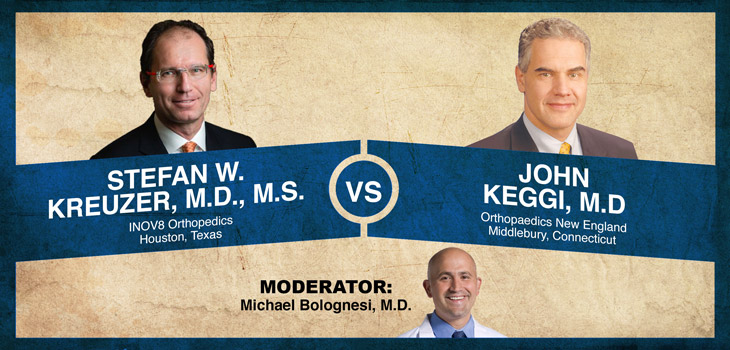
At the 2019 Orthopaedic Summit: Evolving Technologies (OSET), two orthopedic surgeons debated whether a special OR table was needed for a 69-year-old former professional tango dancer requesting anterior total hip replacement. Arguing for was Stefan W. Kreuzer, M.D., M.S., of INOV8 Orthopedics and against was John Keggi, M.D., of Orthopaedics New England. The debate was moderated by a past president of AAHKS, Michael Bolognesi, M.D.
Anterior Total Hip With or Without a Special Table in a 69-Year-Old Professional Tango Dancer
5 min read Premium comments
Great Debates#anteriortotalhipreplacement#johnkeggi#stefankreuzer#tensorfascialatae
Dr. Kreuzer: The anterior approach to a total hip replacement (THR) involves a small incision through the Smith-Peterson interval where you go between the tensor fascia latae and the sartorius muscle. No major releases are required, but a special table is very helpful with this approach.
If you have a Cadillac budget, you can select the ProFx table—quite an expensive choice. If you are opting for the economical choice, the Arch Table is a possibility. Note that I do have a financial interest in this table and thus you should take everything I say with a grain of salt. Generally speaking, we needed to come up with a less expensive solution that works well for all our patients.
You could say that the table acts as a quiet, well-behaved surgical assistant. Annually, a surgical assistant can cost between $40-60,000 ($150,000 in New York City). With this table, there is a one-time expense and you get a quality product. It’s very easy to set up, it’s modular, it’s mechanical, there are no electronics, and it can be used for trauma cases as well.
There’s no doubt in my mind that you get better femoral exposure doing an anterior hip replacement with a table. And if you are operating on a muscular NFL football player—which I’ve done quite a bit lately—then it is particularly helpful.
Another key advantage is that you can use a single offset broach handle versus a double offset broach handle. In addition, intraoperative X-rays are rendered much easier with the table.
Regarding patient positioning, imagine the foot is on your left and the head of the patient is on your right; the leg is dropped down on the table. The end of the bed handily pushes the femur right into the surgical field. Now you can utilize straight reamers with this exposure using the table.
Excellent exposure and a single offset broach handle are simple. Not only can you calcar plane, but you can get good rotational stability. In addition, using a table allows for maximum control of femoral aversion. Frankly, you can almost complete the operation with no retractors.
Although I do not use a C-Arm, which has always been a criticism of the anterior approach, I do feel it’s important to get at least one radiographic representation. To quote another faculty member, “An intraoperative X-ray makes you accept nothing short of perfection.”
You say you want more, Dr. Keggi? Okay! The table makes it easy to incorporate computer navigation and renders revision surgery much simpler.
The table shows up on time, stays late with no lunch breaks, does not call in sick, and can be depreciated. The table is my best friend. And now I must leave you to learn how to tango.
Dr. Bolognesi: John Keggi, do you believe any of that? Tell us your truth.
Dr. Keggi: That was great, Stefan, but I have 10 reasons why you are wrong.
The only table you really need is—a simple picnic table—or a classic OR table.
Here is why.
#10: Cost. Why buy a table when you already have one in the OR? We don’t have a maintenance contract to the extent that you have to have for these other things. You don’t have to pay fluoro techs and you don’t need any special storage.
#9: Availability. I don’t want to fight with my partners, much less my enemies, over the use of the table. If we did go down this path, we would have to buy multiple tables. Not having a special table avoids that conflict.
#8: Set Up. When you don’t use a special table, the set up is very straightforward. You use one gel bump and you’re done. Are you listening, Stefan? The gel bump is placed underneath the hip at the sacroiliac joint and off we go to perform the total hip.
Sure, you can get a special table…they are even advertised on eBay. I read that someone had buyer’s remorse and is now trying to sell their table for around $70,000. But there are no returns, so if you buy it, you keep it.
#7: Extra Personnel in the Room. An OR already has additional personnel standing around so we should put them to work.
#6: Potential Injury. There is documented evidence in the literature that these tables have the potential for injury. This may involve traction, femoral pain, pudendal neuralgia from the post, and even broken ankles.
#5: Fluoro Not Needed. Fluoroscopy…we don’t use it because it is not necessary. We eliminate a lot of waste because we don’t have to pay a fluoro tech. Nor do we have to pay a radiologist to look at the films. And we’re not wasting time on potentially contaminating the field with extra items.
Fluoroscopy does not improve outcomes. This was demonstrated in a study on THR done with and without fluoroscopy: “Does Intraoperative Fluoroscopy Improve Limb-Length Discrepancy and Acetabular Component Positioning During Direct Anterior Total Hip Arthroplasty?” Not only were leg lengths found to be equal in both groups, but there was no difference in cup position. Here is the cup position with fluoroscopy and here is the cluster of cup positions without. You don’t need fluoroscopy—end of discussion. (Bingham, et al., JOA, 2018)
#4: Extreme Positioning. The table you showed, Stefan, with our flexible tango dancer in an extreme position, is just not necessary. Wake up, Stefan! You can do the entire hip on a regular table without moving the leg in an anterior approach.
#3: Stability Testing. You can do improved stability testing using a regular table…and you can do it very easily. And while you can remove the foot from the boot, it’s not necessary. You can push the leg anywhere you want. No problem. Sorry, Stefan, but you are making life very complicated.
#2: Newer is not better. There’s no shortage of table types and you can wander around looking for the perfect one…but perhaps none of them really do the right job.
Also note that if you use a regular OR bed, you can extend the leg. And if you have that little draped window, then how do you extend the leg in the case of an unforeseen problem on your special table?
#1: Results. A standard approach on a standard OR bed will help all comers: the thinnest, the heaviest, all accompanied by a low complication rate. It’s not magic.
A standard OR bed is cheaper, readily available, easy to set up, requires no additional staff, doesn’t hold the potential for injury, involves no fluoro, requires minimal limb manipulation, and allows for easy stability testing.
It’s standard, tried and true. It’s the best way to go. Thanks Stefan, you lose.
Please visit https://orthosummit.com/ for more information on this year’s upcoming 10th Anniversary Orthopedic Summit 2020 event on December 8-12, 2020 at the Bellagio in Las Vegas, Nevada.
Author
React:
Discussion
This is a fascinating development. In my practice we've seen similar outcomes with the revised protocol. The key differentiator seems to be patient selection criteria. Has anyone else noticed the correlation with BMI thresholds?
Great point. I'd push back slightly on the conclusion, the sample size in the cited study is too small to draw population-level inferences. That said, the directional signal is compelling and worth a larger RCT.
We implemented a similar approach last year. Early results are promising but we're still gathering 12-month follow-up data. Happy to share our protocol if anyone is interested.
Join the conversation
Orthopedic professionals are discussing this. Sign in and upgrade to read every comment and add your voice.