
A Danish study found that i-FACTOR, a bone graft produced by Cerapedics, Inc., worked better than allograft in non-instrumented lumbar fusion. The study, “Randomized double blind clinical trial of ABM/P-15 versus allograft in non-instrumented lumbar fusion surgery” was published in the June 2020 issue of The Spine Journal.
Amino Peptide Bone Graft Beats Allograft in New Study
2 min read Premium comments
Secondary#cerapedics#allograft#ifactor#bonegraft
Cerapedics is a Colorado-based ortho-biologics led by CEO Glen Kashuba. “The Study is a valuable addition to our clinical evidence base,” said Kashuba. “This is now our fourth prospective clinical study in which i-FACTOR Bone Graft has demonstrated a clear clinical benefit and builds upon our previously reported fusion in various spine applications,” he continued.
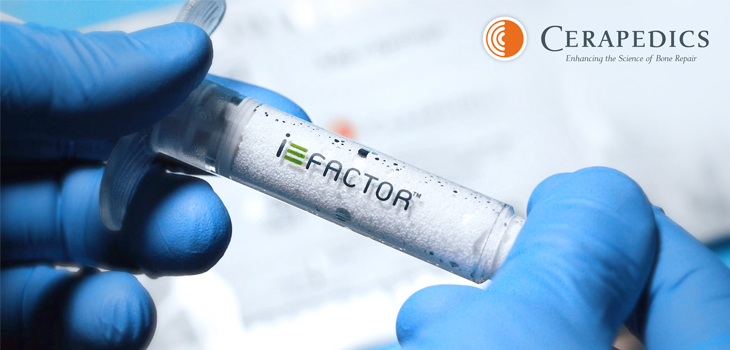
Cerapedics’ only product, i-FACTOR, is a bone graft made of anorganic bone mineral (ABM) and a 15 amino acid peptide attachment factor dubbed P-15. P-15 is a synthetic version of a stretch of the a1 chain of Type I collagen. The peptide is intended “to facilitate attachment of osteogenic cells to the granule component,” according to the product’s instructions for use.
i-FACTOR has been in use in Europe for over 10 years and received FDA approval in 2015 for use at a single level in anterior cervical discectomy and fusion (ACDF). Currently, it must be used with an allograft ring, and with supplemental anterior plate fixation. i-FACTOR is currently one of two bone graft drug-device combinations approved by the FDA, the other is Augment from BioMimetic Therapeutics, LLC. in partnership with Wright Medical Group N.V.
The present study investigated the use of i-FACTOR in non-instrumented lumbar fusion, a commonly considered surgical procedure in Scandinavia for elderly patients with instability, according to Principal Investigator, Dr. Michael Kjær Jacobsen. “Allograft bone has notoriously low fusion rates in this population…i-FACTOR shows an increased fusion rate versus allograft,” Dr. Jacobsen added. The study randomized patients to receive either the i-FACTOR with local bone graft treatment or allograft with local bone as a control. The double-blind, prospective study randomized over 100 patients, and found that in the 49 patients in each group that completes the study i-FACTOR resulted in 50% fusion, while allograft resulted in 20% fusion after 1 year.
Cerapedics President and COO Jeffery G. Marx, Ph.D. said, “We are very encouraged by the results of this level-1 human clinical study in an extremely challenging environment.” He was encouraged by the study and expressed hopes of continued success in the company’s ongoing investigational device exemption (IDE) study for its next-generation P-15L bone graft for transforaminal lumbar interbody fusion (TLIF) surgery.
Author
React:
Discussion
This is a fascinating development. In my practice we've seen similar outcomes with the revised protocol. The key differentiator seems to be patient selection criteria. Has anyone else noticed the correlation with BMI thresholds?
Great point. I'd push back slightly on the conclusion, the sample size in the cited study is too small to draw population-level inferences. That said, the directional signal is compelling and worth a larger RCT.
We implemented a similar approach last year. Early results are promising but we're still gathering 12-month follow-up data. Happy to share our protocol if anyone is interested.
Join the conversation
Orthopedic professionals are discussing this. Sign in and upgrade to read every comment and add your voice.