
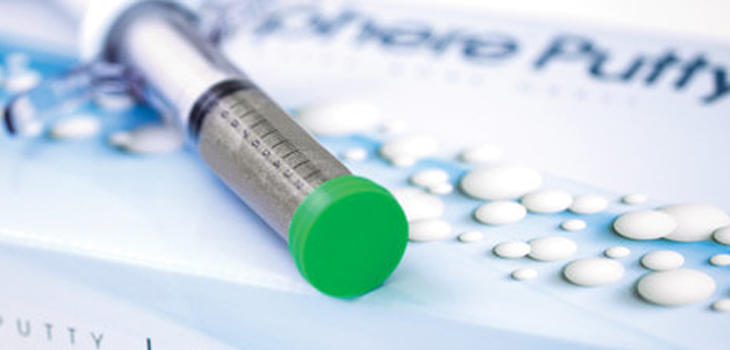
A new study published in the March 2020 issue of the Journal of Spine Surgery, “Clinical experience with the use of a spherical bioactive glass putty for cervical and lumbar interbody fusion,” investigated radiographic fusion rates and visual analog scale (VAS) pain scores at 1- and 2-year follow-ups for a novel bioactive glass product, BioSphere Putty, made by Synergy Biomedical, LLC. of Wayne, Pennsylvania.
248 Patient Study Puts Bioactive Glass to the Test in Spine Fusion
2 min read Premium comments
Secondary#bonegraft#biosphereputty#synergybiomedical
Surgeons often look for alternatives to autograft bone as a bone graft due to limited quality or quantity, or to avoid donor site morbidity. There are natural options such as allograft, or synthetic polymers and ceramics to choose from. However, bioactive glass may be one of the most potent options available.
The material is made of 4 oxides of silicon (SiO2), calcium (CaO), sodium (Na2O), and Phosphorus (P2O5). Bioactive glass has been used clinically for over 20 years. Interestingly, when exposed to body fluids the material forms a layer of apatite-like minerals, including the main mineral component of bone, hydroxyapatite. This layer can bind to bone and is osteoconductive, dissolution of the glass also has stimulating effects on osteoblasts and bone marrow cells, amplifying the bone healing properties of the material. Rates of dissolution and resorption can be controlled by manufacture of the optimal particle size.
Authors of this new study followed 115 patients who were treated with anterior cervical discectomy and fusion (ACDF) and 133 who were treated with lumbar fusion. Most of the lumbar fusion patients (n=103) received a transforaminal lumbar interbody fusion (TLIF), the rest (n=30) underwent anterior lumbar interbody fusion (ALIF). All patients received Bioactive glass instead of allograft or other bone void fill products.
Every patient showed radiographic fusion, and no adverse events were reported, including infection or graft-related complications. Both ACDF and lumbar fusion patients experienced significant reductions in VAS pain at 1-year follow-up, and even greater reduction in pain at the 2-year follow-up. Pain reduction was similar to historic norms, according to the study’s authors. Despite positive fusion in all patients, some did not experience an improvement in pain, or even experienced an increase. Overall, the authors concluded, ACDF with bioactive glass was successful in 93% of patients, and 89% of patients had success with the material in lumbar fusion. The only conflict of interest disclosed was study’s corresponding author employ with Synergy Biomedical.
The study suggests that bioactive glass may be an attractive alternative to allograft or other synthetic bone grafts. The high rate of fusion observed in this study are similar to that seen in studies investigating rhBMP, typically known for its superior fusion rates and its potential complications.
Author
React:
Discussion
This is a fascinating development. In my practice we've seen similar outcomes with the revised protocol. The key differentiator seems to be patient selection criteria. Has anyone else noticed the correlation with BMI thresholds?
Great point. I'd push back slightly on the conclusion, the sample size in the cited study is too small to draw population-level inferences. That said, the directional signal is compelling and worth a larger RCT.
We implemented a similar approach last year. Early results are promising but we're still gathering 12-month follow-up data. Happy to share our protocol if anyone is interested.
Join the conversation
Orthopedic professionals are discussing this. Sign in and upgrade to read every comment and add your voice.