
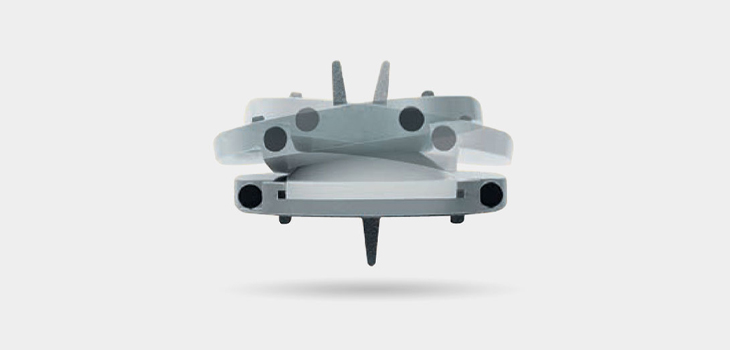
Eighteen years after the first clinical trial implantation, the FDA has given its approval for a two-level indication for Centinel Spine, LLC’s prodisc® L Lumbar Total Disc Replacement (TDR) system. The prodisc first received FDA approval in 2006.
prodisc L Wins FDA Approval for Two-Level Use
2 min read Premium comments
#centinelspine#prodiscSecondary#fdaapproval
In an April 4, 2020 press release, the company said they are now the only company with an FDA approved lumbar TDR device that has been clinically reviewed and found safe and effective for two level use.
Trial and Studies
Jack Zigler, M.D. at the Texas Health Center for Diagnostics and Surgery, Texas Back Institute (TBI), Plano, Texas, performed the first two-level implantation in the U.S. on January 22, 2002 as a part of a two-level study. The company said results from the study have been published in numerous papers and “are part of the over 540 published studies on the ProDisc technology platform.”
Zigler said patients with two-level prodisc L disc replacements “have done remarkably well in long-term follow-up.” He added that TBI began two-level prodisc L implantations in January 2002 as an enrolling site in the FDA study. “I have now seen multiple two-level disc replacement patients with over 15-year follow-up who are still delighted with their clinical results—and have not needed additional surgery that is commonly required after initial fusion surgery. Patients with two-level disc replacement are among my most grateful patients.”
Centinel Spine’s new CEO Steve Murray said the longevity of the prodisc technology, “is due to the design principles of a stable bone interface, a consistent mechanism of action enabling guided motion, and instrumentation that facilitates efficient and reliable implantation.”
“The prodisc platform now consists of six devices, including an anterior and anterior-lateral approach lumbar disc replacement and four cervical disc replacement implants with a variety of endplate configurations “designed to enable surgeons to better suit patient anatomy.”
Developments include a recently initiated clinical trial comparing the prodisc C Vivo and prodisc C SK devices with an approved TDR product as a control, in order to validate their safety and effectiveness in an FDA IDE study.
prodisc and Centinel Spine Provenance
In December 2017, the company acquired the prodisc platform from DePuy Synthes. Centinel Spine is one of the companies owned by Viscogliosi Bros., LLC. The V brothers, Anthony, Marc and John, were the original investors of prodisc and sold it to Synthes in 2003 for $350 million.
In 1999 the brothers and the German firm Aesculap AG & Co. KG, jointly created Spine Solutions, Inc., to bring to market the ProDisc developed by French orthopedic surgeon, Dr. Thierry Marnay.
In June 2019, the company entered into partnership with Tiger Woods. Woods underwent spinal fusion surgery by Zigler’s TBI partner, Rick Guyer, M.D., using Centinel Spine’s STALIF M-Ti Anterior Lumbar Integrated Interbody fusion product in April 2017. Woods quickly went on to win the Masters.
On March 16, 2020, Chairman & CEO John Viscogliosi, stepped down to return to the Viscogliosi Brothers, LLC. Mothership.
Author
React:
Discussion
This is a fascinating development. In my practice we've seen similar outcomes with the revised protocol. The key differentiator seems to be patient selection criteria. Has anyone else noticed the correlation with BMI thresholds?
Great point. I'd push back slightly on the conclusion, the sample size in the cited study is too small to draw population-level inferences. That said, the directional signal is compelling and worth a larger RCT.
We implemented a similar approach last year. Early results are promising but we're still gathering 12-month follow-up data. Happy to share our protocol if anyone is interested.
Join the conversation
Orthopedic professionals are discussing this. Sign in and upgrade to read every comment and add your voice.