
How well (or poorly) does calcium phosphate bone void fill perform in a threaded suture anchor pullout test? The results of a study to determine exactly that was recently published by a team from the Florida Orthopaedic Institute. Their work, “Calcium Phosphate Bone Void Filler Increases Threaded Suture Anchor Pullout Strength: A Biomechanical Study,” appears in the April 2020 edition of Arthroscopy.
New Use and Test Data for Calcium Phosphate Bone Void Fill
3 min read Premium comments
Secondary#accufill#injectablecalciumphosphate#microtrabecularfractures
The test the research team devised was to use a polyurethane foam block model (meant to mimic osteoporotic bone) as well as an in vitro cadaveric humeri model. They filled half of the foam block models with injectable calcium phosphate bone substitute material (CP-BSM) but did not augment the other half of the foam block models with CP-BSM. The team then instrumented the blocks with threaded suture anchors. And then the team repeated the procedure with matched cadaveric humeri model. To test the pullout strengths the research team performed a stepwise, increasing axial load protocol for a total of 40 cycles.
Co-author Christopher E. Baker M.D., an orthopedic surgeon at the Florida Orthopaedic Institute in Tampa Bay, explained the genesis of the study to OTW: “Clinically I have had occasion where I would encounter a patient with very poor bone in both rotator cuff and glenoid labral repair about the shoulder. Most commonly these were very large cysts in early degenerative disease but could also be found in revision repair or severe osteoporosis.”
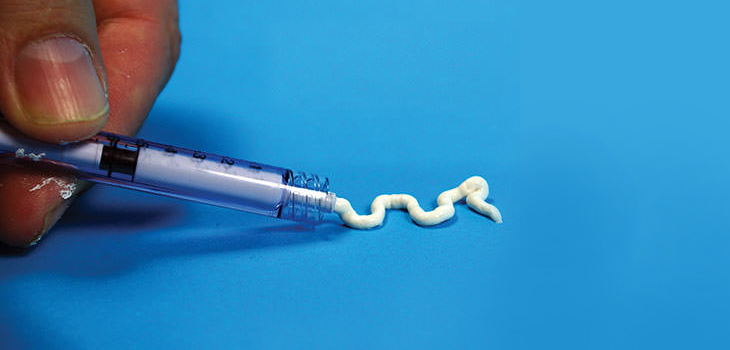
“In these cases, I would become very concerned about the ability for anchor fixation to allow for adequate strength to hold the repaired tissues long enough for healing or even for the act of knot tying at the time of surgery. Currently I know of no easy percutaneous options to treat such deficient bone. Accufill is a proprietary injectable calcium phosphate distributed by Zimmer Biomet that has been used to treat microtrabecular fractures, most commonly about the knee, that I have become very familiar with.”
“My experience with its use in the knee led me to consider that this may be a perfect use of this injectable calcium phosphate in these larger defects in the shoulder and could possibly allow for improved pullout strength in repair for these patients. We have performed nearly 20 repairs in the last 5-6 years using this injectable calcium phosphate in the shoulder with great success clinically and radiographically, but we had no biomechanical data to prove that we had indeed increased the pullout strength of the anchor and therefore the repair. This is what motivated us to endeavor on this study.”
According to Dr. Baker the study demonstrated that “The pullout strength of the anchors was significantly higher in the group treated with calcium phosphate, both in a foam block and cadaveric model, actually almost double the pullout strength.”
“The second finding was that in our best effort to create an in vivo situation of immediately testing the pullout strength after 10 minutes of allowing the calcium implant to cure, the implant was strong. This is important because it means that this can be used in the OR with hopefully minimal disruptions to the surgeon’s typical surgical technique.”
“The third important finding, and one we did not foresee, was that the 7.5 PFC foam block model pullout strengths very closely resembled that of the osteoporotic cadaveric model. This could potentially help in the future by reducing cost and complexity for follow-up studies concerning this problem and our solution allowing us to consider simply using the 7.5 PCF foam in place of the cadaveric specimens.”
Dr. Baker also offered this caution for doctors who are considering the use of percutaneous augmentation with calcium phosphate for bone defects (cysts, revision surgery, osteoporosis, etc.). “The surgeon needs to understand that not all calcium phosphates are the same and most would not be able to be placed in a percutaneous manner as discussed in this article without first creating a macro defect.”
“When approaching repair of the rotator cuff or labrum in the face of cystic defects or other deficient bone consider first augmenting that bone with injectable calcium phosphate. Do not attempt it use after an anchor has been placed and then been pulled out due to no fixation. Once a large hole has been created in the cortex this material is difficult to work with as it will egress into the joint and soft tissues.”
Author
React:
Discussion
This is a fascinating development. In my practice we've seen similar outcomes with the revised protocol. The key differentiator seems to be patient selection criteria. Has anyone else noticed the correlation with BMI thresholds?
Great point. I'd push back slightly on the conclusion, the sample size in the cited study is too small to draw population-level inferences. That said, the directional signal is compelling and worth a larger RCT.
We implemented a similar approach last year. Early results are promising but we're still gathering 12-month follow-up data. Happy to share our protocol if anyone is interested.
Join the conversation
Orthopedic professionals are discussing this. Sign in and upgrade to read every comment and add your voice.