
The highest form of love, teaches every major form of religion, is the unselfish giving of one’s fellow man to another. The healing arts flow from this sacred font. By giving, we receive.
Milwaukee Surgeons in Nicaragua, Giving, Receiving and Renewing
6 min read Premium comments
#medicalcollegeofwisconsin#medicalmissions#nicaragua
When the demands of modern medicine weigh particularly heavily, many physicians make it a point to travel to a different place, a different culture, to work, for free, with donated equipment and in the most difficult conditions to simply heal as best they can.
When they do that, they experience something profound. They return home renewed and restored.
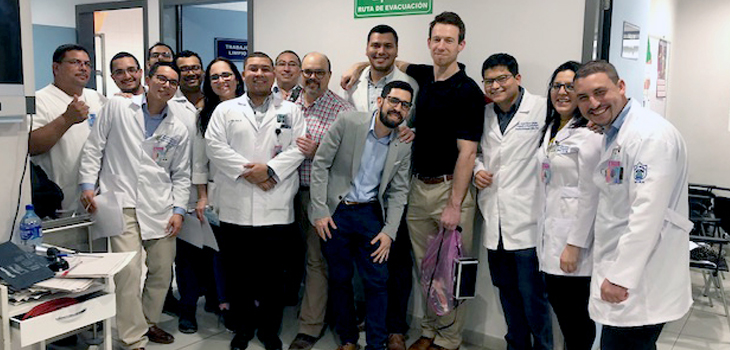
A team from Milwaukee recently returned from Nicaragua, one of the poorest countries in the Americas where 80% of the population lives on less than $2 per day. They went to Nicaragua, a country where conditions vary considerably from the typical U.S. operating theater, where surgeons operate without reliable fluoroscopy, arthroscopy towers, or what would be considered necessary instruments and hardware in any U.S. hospital or clinic.
These physicians and their affiliated health care providers came from the Medical College of Wisconsin (MCW) and were led by Steven Grindel, M.D., MCW’s head of hand and upper extremity surgery.
In the Beginning
According to Dr. Grindel, the program was started by MCW’s former chair, Dr. Jeffrey Schwab. “More than 20 years ago Dr. Schwab connected with colleagues in Nicaragua who were focused on pediatric orthopedics. After hearing about their problems, he decided to take residents to several small towns in Nicaragua and do surgery.”

“Eight years ago, we began hearing from the Nicaraguan Ministry of Health that they needed people in their teaching hospital in Managua. So, we went there and set up a program for Nicaraguan residents and attendings to teach fracture care, infection treatment, and deformity correction. This culminated in the formation of ‘Milwaukee Orthopaedics Overseas,’ a group that travels to Nicaragua on a semiannual basis, bringing along at least one attending, resident or fellow. I am charged with providing instruction on hand to shoulder surgery to the Nicaraguan trainees.”
Milwaukee Orthopaedics Overseas
Over the years, Dr. Grindel’s team and their counterparts in Nicaragua have developed a system of shared responsibilities. “The Nicaraguan team spends months on patient selection, sending us information via email for us to review ahead of time,” he says. “If imaging is available, they also get this to us while we are still in the U.S. We then develop a plan and procure the instruments and devices.”

“We do much of our work at Fernando Velez Paiz Hospital. When we arrive, we spend Sunday evaluating patients and organizing who is going to see which patient. We examine the available resources and do our best to ensure that we have the correct implants, hardware, plates, screws, etc. And in addition to the preselected patients, many more travel from all over the country to be evaluated. Unfortunately, only a fraction of those can be listed for surgery that week.”
The team works in two teaching hospitals in Managua, operating Monday through Friday and conducting as many surgeries as possible.
Dr. Grindel: “On a good day we can perform six surgeries. On the occasions when we can only do three then it is often because we may be doing more complex cases which require more operative time or we don’t have the necessary imaging or instruments to complete more on any given day. Much of what I do is shoulder surgery and because the head of Orthopedics at Fernando Velez Paiz Hospital, Dr. Pablo Carea, trained with us, their training program now has a surgeon who can perform these surgeries. They really did not have the necessary equipment to do these cases in Managua.”
Building an Enduring Legacy With Teaching and, Yes, Live Broadcasting
Nearly every year, says Dr. Grindel, Nicaraguan trainees come to Milwaukee to acquire vital surgical skills. “We have the resident or fellow work here at the Medical College of Wisconsin for six weeks. They select their area of interest—foot and ankle, trauma, sports etc.—and we pair them with a practicing orthopedic surgeon.”
Another approach to developing in-country talent is via a nationally broadcasted conference, surely more important now than ever.
“This February we did participate in routine care, but we also worked with our Nicaraguan counterparts to arrange a live national conference. There was broadcasting into an auditorium, and audiences from all over the country could view the surgeries we were performing. A Nicaraguan resident or visiting attending was scrubbed in with me for each operation. One of the surgeries we did was a Latarjet procedure where we cut the bone in the shoulder and moved it to another part of the shoulder to prevent dislocation. As for visualization, we had to rely on intra-operative landmarks and clinical judgement to confirm appropriate positioning of the bone graft and screws. The feedback on the conference was so positive that it will be repeated annually.”
OTW asked Dr. Grindel what his program needs most. “I would love to create a program that would enable us to have a steady stream of supplies that does not come through me but goes directly into these teaching hospitals. In addition, it is only by enhancing the educational component of our work that we will make a sustainable contribution to the musculoskeletal health of the Nicaraguan people.”
Changing Perspectives, Humbled and Fulfilled
The entire program has had as profound an effect on the MCW team as it has on the Nicaraguan people. According to Dr. Grindel, “They have certainly taught me how to approach problems in surgery in a more open-minded way and have forced me to find solutions with whatever tools are available. Without sounding too cliché, it has opened my eyes to how we are blessed to be practicing in the United States with all of the resources that we need at our fingertips.”

“I have also learned how resourceful less fortunate societies are that they are able to accomplish all that they do. It’s humbling to try to perform some of these surgeries without the full preoperative work up that I’m used to and without all of the fancy tools that I have here at home. In short it has made me more patient.”
“These trips most definitely enrich my spirit,” stated Dr. Grindel. “To put it in some context Dr. Pablo Corea and I first met when he was a resident in Nicaragua and came to MCW for a short six-week rotation. I met him as a young surgeon and have watched him grow into a very accomplished leader and educator.”
“In 2019 Dr. Corea returned to Milwaukee and spent six months with me as my international fellow; upon his return he assumed the role of head of orthopedics at his hospital. It’s really through his efforts that a lot of these educational opportunities have presented themselves and come to fruition.”
“A major highlight of this program has been the educational exchange certainly. The other obvious highlight is clinical. It is a privilege to be able to bring my skills to the Nicaraguan people and help them with these complicated issues. It is overwhelming that each of the times that I’ve been there patients have traveled from all over the country to have an opportunity or a shot at having our team take care of them. It is particularly sad knowing that as much as we can accomplish in any given mission trip so much more needs to be done.”
“Lastly but not any less important is our bringing with us residents and fellows from the United States to expose them to this volunteerism. Each of them comes away feeling grateful that they’ve volunteered their time and skills to help such a worthy cause and many of them have been stimulated to go on and continue this type of work well into their careers.”
It takes a village…and more than ever, the world is a global village.
For additional information about Milwaukee Orthopaedics Overseas, please contact Steve Grindel, M.D. at sgrindel@mcw.edu
Author
React:
Discussion
This is a fascinating development. In my practice we've seen similar outcomes with the revised protocol. The key differentiator seems to be patient selection criteria. Has anyone else noticed the correlation with BMI thresholds?
Great point. I'd push back slightly on the conclusion, the sample size in the cited study is too small to draw population-level inferences. That said, the directional signal is compelling and worth a larger RCT.
We implemented a similar approach last year. Early results are promising but we're still gathering 12-month follow-up data. Happy to share our protocol if anyone is interested.
Join the conversation
Orthopedic professionals are discussing this. Sign in and upgrade to read every comment and add your voice.