
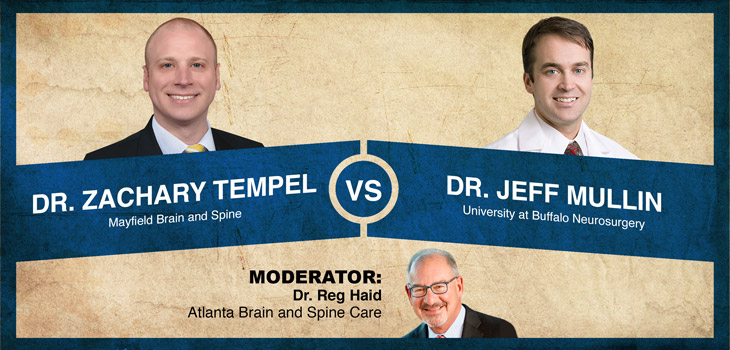
This week’s Case Debate Series, hosted by NuVasive, Inc., features complex spine and raises several important questions regarding material, procedure, and tethering as part of a distributed loading technique. Dr. Zachary Tempel, neurosurgeon at Mayfield Brain and Spine, provides a very thoughtful discussion of intraoperative rod technique while also highlighting material selection and construct configuration. Dr. Jeff Mullin, a neurosurgeon at University at Buffalo Neurosurgery, leans toward the materials and specifically highlights load distribution tethers while also mentioning an intraoperative weave technique. Dr. Reg Haid of Atlanta Brain and Spine Care referees this lively debate.
Materials or Technique? Tempel Takes on Mullin
8 min read Premium comments
Great Debates#jeffmullin#softlanding#tethering#zacharytempel
Moderator Haid: This is our second of our Case Debate Series hosted by NuVasive. We’d like to thank our industry sponsor and partner NuVasive for their help.
We’re going to hear a couple of peers discuss, debate, and talk about the pros and cons of procedural approaches and the application of technology. Today’s debate is going to be about creating a softer landing in our long fusion constructs, its complex spine and distributed loading techniques and all about a gradual change in stiffness for a soft landing for long constructs.
We have a couple of exemplary young spine guys. The first is Zachary Tempel, a neurosurgeon at the Mayfield Brain and Spine in Cincinnati, Ohio. Jeff Mullin is a neurosurgeon and assistant professor at the University of Buffalo. Let’s start with Dr. Tempel.
Dr. Tempel: I think this is an interesting topic. Rod stress and demand is not the same throughout a construct. The optimal degree of stiffness required where the correction happens is not the same as what’s necessary at the top of the construct, which is why we place additional rods across a pedicle subtraction osteotomy or other points of stress. It doesn’t make sense to prescribe the same universal rod, stiffness, or material to a construct and then have it abruptly transition to normal anatomy. How do we transition from a highly rigid construct to a less rigid construct while minimizing the disruption of normal anatomic structures?
For the majority of my deformity operations, I combine multiple materials of various stiffness to transition across the construct. I’m trying to be more accurate with how I prescribe a material based on the location of the construct and the corrective goals.
The first case is a 70-year-old male with Parkinson’s who had pseudarthrosis and failure after an L2-5 TLIF done at another hospital. We did a single-level lateral interbody fusion at the L1-2 level and extended the fusion up into the lower thoracic spine and also fixed the focal coronal deformity there. We ran a parent rod from T12 down to the pelvis, which was a 5.5 mm cobalt rod. We used separate 5.5 mm titanium rods to span T10-11. We bridged that gap in this case with another 5.5 mm cobalt rod and side-to-side connectors to link in the two constructs together. And the goal here is to provide a little bit extra give at those top two segments in hopes that this reduces the stress on the adjacent segments. With a technique like this, there’s no laminar work done at the UIV plus one, and no disruption of the posterior ligamentous complex. It works out nicely.
This next case is a 70-year-old woman with adjacent segment generation, severe foraminal stenosis above a unilateral construct and focal scoliosis. She needed a little bit of correction, which we were able to achieve with the 15-degree lateral cage and extension of her fusion up to T9. Rather than use the side-to side-connectors, we used dual-headed pedicle screws to accommodate an outrigger rod from T11 down to the pelvis. The parent rod consisted of 5.5 mm cobalt and a separate 5.5 mm titanium rod at T9-10 connected with 5.5 mm titanium outrigger rods.
The third case here is an idiopathic scoliosis case with a focal sagittal plane deformity but well compensated overall. We got our correction with three levels of lateral. She didn’t need a ton of correction in the sagittal plane. Similar in concept, we developed this construct using multiple materials ranging from super stiff cobalt chrome 6.0 mm and 5.5 mm to less stiff titanium rods measuring 5.0 mm to 6.0 mm and connecting those with dual-headed pedicle screws at the top of the construct.
Before using the built-in dual-headed screws I would employ the side-to-side connector system we typically use for outrigger rods and match that to the patient. It’s almost impossible to get dual-headed screws to fit well in the upper thoracic spine, so I still tend to use side-to-side connectors, but this puts a lot more stress on the connecting rod as there’s a much larger gap in between where those connectors sit.
The dual-headed pedicle screw technique puts most of the stress on the screws themselves, rather than the connecting rods. The dual-headed pedicle screws are placed either at the UIV minus one or UIV minus two, depending on how much give you want to provide at the top of the construct. Ideally you don’t want to have that gap with outrigger rod spanning T12-L1 if you can avoid it. This is a very nice way to share that load with the pedicle screws and create a biomechanically strong construct at the top while providing some give there and preventing undue stress on the superior levels.
Dr. Mullin: You and I are on the same page that we want to go from a fused long segment and have some way to get a soft landing. My way is getting transitioned through these tethers.. I’m doing more the spinous process tethering, which again is just another way to get the soft landing.
I played around in lab on the sublaminar technique. I don’t think we need to be subjecting patients to something with unproven benefit, so that’s why I tether the spinous process. Spinous process tethering offers pretty minimal disruption of the soft tissue. My one concern in Zach’s concept of his soft landing is that it’s not soft enough.
There are a couple different ways reported for weaving technique. I’ll thread in the inner spinous between T10 and T11 and then go through a hole I drill with the matchstick and use a tenaculum at T9 to thread through the T8 posterior ligamentous complex and back down into the T9 spinous process where it’ll be one hole, but the tether will pass through twice and finally loop down back through the T10, T11 interspinous space. The immersing tether has a blunt needle attached to it, which makes it easier to pass through.
Dr. Tempel: What we’re trying to figure out is the optimal degree of stiffness to maintain structural support. So, two separate camps. The tethers are more of a ligamentous augmentation technique, and the distributed loading rod technique is still about fixation. Maybe a titanium rod is still too much; where do we draw that line? Is there an option to start talking in the future about bringing peek rods back or incorporating 5.0 titanium?
Dr. Mullin: I don’t think there’s a holy grail. Maybe for your patient who needed a really major correction, you need to have more and go higher to T9 with transition rods. but a little old lady maybe doesn’t need quite as much correction, and you can use the tether. In the future we need to look at more patient-specific outcomes and how we can determine ideal optimization on patient-specific levels based on large clinical outcome.
Dr. Tempel: I agree. I think that solving that problem is going to rely on our partners here to help us do that. As I look at all these things on a scale, it’s all a gradation, starting from super stiff to less stiff. The question should not be: “What’s better a tie or a multiple material rodded construct?” It’s: “What’s the best thing for that individual patient?” That’s how we have to think moving forward.
Dr. Mullin: Reg, what are your thoughts on this debate regarding the gradients and materials here and the most accurate way to prescribe a construct for an individual patient?
Moderator Haid: These topics are near and dear to my heart. I’ve been doing this for about 30 years and I’ve always been concerned about types of metals. What we’re really talking about is a transition in stiffness in long constructs, a soft landing. We’ve tried hooks, we placed unilateral screws, and unilateral transverse process hooks. Chris Shaffrey, Justin Smith, Shay Bess and I have helped design a tether which got talked about; we talked about the finite element analysis as well as the clinical outcomes of stiffness.
We talked about rod stiffness and going from 3.5 mm rods to 6.5 mm rods. As you increase the radius of a rod, you cube the strength. To go from a 5.5 mm to a 6.0 mm rod may not sound like much, but that strength change is huge.
As we evolved years ago from stainless steel into titanium for MRI compatibility, we found that titanium had a spring to it. We started using larger rods and then cobalt chrome rods, which are stiffer and also stronger. If we talk a little bit more about stiffness and strength, stiffness is an elastic feature. Strength is when something bends and stays bent. Cobalt chrome is stronger, probably 30% stronger in yield strength and stiffness and it maintains the bend, while titanium springs back. In summary, what Zach’s talking about are very sophisticated principles that surgeons should use up and down the spine.
Zack and Jeff talked about using interlaminar tethers. The concept of tethers isn’t new. Before we had screws in the cervical spine, we used 18-gauge wire. Then we took 22-gauge wire and we braided it, which had the same strength as 18-gauge wire and was much more malleable. Then the Songer and Atlas cables, and a thing called SoftLayer came around, which were stainless steel and later titanium cables that allowed us to do spinous process, facet, or sublaminar wiring.
Jeff discussed this well and I’d like to refer you to the excellent work of Justin Smith. You can Google that and just look at several of his articles.
We also talked about the new sublaminar tethers or spinous process tethers. If you use a spinous process tether, it preserves the muscular envelope. If you do a sublaminar tether, you’re doing deeper denervation of the posterior muscles.
To use a matchstick and then a tenaculum at the base of the spinous process, you have to go to where the spinous process hits the lamina. If it’s too high in the spinous process it will fracture. You want to use the matchstick and the tenaculum closer to the lamina and do a weave pattern one and two levels above preserving the posterior musculature.
If you use a 3.5 mm titanium rod, you’re still having to denervate by placing screws or hooks. I think Zach is extremely thoughtful when he talks about changing the stiffness of the longitudinal construct. If you can combine the best of both worlds you would have stiffer, stronger rods where you need to correct and maintain correction of the deformity, particularly down low or the apex of the curve or after an osteotomy. You can diminish that stiffness based upon diameter and material. We’ve used peek rods for years and designed peek rods used in Europe now for lumbar areas. The peek rods have not panned out as much as people like.
I think this discussion was simply excellent. Pay particular attention to the technique of tethering. We all have to do a bit more studying to determine what is the optimal rod construct and whether you change the longitudinal members or not. I think we’re still trying to figure that out.
Gentlemen, I think you’ve done an excellent job of this, and I like to congratulate you. Thank you.
Author
React:
Discussion
This is a fascinating development. In my practice we've seen similar outcomes with the revised protocol. The key differentiator seems to be patient selection criteria. Has anyone else noticed the correlation with BMI thresholds?
Great point. I'd push back slightly on the conclusion, the sample size in the cited study is too small to draw population-level inferences. That said, the directional signal is compelling and worth a larger RCT.
We implemented a similar approach last year. Early results are promising but we're still gathering 12-month follow-up data. Happy to share our protocol if anyone is interested.
Join the conversation
Orthopedic professionals are discussing this. Sign in and upgrade to read every comment and add your voice.