
Procedures and instrumentation to treat spine pathologies have co-evolved over decades to improve patient outcomes through more efficacious treatment and minimizing of the risk of adverse events. Typically, a new procedure is developed using implants and instruments available at the time. Later, devices are developed to help surgeons perform the procedure more easily, and the cycle repeats.
Going Obliquely Into the Spine: We’ve Come Full Circle
9 min read Premium comments
#camberspine#obliquelumbarinterbodyfusion#johnpeloza
Methods to fuse the lumbar spine as a treatment for degeneration or deformity has literally come full circle from open posterior surgery to open anterior, then back posterior and anterior as minimally invasive approaches.
The latest stage in the evolution of lumbar spinal fusion is the oblique lumbar interbody fusion (OLIF) procedure. The procedure takes cues from traditional anterior procedures once used to treat tuberculosis-related spine pathologies in the late-1800s and early-1900s.
Recent interest in minimally invasive OLIF began in the late 1990s and has become more accessible in the last few years with presentations by experienced surgeons, such as Richard Hynes, M.D., F.A.C.S. from the BACK Center in Melbourne, Florida.
While daunting to some, surgeons currently employing this technique encourage experienced surgeons to give it a try and are hoping to get it into the hands of spine surgery fellows early in their training in the next few years.
Explaining the Oblique, Muscle Sparing Approach
As suggested by the name, the procedure takes an oblique approach to the anterior column; the surgical site is between those for the anterior lumbar interbody fusion (ALIF) and lateral lumbar interbody fusion (LLIF).
Experienced surgeons recommend positioning patients laterally to give the best angle for the procedure. Lateral positioning also allows for access to the posterior elements to perform percutaneous fixation during the same OR session without repositioning the patient.
The surgical corridor used in OLIF is both done anterior to the psoas and retroperitoneal. In contrast to the LLIF, which requires splitting of the psoas to access the intervertebral space, OLIF avoids the muscle entirely.
ALIF often requires a transperitoneal approach, which requires the services of an anterior access surgeon before a spine surgeon is able to work. The OLIF uses a corridor that naturally forms in most patients as the peritoneal contents fall anteriorly due to gravity. The extension of the hip and knee, permitted by the lateral positioning, tenses the psoas pulling it more posteriorly revealing more of the anterior column.
Three retractor blades are typically used to maintain the working corridor, two laterally and one caudally to protect the blood vessels and provide the operating corridor. Retractors with an integrated light source are recommended due to the relatively narrow channel. Once retractors are placed and the disc is excised, an interbody device can be placed.
A common pain point for surgeons is the “orthogonal maneuver,” which involves rotating an anterior or lateral interbody cage properly from the oblique angle.
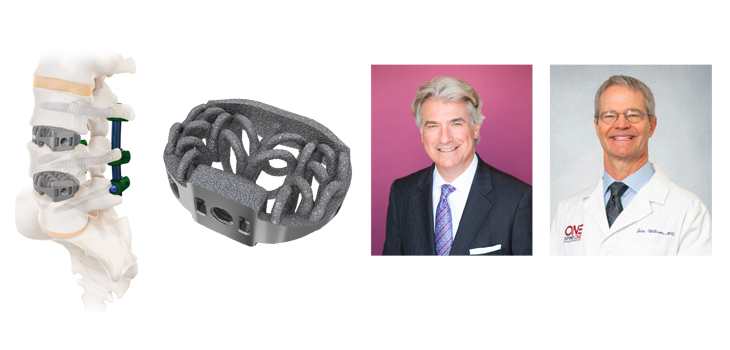
John Peloza, M.D., from the Center for Spine Care in Dallas, Texas and John Williams, M.D. from Ortho Northeast in Fort Wayne, Indiana, recently spoke about their experience learning and using the OLIF procedure. Both surgeons have about four years of experience in performing the OLIF procedure and claim that fusion of any lumbar level is possible, even L5-S1, with the OLIF procedure.
John Peloza, M.D.: OLIF is a simple approach without the risks of ALIF or LLIF.
Dr. Peloza claims that OLIF takes the best of the ALIF and LLIF by allowing placement of a large cage and is a simple approach without many of the risks. ALIF is associated with potential blood vessel and nerve damage, as well as requiring an access surgeon to minimize risk to internal organs. LLIF requires transection of the psoas muscle, which can result in weakness and potential post-surgical pain lengthening recovery.
Further, OLIF can access all levels from L1-S1, while lower levels are inaccessible using LLIF because of the iliac crest and ALIF is limited at higher levels by the presence of the aorta and inferior vena cava.
When compared to posterior-only interbody fusion with transforaminal lumbar interbody fusion (TLIF), OLIF is much more reliable and durable. OLIF allows surgeons to implant a larger footprint device, which better promotes fusion than the smaller devices used for TLIF with lower risk of subsidence.
Peloza believes that “TLIF is more of a disease than an operation” and revisions are so routine that he performs several each month. In contrast he has seen few revisions of his OLIF patients.
John Williams, M.D.: OLIF is the natural evolution of MIS spine.
Dr. Williams considers OLIF to be the latest step in the evolution of minimally invasive procedures. He stated that OLIF “moves surgery into a more minimally invasive realm…the goal is to perform the operation with less soft tissue destruction and delivering the implant with less morbidity to the patient.”
Another significant benefit of the OLIF procedure is lower pressure on patient selection. It may be indicated for patients with different pathologies or co-morbidities who would not be candidates for other procedures. Unlike ALIF or LLIF, which may depend on a specific patient’s anatomy, the location of the bifurcation of the aorta into the iliac arteries is not a concern to surgeons experienced in performing OLIF.
The only considerations are chronic inflammatory conditions such as ulcerative colitis, and Crohn’s disease that make anterior based surgeries riskier. Extensive prior surgery, such as that for cancer, may also be a contraindication due to potential loss of retroperitoneal space. There are few anatomical limitations to performing OLIF. Additionally, OLIF is well suited for obese patients. Due to the lateral positioning, much of the excess fat is pulled away from the surgical site by gravity, minimizing the risk of complications that often arise during surgeries performed in supine or prone positions on large patients.
A common hesitation of surgeons learning the procedure is concern over vascular injury due to the proximity of the iliac vessels. While the actual risk of damaging a vessel is low, a benefit of the oblique approach is the ability to rapidly access the surgical site through a larger incision if an OR emergency occurs. Because the surgical corridor is relatively far from organs or muscle a problem can be quickly rectified.
Faster, Cheaper, Less Blood Loss
Typical OLIF surgeries result in very low amounts of blood loss.
In addition to reduced operative time and disposables costs, due to the ability to perform both the anterior and posterior operations in one session, OLIF can reduce hospital costs in other ways.
After sufficient training, a spine surgeon can perform an OLIF without the help of an access surgeon, as is common in ALIF procedures. A reduction in OR time and time under anesthesia is beneficial to all patients, especially the elderly. Fewer surgical sessions and less invasiveness help to reduce overall length of stay, as well.
Despite data showing similar outcomes at six months and one year, the early improvements and ability to return to work can be the difference between the loss of a career and a short interruption of their usual routine.
Patients who underwent OLIF report lower VAS [Visual Analog Scale] scores shortly after surgery and tend to return to work earlier than those undergoing more invasive approaches.
The literature, according to Dr. Peloza, points out that ODI [Owestry Disability Index] does not include sleep, “When you can’t sleep, that’s the biggest problem with chronic pain,” he said. There is also evidence that patients who have minimally invasive surgery require less opioids after surgery and are less likely to develop opioid dependence. Meaningful outcome measures that are important to patients, and may be more objectively measured, need to be collected. An upcoming study by the Rothman Institute expects to collect sleep scores and use of pain medications, both objective measures of a patient’s post-operative pain. The study may include all minimally invasive approaches or focus on OLIF; it is still being designed.
While there are clear benefits of OLIF, there are still many surgeons worried about learning the new procedure. Knowing some of the potential pitfalls, and how much to worry about them, will be helpful to assuage fears and improve confidence. Dr. John Williams recently described a number of obstacles to OLIF and how to mitigate risk.
Concerns About OLIF
A concern, paramount to many, when approaching the anterior column is avoiding blood vessels. Experienced OLIF surgeons tend not to fear vessels unless calcified and stiff. The aorta and iliac arteries move aside easily, and surgeons can identify tricky vessels ahead of time using preoperative imaging.
Iliac veins that are set wide apart or have a layer of fat between them and the vertebral body are easy to avoid or move. Small vessels can be ligated or electrocauterized to reduce bleeding. Vessels bound by osteophytes often scare away inexperienced surgeons or the access surgeons preparing for an ALIF procedure.
Still, after completing enough straightforward cases, doctors using OLIF can typically avoid the vessels that cannot be moved. While the OLIF is usually performed from the patient’s left side, it can be done from the right depending on the patient’s specific anatomy.
The risk of nerve injury is reduced in OLIF by avoiding the psoas and the lumbar plexus. Rates of retrograde ejaculation are significantly lower than those observed in men undergoing ALIF.
The “orthogonal maneuver” required to rotate a lateral or anterior interbody into position is another difficulty that new surgeons must overcome. However, implants designed specifically for the OLIF procedure solve that issue.
Advice for First-Timers and Finding a Solution for the “orthogonal maneuver”
When asked what they would say to surgeons considering preforming OLIF, but still lacking confidence Dr. Williams suggest finding someone doing the surgery now and scrub in to see a few cases and watch an experienced surgeon wrestle through different situations. “I scrubbed into surgery with Dr. Richard Hynes, in Melbourne, Florida, and then Dr. Scott Spann in Austin, Texas. I really picked up a lot of tricks that way,” says Dr. Williams of his experience learning how to do the OLIF procedure.
A complaint of surgeons who have been performing OLIF has been the need for the “orthogonal maneuver” to position interbody devices designed for lateral or anterior approaches.
Cleared in 2019, the Camber Spine SPIRA®-O was designed specifically for the oblique approach. The SPIRA®-O is made of 3D printed titanium arches with a solid titanium corner to help distract the endplates during insertion. The implant is designed to be inserted at a 25o angle from lateral. The lordosis of the implant aligns with the lordosis of the spine and eliminates the need for an orthogonal maneuver, which is required when using implants designed for ALIF or LLIF. Camber Spine is based in King of Prussia, Pennsylvania.
The company states that the open architecture of the device is intended to promote osseointegration, and for the arches to allow for even load distribution across the endplates. This load distribution should not only reduce adverse events such as subsidence, but should also encourage bone growth through mechanotransduction, a tenet of Wolff’s Law.
In addition, surface texture is designed to provide an ideal cellular microenvironment for cell differentiation and proliferation. Dr. Williams explained that with the SPIRA®-O, Camber Spine is “delivering a true open ALIF sized implant through a minimally invasive exposure.” The large footprint of the SPIRA®-O is complemented by surface area in contact with bone, up to a touted 40 points of contact with the endplates.
Camber Spine is expected to produce a purpose designed instrument set and retractor to further simplify the procedure, with an expected release later in 2020. Mindy Elgart, company marketing director, says that Camber Spine plans to host cadaver training courses every 60 days at both their home office in Pennsylvania and Dallas, Texas starting in May.
In addition, one day preceptorships will be facilitated at multiple locations across the country. Of Camber Spine, Dr. Williams believes that the company’s commitment to training sets them apart from other companies. He is one of several, along with Dr. Peloza, who are part of an advisory board to provide input to make the OLIF implant and instruments surgeon-friendly and accessible. Elgart said that several training sessions that had been scheduled for the spring have been cancelled due to travel restrictions, but they are using this time to continue instrument design and development and to plan the roll out during fall conferences.
Dr. Williams sees a strong future for the procedure stating, “I anticipate [oblique lumbar interbody fusion] becoming, if not the standard of care, a procedure that surgeons will consider a standard of care for addressing anterior pathologies. It’s just too slick. Once you have it dialed in it is very safe, there are fewer complications, and patients are getting up and moving faster. There are multiple advantages of this procedure over traditional ways of doing [lumbar fusions].”
Author
React:
Discussion
This is a fascinating development. In my practice we've seen similar outcomes with the revised protocol. The key differentiator seems to be patient selection criteria. Has anyone else noticed the correlation with BMI thresholds?
Great point. I'd push back slightly on the conclusion, the sample size in the cited study is too small to draw population-level inferences. That said, the directional signal is compelling and worth a larger RCT.
We implemented a similar approach last year. Early results are promising but we're still gathering 12-month follow-up data. Happy to share our protocol if anyone is interested.
Join the conversation
Orthopedic professionals are discussing this. Sign in and upgrade to read every comment and add your voice.