
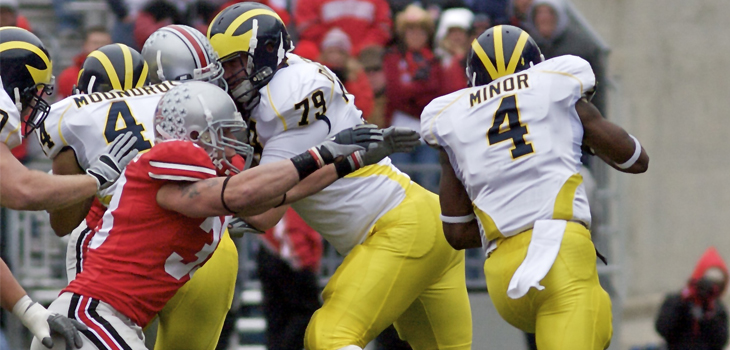
Offensive linemen in football experienced about 40% fewer hits to the head if they started a play standing up instead of with their fingers touching the ground in a new study.
Football: A Change in Starting Stance Can Reduce Head Injury
3 min read Premium comments
Secondary#footballinjuries#braindamage
Previous studies have shown that repetitive hits to the head can cause brain damage even without a concussion.
The research conducted by Purdue University and Stanford University, “Distribution of Head Acceleration Events Varies by Position and Play Type in North American Football,” was published in the March issue of the Clinical Journal of Sport Medicine.
Offensive linemen are at particularly high risk for hits to the head. The researchers say, though, that making a slight change to their stance could cause a significant reduction without affecting the game.
“An offensive lineman tends to start off in a three-point stance, which means that one hand remains in contact with the ground until the start of the plan, similar to sprinter fashion. The first move is always to come up, and most players tend to lead with their head,” Eric Nauman, a Purdue professor mechanical engineering and basic medical sciences, explained.
“If you’re required to be in a two-point stance, meaning standing up with no hands on the ground, then you’re already up a little bit. You’ve already got your hands in a good position and it’s harder, actually to lead with you head.”
Their findings support a rule change suggested by Paul Auerbach, M.D., M.S., F.A.C.E.P., M.F.A.W.M., the Redlich Family Professor Emeritus in the Department of Emergency Medicine at the Stanford University School of Medicine. He wrote a letter in 2016 published in the Journal of the American Medical Association suggesting the elimination of the “down lineman”. He proposed the rule change again in a 2018 opinion editorial for the Wall Street Journal.
“It seemed logical that if something could be done to lessen the number of potentially injurious blows to the heads of the linemen, that this would be desired by people who care about making the game safer. So, I was delighted when I was contacted by Brian Woods, CEO of The Spring League, who inquired what he might do to help figure this out,” said Auerbach, who has experience as a team physician for high school, college and professional football teams.
The pilot study involved three Spring League practice sessions and one exhibition game in July 2018 in San Diego.
To record the number and intensity of hits, the researchers glued sensors behind the ears of the 78 participating athletes. Video footage captured which players were on the field at any time during a play as well as whether the offensive line was in a two-point stance or a three- or four-point stance.
Overall offensive and defensive linemen experienced the most hits to the head, 98 and 52 hits, respectively. However, the offensive linemen in a two-point stance were hit fewer times than those in a three- or four-point stance.
While the study was small, the researchers say there is enough data to support a rule change.
“If nothing else, this study suggests that you can actually make a big difference with rule changes that quite honestly, at least from our perspective, didn’t affect the game play in any meaningful way. In fact, if you make everybody start in a two-point stance, it’s harder to tell if it’s a run or pass play,” Nauman said.
“Forty percent fewer hits would translate to both games and practices. The next step is to improve coaching and blocking and tackling techniques, which could lead to reducing even more hits to the head,” Thomas Talavage, Ph.D., a professor of electrical and computer engineering and biomedical engineering at Purdue, said.
Purdue researchers are in the process of developing helmet sensors that can help referees make better calls on players who “spear” or use their heads as weapons.
Author
React:
Discussion
This is a fascinating development. In my practice we've seen similar outcomes with the revised protocol. The key differentiator seems to be patient selection criteria. Has anyone else noticed the correlation with BMI thresholds?
Great point. I'd push back slightly on the conclusion, the sample size in the cited study is too small to draw population-level inferences. That said, the directional signal is compelling and worth a larger RCT.
We implemented a similar approach last year. Early results are promising but we're still gathering 12-month follow-up data. Happy to share our protocol if anyone is interested.
Join the conversation
Orthopedic professionals are discussing this. Sign in and upgrade to read every comment and add your voice.