
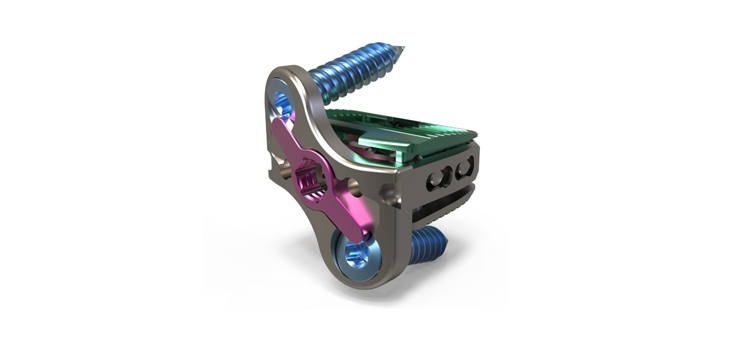
The U.S. FDA recently cleared the first ever expandable, stand-alone cervical interbody that offers adjustable height and lordosis of up to 20 degrees.
FDA Clears First-of-its-Kind Cervical Interbody Fusion Device
1 min read Premium comments
Secondary#atlasspine#hijak#cervicalfusion
The Jupiter, Florida-based, Atlas Spine, Inc., received U.S. FDA 510(k) clearance for the HiJAK SA system on February 28, 2020 for up to two contiguous levels from C2-T1. The HiJAK SA adds functionality to the company’s current offerings of the HiJAK AC, an expandable cervical interbody with adjustable lordosis, and the V3 segmental plating system.
Atlas Spine CEO and Co-Founder Matt Baynham explained that: “With the addition of the stand-alone variant to our expandable cervical interbody and guided segmental plating system, we can now address broader patient conditions and surgical preferences.”
The device uses textured titanium alloy endplates intended to improve osseointegration over PEEK or smooth titanium and includes a graft window that can be filled with the surgeon’s desired bone graft after implantation and adjustment.
The device uses an integrated cage and low-profile plate design to offer greater fixation strength compared to zero-profile, stand-alone interbody devices. According to the company website, the HiJAK SA is expected to launch during the summer of 2020. Vice President of Product Development Brett Zarda said, “Focusing on the clinical history of stand-alone devices, we identified opportunities to further improve positive attributes and eliminate drawbacks. Our final product gives surgeons and their patients the best of both worlds, the clinical benefits of a customizable interbody with enhanced structural integrity, and the ease of integrated fixation.”
With surgeon input, Atlas Spine has created a device that offers most of the currently available features on the market in one package that is easy to use and will hopefully lead to improved results. After testing the device, Patrick Senatus, M.D., Ph.D., a spine specialist and Medical Director of Minimally Invasive and Functional Spine Surgery at Hartford Healthcare, reports that, “It doesn’t get much easier than this.”
Author
React:
Discussion
This is a fascinating development. In my practice we've seen similar outcomes with the revised protocol. The key differentiator seems to be patient selection criteria. Has anyone else noticed the correlation with BMI thresholds?
Great point. I'd push back slightly on the conclusion, the sample size in the cited study is too small to draw population-level inferences. That said, the directional signal is compelling and worth a larger RCT.
We implemented a similar approach last year. Early results are promising but we're still gathering 12-month follow-up data. Happy to share our protocol if anyone is interested.
Join the conversation
Orthopedic professionals are discussing this. Sign in and upgrade to read every comment and add your voice.