
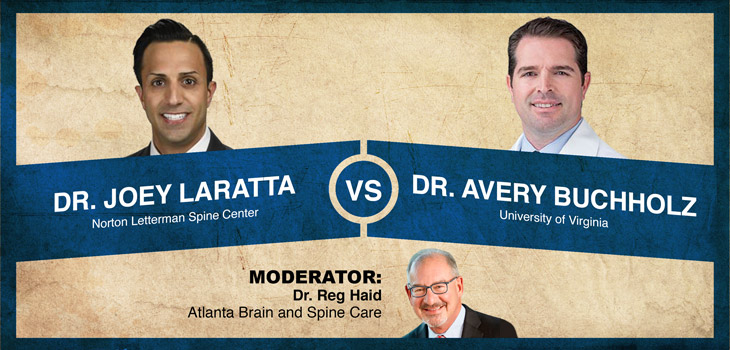
This week’s Case Debate Series, hosted by NuVasive, Inc., features a spirited debate regarding the preferred thoracolumbar procedure approach: anterior or posterior? Dr. Joey Laratta, orthopedic surgeon at Norton Letterman Spine Center, argues on behalf of the anterior-approach, highlighting minimally invasive anterior based surgery for adult degenerative scoliosis patients, and Dr. Avery Buchholz, neurosurgeon at University of Virginia, presents the argument in support of the posterior approach, highlighting posterior-only surgery for the same patient population. Today’s moderator is Dr. Reg Haid of Atlanta Brain and Spine Care.
Deformity Correction: Laratta vs Buchholz: Anterior Versus Posterior
9 min read Premium comments
#misGreat Debates#adultdegenerativescoliosis#deformity
Moderator Haid: It is an honor to moderate the first Case Debate hosted by NuVasive. This is the first debate in our series and it will compare anterior with posterior thoracolumbar approaches for degenerative scoliosis.
Let’s start with Dr. Laratta.
Dr. Laratta: Thank you for the introduction. We’re going to be talking about thoracolumbar procedural approaches and I am taking the side of anterior approaches. There’s been a transition from all posterior approaches, the way I was trained in residency, towards the anterior column, and the importance of anterior interbody support.
My patient is a 62-year-old female with a significant back pain. She can’t walk long distances, and feels like she’s leaning forward, which seems like a sagittal imbalance problem. She failed extensive nonoperative treatment. She’s a non-smoker and has compensatory mechanisms. When we look at her 36-inch sagittal, I see a mismatch of 51 degrees, pelvic retroversion with a pelvic tilt of 38 degrees, and lumbar lordosis of essentially zero. On her AP radiograph, she has a coronal Cobb angle of 43 degrees and two centimeters. We understand compensatory mechanisms of patients with sagittal imbalance and how these mechanisms relate to the Dubousset cone of economy. However, we plan our surgeries all from a single standing 36-inch film.
I reevaluate after having the patient walk for 5 to 10 minutes to unmask hidden sagittal imbalance in someone who has a compensated deformity. On the 36-inch lateral, she has poor parameters in terms of her pelvic retroversion, but she’s globally compensated. Her SVA [sagittal vertical axis] is only five, but after walking her pelvic and spinal extensor muscles start to fatigue, unmasking hidden decompensation.
I use a coronal CT to plan from which side I’m going to approach. The patient is relatively fused on the right side at L2-3. Anterior fusion through the disc space, which in my hands is relatively difficult to correct posteriorly, is straightforward to correct with these minimal access lateral techniques.
I indicated a multi-level ALIF with an ACR at L3-4 for this patient. The surgery was a T10 to pelvis posterior fixation staged after a multi-level LLIF, anteriorly. Once you do those osteotomies in the back after you’ve released laterally the spine falls exactly where you want it.
We achieved correction of her coronal alignment and harmonious correction of her sagittal alignment.
LLIF [lateral lumbar interbody fusion] really allows for powerful coronal correction and we can limit the amount of bone morphogenetic protein (BMP) that we use by having interbody support at most levels.
Cages, like the Modulus, have a high coefficient of static friction, which allows for early, strong, apophyseal fixation that obviates the need for these multiple rod constructs that we use with all-posterior techniques.
Dr. Buchholz: My patient is a 71-year-old male with progressive back and leg pain. We exhausted conservative measures such as physical and pool-based therapy, injections, and medication. The pain progressed, quality of life decreased, and the patient started to have weakness in his right foot. He has a mismatch of 32 degrees, sagittal imbalance, and a coronal Cobb angle of 44 degrees. Overall, he’s balanced, and the head is above the pelvis where we like it to be.
In my hands, posterior alone, seems to be more reproducible for deformity correction. It is less morbid on these patients with less operative time and anesthesia. It’s a single stage, same day surgery. Hospital stays aren’t longer than with the minimally invasive or staged anterior posterior approach.
Dr. Laratta: I don’t know exactly what drives the patient’s length of stay. Some patients that I expected to be really quick movers end up staying for a long time and some people I expect to stay longer really surprised me and were able to mobilize quickly to get out of the hospital.
Dr. Buchholz: I agree with you. I’ve seen the same thing. Some patients have minimal work done and are in horrible pain, but some patients with open T10 to pelvis feel great and go home a few days later. It’s really hard to predict.
This patient has pinched nerves, radiculopathy, and foraminal stenosis. When I see air in the disc space, I know that it’s going to be a relatively easy correction. We do a facet release, release things posteriorly, and most of the time we’ll be able to correct them fairly easily.
Joey showed a great case of using interbodies to do this. The fusion that provides is beneficial. I’m going to rely more on posterior fusion to achieve the same thing. I am going to get this with the posterior release.
We did a T10 to pelvis corrective surgery with pedicle screws at each level, a transforaminal lumbar interbody fusion (TLIF) at L4-5 and L5-S1, primarily for fusion, and we used a third rod. When we do our TLIFs, we do a big posterior column osteotomy and take down facets bilaterally. We distract posteriorly, do our disc work, and try to put a big cage anteriorly. We’re essentially doing the same technique as Joey from behind. We get a lot of correction with that cage, but we didn’t need a ton of lordosis in this case.
We found that at 4-5 and 5-1 there is some percentage of pseudarthrosis and rod fracture, so we started using cages, something Dr. Chris Shaffrey made popular. We haven’t had a problem with pseudarthrosis or rod fracture using a third or fourth rod.
We did a polyethylene weave at T8 and T9 spinous processes and tension that into our VersaTie attached to the rods. We usually put the VersaTie one or two levels below the proximal pedicle screw.
The patient was already balanced coronally, and we got a good sagittal correction. We brought the head into a better alignment above the shoulders and pelvis. We reduced the SVA, PIL mismatch, and we’re happy with this correction.
We rely on our L4-5, L5-S1 cages for fusion. Otherwise, we’re doing a large posterior lateral fusion. Interbodies are a good option for that, but that’s an expense.
We try and be good stewards of the hospital and minimize those costs. Doing a good posterolateral fusion is important for these patients; you have to rely more on carpentry for the posterolateral arthrodesis than you would using some of the anterior techniques. Neither way is wrong, but it’s been more reproducible to do posterior alone.
Dr. Laratta: This is supposed to be a debate, but I think you’re 100% correct that the gold standard for spinal deformity is a posterior approach. The anterior approach is interesting; I think it can provide a lot of benefit in specific situations.
As minimally invasive surgeons, we live and die by the interbody fusion. We have to realize that it may cut down on BMP costs, but we have to be stewards when it comes to how many cages we use, and what is most cost effective in light of the healthcare economy that we have right now.
Moderator Haid: Joey and Avery, I’d like to thank you once again for your discussions today. I think you both have done an excellent job of highlighting the pros and cons of each technique. Let me first start by saying there is not one unique, proper way to do this technique. This can be done in a variety of approaches, both open, minimally invasive and hybrid.
What’s most important is that each surgeon chooses his or her own approach and for what they feel comfortable. I continue to evolve in my practice with what I do anterior, or lateral, or posterior, or combined. The one thing that we all know if we had the same discussion two years from now, we would each share an evolving perspective about this.
I first found it interesting that you both talked about aquatic therapy and I ask patients if they get into a swimming pool. I’ve had a procedure, anterior and posterior for degenerative lumbar disease. And I found it amazing that when I went down to see my parents in Florida, if I got into a swimming pool, my pain would just go away. It is good to understand if the pain is weightbearing, or non-weightbearing. Joey another thing you’ve talked about is compensation and decompensation. When I see people in my office, I make a point of making them walk into my computer room and I make them stand there. I don’t go to their particular patient room and watch them sit down. My nurse walks a patient down the hall, and I look at how they walk. Then I make them stand up while I examine them and ask them questions. Invariably, you’ll see people start to bend over, lean on a counter, or ask to sit down.
Having them walk for five minutes and take a new set of X-rays where they’re no longer able to maintain that compensatory posture, is absolutely key. I’m going to bring that into my practice quite frankly. I think it’s also clear that when you look at the literature, anterior approaches provide improved lordosis and sagittal balance.
I’ve taught around the world with Juan Uribe and Chris Shaffrey about this. It’s clear from the literature that an ALIF offers greater restoration of sagittal alignment and lumbar lordosis. If there’s one place where you have to get lordosis, it’s at L5-S1.
Juan was showing some XLIFs, and Chris Shaffrey and I mentioned, “You know, Juan, your coronal balance is incredible, but your sagittal, not so much.” To Juan’s credit, he went back and looked at it, and that was before sectioning the anterolateral ligament (ALL). As Joey alluded, unless you section the ALL with a lateral approach, you could not obtain optimal sagittal, lordotic balance. With ALIF, you section the ALL and put in a big spacer and you’re able to create great lordosis. An XLIF does not give the best sagittal alignment but gives phenomenal coronal alignment. I do a lot of ALIFs at 3-4, 4-5, and 5-1 where I can really get great height and lordosis. I do a preoperative CAT scan looking for calcification of vessels. If you see calcification of the vessels, you may need to do an XLIF, or a TLIF, if you prefer interbody techniques, like most of us do. It’s important for the surgeon have a variety of techniques to employ.
When listening to these talented surgeons, I thought about Joey representing Juan Uribe and Avery representing Chris Shaffrey. Avery trained with Chris and is a highly skilled, technical surgeon that trained at the foot of the master of TLIFs. Chris Shaffrey is the best TLIF-er I know. Avery is right behind him. As Chris and I teach around the world, we quickly find that not everybody has the same approach that we do. What Avery’s talking about is a deformity lift; you go in, do osteotomies, place screws, distract, and use a spinous process distractor or a distraction rod. You do a very thorough discectomy, then slide a spacer in anterior. This is not new. This was taught to me by Dr. Ogilvy, who was a deformity orthopedic surgeon at Minnesota. His young associate named Polly who later became president of the Scoliosis Research Society (SRS), also described this in several papers. To get the deformity correction that Avery talked about, bilateral facetectomies, extraction, complete discectomy, and an anterior placed device followed by posterior compression are absolutely critical.
I agree with everything said with the exception of Joey saying this is technically simple. I don’t think it is. I’ve spent decades learning these techniques, visiting other surgeons, and cadaveric labs. My recommendation is to visit surgeons, do clinical observations, do live cadaveric, and to do remote lab visits.
Since NuVasive sponsored this debate, I can tell you that they’re very proactive in teaching people open techniques, minimally invasive techniques, anterior, lateral, et cetera. You can always contact your local rep for that. I’d like to thank Avery and Joey for doing an excellent job. It’s obvious that the future of spine surgery is in great hands. With an industry partner like NuVasive, I think we’ll serve our patients well. Thank you so much.
To view the entire debate, click here.
Author
React:
Discussion
This is a fascinating development. In my practice we've seen similar outcomes with the revised protocol. The key differentiator seems to be patient selection criteria. Has anyone else noticed the correlation with BMI thresholds?
Great point. I'd push back slightly on the conclusion, the sample size in the cited study is too small to draw population-level inferences. That said, the directional signal is compelling and worth a larger RCT.
We implemented a similar approach last year. Early results are promising but we're still gathering 12-month follow-up data. Happy to share our protocol if anyone is interested.
Join the conversation
Orthopedic professionals are discussing this. Sign in and upgrade to read every comment and add your voice.