
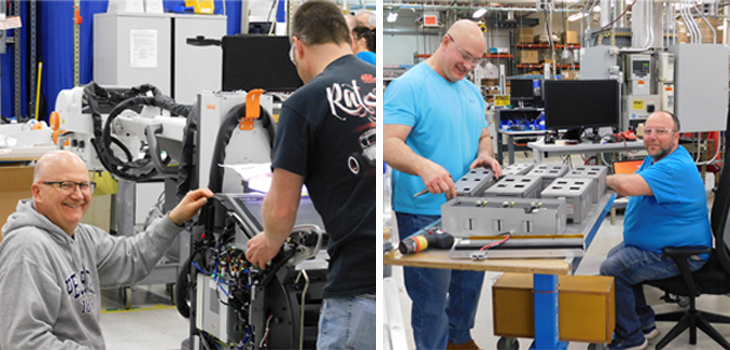
Healthcare needs have grown exponentially during the COVID-19 pandemic and Carestream Health has responded with increased production of its mobile diagnostic imaging systems.
Carestream Increases Production of Mobile Imaging Systems
1 min read Premium comments
Secondary#covid19#carestream#mobileimagingsystem
The need for X-rays has grown as chest X-rays are being performed in suspected or confirmed COVID-19 patients. To aid hospitals and urgent care centers, Carestream is expanding its production of its DRX-Revolution Mobile X-ray System and its DRX-Revolution Nano Mobile X-ray System.
Charlie Hicks, Carestream’s general manager for premium tier solutions said, “Our manufacturing plants and warehouses are operating at full capacity with employees putting in long hours and extra days to support the healthcare professionals who are on the front line of this exhausting fight.”
Hicks continued, “Likewise, Carestream suppliers and partners are ramping up production to help support this humanitarian crisis.”
Carestream’s portable solutions aid in patient diagnosis by delivering real time, digital radiography images from the patient’s bedside. Mobile equipment aides in social distancing by allowing patients to remain in bed. Further, mobile equipment provides flexibility for healthcare providers as traditional treatment facilities reach capacity.
Increased equipment manufacturing is a team effort. Director, Manufacturing and Supply Chain, X-ray Solutions, Greg Rabidoux told OTW, “I could not be more proud of the team. Their dedication, attention to quality and focus on meeting a significant increase in demand have enabled medical professionals around the globe to help combat this pandemic.”
Rabidoux continued, “Each day the team is coming up with innovative ways to speed up production and increase capacity during this critical time. It is an honor to work with such a motivated and inspirational team of people!”
Headquartered in Rochester, New York, Carestream provides medical imaging systems and X-ray imaging systems for non-destructive testing. The DRX-Revolution system has an improved design that helps reduce contamination. The nonmotorized DRX-Revolution Nano Mobile X-ray System’s compact design allows “easy maneuverability and arm positioning.”
Author
React:
Discussion
This is a fascinating development. In my practice we've seen similar outcomes with the revised protocol. The key differentiator seems to be patient selection criteria. Has anyone else noticed the correlation with BMI thresholds?
Great point. I'd push back slightly on the conclusion, the sample size in the cited study is too small to draw population-level inferences. That said, the directional signal is compelling and worth a larger RCT.
We implemented a similar approach last year. Early results are promising but we're still gathering 12-month follow-up data. Happy to share our protocol if anyone is interested.
Join the conversation
Orthopedic professionals are discussing this. Sign in and upgrade to read every comment and add your voice.