
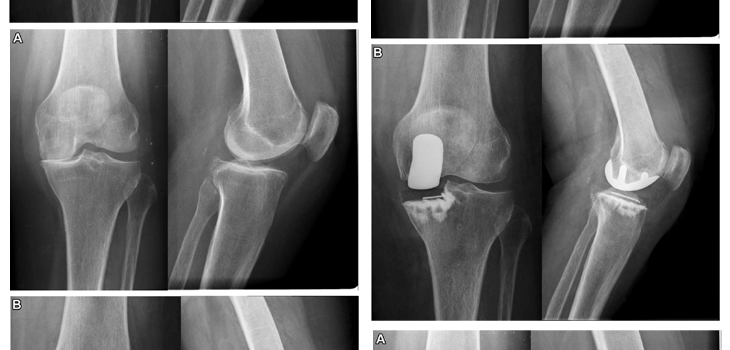
A research team at Avon Orthopaedic Centre, Southmead Hospital in Bristol, UK, has just published results from a 10-year follow-up study of 184 patients who had been treated with medial fixed all-polyethylene bearing unicompartmental knee arthroplasty (UKA).
10-Year Follow-Up Data for All-Poly Uni Knees
1 min read Premium comments
Secondary#unicompartmentalkneearthroplasty#medialosteoarthritis
The work, “Minimum 10-year outcomes of a fixed bearing all-polyethylene unicompartmental knee arthroplasty used to treat medial osteoarthritis,” was published in the March 24, 2020 edition of The Knee.
Co-author David Bruce described the study to OTW, “For many years, we have been using a unicompartmental knee replacement with a fixed all-polyethylene tibial component in suitable patients. Although there have been reports in the literature that this implant design led to worse clinical outcomes, this did not appear to be the case in our institution. Therefore, we undertook a retrospective analysis of our cohort.
The researchers studied 214 medial unicompartmental all-polyethylene tibial bearing UKAs implanted in 184 patients at a tertiary referral center between November 2002 and December 2007.
And in this study the older folks fared better.
“The survivorship of the implant was 89.1% at 10 years and for those 70 years or older, the survivorship was 92.4% at 10 years,” stated Bruce.
“Patient reported outcomes were measured with the Oxford Knee Score, American Knee Society Score and WOMAC score. These demonstrated that the significant improvement in knee function was maintained during this period.”
“Medial fixed all-polyethylene bearing has acceptable long-term survivorship and patient outcomes. In our cohort, this was particularly so in the older population (>70 years old) and may be a suitable option for treatment of medial compartment osteoarthritis in this group.”
“We found this implant design to provide reliable, efficacious and relatively low-cost treatment of medial compartment osteoarthritis. Consider the use of a medial fixed all-polyethylene bearing, particularly in the older patient who is suitable for a unicompartmental knee replacement.”
Author
React:
Discussion
This is a fascinating development. In my practice we've seen similar outcomes with the revised protocol. The key differentiator seems to be patient selection criteria. Has anyone else noticed the correlation with BMI thresholds?
Great point. I'd push back slightly on the conclusion, the sample size in the cited study is too small to draw population-level inferences. That said, the directional signal is compelling and worth a larger RCT.
We implemented a similar approach last year. Early results are promising but we're still gathering 12-month follow-up data. Happy to share our protocol if anyone is interested.
Join the conversation
Orthopedic professionals are discussing this. Sign in and upgrade to read every comment and add your voice.