
NuVasive, Inc.’s MAGEC Rod, a winner of the Orthopedics This Week Best Technology in Spine awards in 2011, was and remains one of the more important innovations in the treatment of early onset scoliosis.
The MAGEC Rod Controversy, Implant or Technique?
7 min read Premium comments
#earlyonsetscoliosis#growthrodfracture#juvenilescoliosis#magecrods
Developed by California-based Ellipse Technologies, Inc., the system uses magnetically expandable rods to correct moderate to severe scoliotic spine curvature. Because the rods are expandable in situ using magnets, as the patients grow, the rods can be adjusted without additional surgery. Not only does this reduce the trauma of repeated surgeries, it reduces costs.
In situ rod expansion is not a new concept. In 2004, Jean Dubousset, M.D., a reknown spine surgeon, and Arnaud Souberian, a French medical engineer, developed and used a magnetic rod known as the Phenix device which, itself, was derived from an expandable rod for bone tumors.
The first information about Ellipse’s MAGEC rod was presented by Akbarnia in 2009 wherein he described an implantable magnetic rod which could be distracted by external, non-surgical device. Three years later, Akbarnia published data on Yucatan pigs which showed distraction was possible at a rate of 7mm/week for 7 weeks using an external adjustment device. The researchers found that they could achieve 80% distraction non-surgically.
Akbarnia later presented data from a multicenter study of 33 patients which documented the ability of the MAGEC rods to successfully improve Cobb angles 46% and 48%, respectively, in single and dual rods, respectively. Dannawi, in 2013, found that using MAGEC instrumentation in 34 children (mean age 8 years) with early onset scoliosis delivered statistically significant improvement in mean pre-operative, immediate post-operative and final cobb angles and also significant increase in the mean T1-S1 distance.
Other researchers, notably La Rosa et al, Ridderbusch et al and Yılmaz et al also documented outcomes using MAGEC and reported that it was efficacious in allowing noninvasive distraction without repeat surgeries and that it achieved spinal growth comparable to conventional growth rod techniques.
In 2016, NuVasive acquired Ellipse and the MAGEC rod technology for $410 million.
To date, MAGEC rod instrumentation has been used in more than 100,000 patients.
MAGEC Rod Fractures and the FDA MAUDE Reports
MAGEC was initially cleared by the FDA for sale in the United States in 2014. Since then, the FDA has cleared updated versions of the MAGEC rod instrumentation several times.
Aakash Agarwal, Ph.D., Director of Research at Spinal Balance and adjunct faculty in the Departments of Bioengineering and Orthopaedic Surgery at the University of Toledo and one of the most respected, if not revered biomechanical researchers in orthopedics, has studied complications in pediatric spinal rod implants for the treatment of early-onset scoliosis for years.
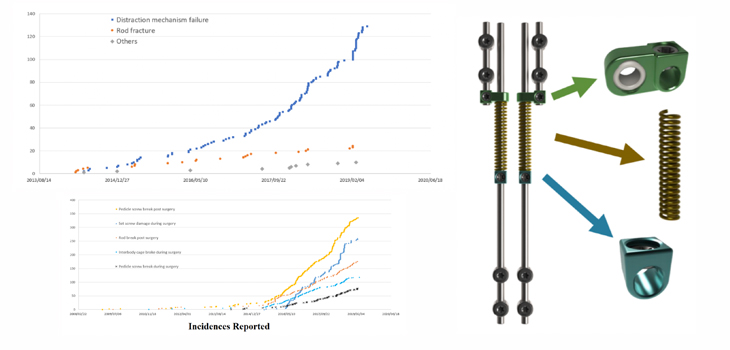
He and his team have been tracking the FDA Manufacturer and User Facility Device Experience (MAUDE) databases for reports on MAGEC rods and instrumentation used for spinal fusion. They found reports of 163 device-related adverse events: 129 were failure of noninvasive distraction mechanism, 24 were rod fracture, and 10 were for other medical complications.
Agarwal first noticed that the clinical literature indicated “distraction-based systems stimulated apophyseal growth of the axial skeleton compared to normal growth rate.” He brainstormed on where this stimulation might be going off-course.
“Based on Hueter-Volkmann principle,” Agarwal told OTW, “this could only occur through applying a higher distraction force than physiologically necessary.” At this point, Agarwal had a realization: the oversight must be related to the biomechanics of the distraction force being applied surgically.
“Ironically enough,” said Agarwal, “there was no biomechanical work done on understanding the effect of these distraction forces on growth rods. In every surgery, the surgical team [was] applying the maximum distraction forces possible.”
Agarwal then began clinical trials to document how much force was being applied and create a biomechanical model which would predict the propensity of failure.
Agarwal’s Study
Agarwal and his colleagues found that distraction mechanism failure was the most commonly reported complication associated with MAGEC rod usage in pediatric patients with scoliosis.
Their paper, “Device-Related Complications Associated With MAGEC Rod Usage For Distraction-Based Correction Of Scoliosis,” published in the October 2019 issue of Spine Surgery and Related Research.
Co-authors were Amey Kelkar, Ashish Garg Agarwal, Daksh Jayaswal, Arvind Jayaswal and Vithal Shendgewas, Department of Bioengineering and Orthopaedics Surgery, University of Toledo and the Department of Orthopedics at Primus Super Speciality Hospital in New Delhi, India.
According to Agarwal and his team, “higher distraction magnitude results in the generation of higher distraction forces, and this in combination with off-axis loading (exemplified by “growth marks”) result in wear and breakage of MAGEC rod’s components.”
“Therefore, one method to reduce the propensity of such failures would be to apply minimum distraction at higher frequency, for example, 1.5–2.0 mm every month, instead of 4.5–6.0 mm every 3 months. This would also reduce tissue trauma and its effects, such as autofusion…Other technical methods to reduce attrition could include ceramic coating at wear generating surfaces, also applicable for growth guidance techniques.”
In previous research, Agarwal had written that using “shorter distraction magnitude at shorter intervals” could mitigate MAGEC complications coming from excessive, remote distraction force.
Agarwal explained, “Distraction forces cause the rods to fracture, but are also necessary to achieve the objective of the surgery, that is height gain in children. The solution that occurred to our team was gradual distraction of the growth rods, instead of maximum possible distractions. With traditional dual growth rods, changing the frequency of distraction is not an option, but with the use of MAGEC (MAGnetic Expansion Control, Nuvasive) it is feasible. We found in our study that frequent distractions with smaller distraction forces will induce much lower stresses in the rods. This is a fact and has remained consistent with our ongoing studies with FDA and other collaborative research work.”
MAGEC Is the Only Ethical Device for Early Onset Scoliosis
In Agarwal’s view, in situ or other forms of non-surgical distraction techniques instead of repeated surgeries is the only ethical choice for treating children with early onset scoliosis when the best treatment option is spine distraction. Traditional growth rods (which require repeated surgeries in order to adjust for the patients growth) are still commonly used in countries with limited resources. In Agarwal’s opinion, traditional growth rods should be replaced with either MAGEC, guided growth techniques (SHILLA), vertebral tethering, or hybrid techniques like active apex correction or spring distraction systems.
Other Researchers Chime In – and Create New Controversy
In 2017, European Spine Journal published a study called “Rod fracture and lengthening intervals in traditional growing rods: is there a relationship?,” by Pooria Hosseini, M.D., M.Sc.; Jeff B. Pawelek; Stacie Nguyen; George H. Thompson; Suken A. Shah; John M. Flynn; John P. Dormans; Behrooz A. Akbarnia; and Growing Spine Study Group.
The authors cited the previous work of Agarwal and his colleagues. Which started the controversy.
When Agarwal read the 2017 European Spine Journal study, he took strong exception to some of the study’s conclusions. He wrote a letter to the editor saying, in part, “We read with great interest the article by Hosseini et al., published in the European Spine Journal…The article was well written but their interpretation of our work was erroneous.”
“We highlighted the importance of shorter intervals of distraction, with low magnitudes of distraction forces, as a way to reduce stresses on the rods. This reduction in stresses would in turn reduce the propensity of rod breakage, which are very often seen with growth rod constructs. They [Pooria Hosseini et al] however, presented a correlation between the ‘different distraction intervals’ and the ‘incidences of rod breakage,’ without factoring in the actual magnitude of forces that were applied during the procedures. Their conclusion mistakenly assumes that the distractions simulated by us were of same magnitudes, and only differed in the interval of application. This misunderstanding deters further research into using shorter intervals.”
Agarwal told OTW that he received a response, but it only corroborated the fact that the premise of [Pooria Hosseini et al.’s] study design “change the frequency of lengthening, without addressing the forces” was a misunderstanding of the concept he had proposed.
Hosseini Begs to Disagree
The authors of the European Spine Journal study, specifically Dr. Hosseini, explained the purpose of their study to OTW, “The purpose of our study was just assessing the lengthening intervals. We understand forces applied to the rod play a role in rod failure. However, there is no way to measure applied forces on the rods in a clinical retrospective study of our studied cohort.”
Dr. Hosseini had earlier written a response to Agarwal’s letter to the editor where he stated, “In response to your concerns about minimizing the distractions without consideration of applied forces; we did not recommend minimizing distraction intervals. We simply concluded that based on our study in a cohort of 138 patients, which was the largest sample size at the time of its publication, there was no statistical difference between rod fracture (RF) and no rod fracture (NRF) groups in relation with lengthening intervals. In our study we recognized that for assessment of shorter intervals (less than 6 months) we need to look at MCGR [magnetically controlled growth rods] cases to come up with better understanding of the effects of short versus long intervals, since they usually are lengthened more frequently.”
“Finally, in regards with stiffness, we totally agree with your comment. We also have concerns about the availability of stiffness assessment data at baseline. However, as it is mentioned in the limitations of the study, there are few missing data points that are mainly due to retrospective nature of the study. Assessment of spine flexibility at baseline is one of them.”
Looking Forward
Dr. Agarwal is considered to be an expert in both traditional and MAGnetic Expansion Control (MAGEC™) growth rods for scoliosis correction and their failure modes. The research coming out of Agarwal’s lab is showing that surgical technique, specifically the practice of employing shorter distraction magnitudes at shorter intervals could decrease complication risk, including fracture risk.
The MAGEC rod’s primary benefit is that it allows for noninvasive distraction of growth rods and a resultant reduction in the number of consecutive surgeries, and sometimes the possibility of reducing growth rod fracture or autofusion. Although the MAGEC leads to fewer complications than traditional rods, repeated unexpected failure of noninvasive distraction mechanism should encourage further research and innovation toward reducing them.
Agarwal and his team wrapped up their study by writing, “Better technical and clinical controls need to be set in place to avoid adverse events, which leads to unplanned open surgeries.”
Author
React:
Discussion
This is a fascinating development. In my practice we've seen similar outcomes with the revised protocol. The key differentiator seems to be patient selection criteria. Has anyone else noticed the correlation with BMI thresholds?
Great point. I'd push back slightly on the conclusion, the sample size in the cited study is too small to draw population-level inferences. That said, the directional signal is compelling and worth a larger RCT.
We implemented a similar approach last year. Early results are promising but we're still gathering 12-month follow-up data. Happy to share our protocol if anyone is interested.
Join the conversation
Orthopedic professionals are discussing this. Sign in and upgrade to read every comment and add your voice.