
A father-son team, with the backing of Purdue University, say they have developed an injectable new bone healing drug which repairs bone fractures faster than current products on the market.
Targeted Bone Healing Drug From Purdue
2 min read Premium comments
Secondary#bonehealing#novosteo#purdueuniversity
The injectable drug, NOV004, is “unique” because it concentrates at the fracture site while reducing exposure to the rest of the body.
The father is Philip Low, Ph.D. the Presidential Scholar for Drug Discovery and the Ralph C. Corley Distinguished Professor of Chemistry at Purdue. The son, Stewart Low, Ph.D., is a Visiting Scholar at Purdue’s Department of Chemistry. They are the founders of Novosteo, Inc., the Purdue-affiliated company charged with commercializing the drug. The son is the primary inventor of the technology.
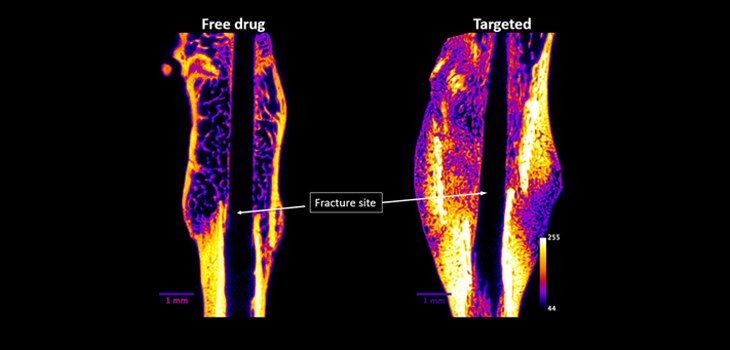
The image above shows fractured femurs at four weeks post-fracture. The “targeted” bone received Novosteo’s injectable targeted drug. Yellow and orange colors indicate higher density bone than purple and blue.
Clinical Trials in 2020
On February 11, 2020, Scott Salka, who recently joined the startup as executive chair, said the team has completed preclinical studies with NOV004 and are looking to take it to clinical trials later this year.
Salka has some history in leading efforts to advance novel drugs through preclinical and early clinical development, most recently at publicly traded Ampliphi, now Armata. Prior to that he founded and served as CEO for both Ambit Biosciences, acquired by Daiichi Sankyo, and Rakuten Medical.
Novosteo’s technology is licensed through the Purdue Research Foundation Office of Technology Commercialization. The company also received entrepreneurial support from Purdue Foundry, an entrepreneurship and commercialization hub in Discovery Park District’s Convergence Center for Innovation and Collaboration where startups, entrepreneurs, innovators and companies can collaborate with Purdue to address global challenges in health, sustainability, IT and space.
Targets Fracture Site
The technology is unique for its ability to target the fracture site.
“When we inject this drug systemically, it will circulate throughout the entire body but only accumulate at the fracture site,” Stewart Low said in a 2018 interview. “Because of this, we’re potentially able to bypass any side effects and give patients drugs that would otherwise be too potent to administer. Essentially, doctors will be able to give higher drug doses and have reduced patient side effects.”
“The only clinically approved bone healing drug must be applied locally during surgery, where the pharmaceutical is painted directly onto the broken bone,” he said. “This is an invasive process, and one we’re trying to avoid. Our technology is similar to an insulin shot; an injection of the drug needed as the first line of defense.”
“Through preclinical studies we have demonstrated that our drug heals bone fractures better than an untargeted drug,” Low said. “We’ve shown that we can dramatically speed up and improve the fracture healing process. With further funding we hope to make more strides in proving the efficacy of the drug and accelerating its translation into the clinic.”
The company is also looking at the future use of the injectable-targeted drug for other applications, including dental implants, head and facial fractures, and hip and knee replacements. In addition, Novosteo has a pipeline of drugs for treating an array of musculoskeletal maladies.
But for now, the next step is a clinical trial.
Author
React:
Discussion
This is a fascinating development. In my practice we've seen similar outcomes with the revised protocol. The key differentiator seems to be patient selection criteria. Has anyone else noticed the correlation with BMI thresholds?
Great point. I'd push back slightly on the conclusion, the sample size in the cited study is too small to draw population-level inferences. That said, the directional signal is compelling and worth a larger RCT.
We implemented a similar approach last year. Early results are promising but we're still gathering 12-month follow-up data. Happy to share our protocol if anyone is interested.
Join the conversation
Orthopedic professionals are discussing this. Sign in and upgrade to read every comment and add your voice.