
Salt Lake City, Utah-based OrthoGrid Systems, Inc. has entered into a partnership with University of Utah Health to provide orthopedic surgeons with advanced surgical precision technology.
OrthoGrid and University of Utah Form Research Partnership
2 min read Premium comments
Secondary#orthogridsystems#universityofutahhealth
“At University of Utah Health, we are dedicated to providing optimal care to our patients, which means integrating innovations and tools that allow our surgeons to achieve greater precision and better patient outcomes,” said Jeremy M. Gililland, M.D., associate professor of orthopedic surgery at University of Utah Health, and chief of orthopedic surgery Salt Lake City VA Medical Center. “OrthoGrid’s platforms have gained notoriety across the global healthcare landscape based on its position as an intraoperative solution for surgeons to make better decisions in the Operating Room, which made them a natural choice to partner with.”
A company representative told OTW, “OrthoGrid has had a strong ongoing relationship with the University of Utah over the years as it relates to research. Expanding our relationship to a partnership of this nature made sense given the close alignment and dedication both our organizations have to quality patient care and enhancing the intraoperative experience for surgeons. OrthoGrid’s technology platforms help to achieve both of those outcomes.”
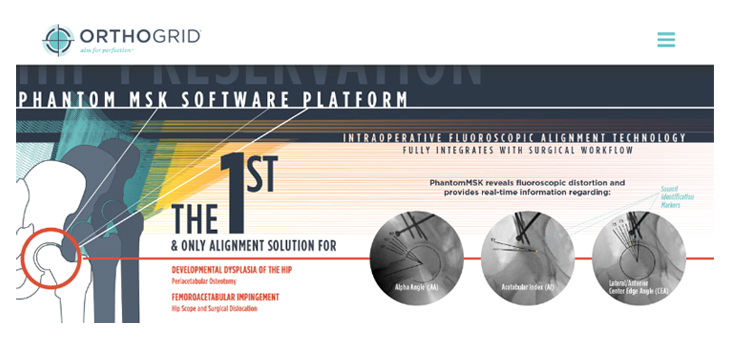
“OrthoGrid’s goal one year out is to continue integrating the latest AI [artificial intelligence]-enhanced algorithms in our platform and applications and partnering with as many hospitals across the country as possible. By equipping orthopedic surgeons with the latest technology in surgical precision, OrthoGrid’s software contributes to the reduction in hospital readmissions, the reduction in leg-length discrepancy, and contributes to the decrease in hospital re-admissions. OrthoGrid’s software leads to the improvement of patient outcomes for a variety of procedures, including total hip replacement. OrthoGrid’s software technology is used directly in the OR via surgeons’ existing imaging tools, providing accuracy in a field where it’s extremely important and could impact leg length discrepancies and overall mobility for patients.”
“Our technology platforms work for all orthopedic implants in the market, easing the onboarding and integration process for surgeons, “said co-founder and CEO of OrthoGrid, Edouard Saget. “Health systems like University of Utah Health, that are dedicated to quality patient care and enhancing the intraoperative experience for surgeons, make these partnerships possible.”
Author
React:
Discussion
This is a fascinating development. In my practice we've seen similar outcomes with the revised protocol. The key differentiator seems to be patient selection criteria. Has anyone else noticed the correlation with BMI thresholds?
Great point. I'd push back slightly on the conclusion, the sample size in the cited study is too small to draw population-level inferences. That said, the directional signal is compelling and worth a larger RCT.
We implemented a similar approach last year. Early results are promising but we're still gathering 12-month follow-up data. Happy to share our protocol if anyone is interested.
Join the conversation
Orthopedic professionals are discussing this. Sign in and upgrade to read every comment and add your voice.