
A new survey sponsored by Chicago, Illinois-based BandGrip, Inc. asked 100 orthopedic patients about their surgical scars. Not surprisingly, they would rather not have a scar. Surprisingly, the vast majority of the patients said that they would NOT recommend a physician who left them with unsightly scars.
New Survey Tackles Surgical Scar Issue
2 min read Premium comments
Secondary#bandgrip#surgicalscar
Here are the details:
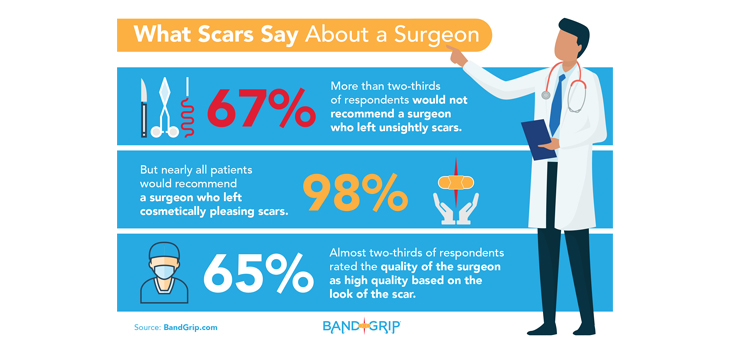
- “More than two-thirds of respondents (67%) would not recommend a surgeon who left unsightly scars.
- But nearly all patients (98%) would recommend a surgeon who left cosmetically pleasing scars.
- Almost two-thirds (65%) of respondents rated the quality of the surgeon as high quality based on the look of the scar.”
“Patient-centered care is everything in my practice,” said Brian Cole, M.D., M.B.A., associate chairman and professor in the Department of Orthopedics at Rush University Medical Center. Dr. Cole, head team physician for the Chicago Bulls and co-team physician for the Chicago White Sox. “After more than two decades of being in practice, I have clearly learned the value of paying attention to every detail when it comes to surgical solutions and the incisions do matter.”
Regarding BandGrip, Dr. Cole noted: “One of several advantages of BandGrip is the superior cosmetic results compared to other closure methods such as sutures and staples.”
Other results show:
- “39% of respondents said concerns over scarring were top of mind heading into surgery, and a majority (53%) of them care quite a bit about their spouse, partner or children having a bad scar.
- A majority (54%) said they consider important all three components of surgery—a successful surgical outcome, good patient education and minimal scarring—but 38% of respondents said it is most imperative the surgeon fixes the medical problem.
- Most patients (68%) speak to their surgeon about the incision scar prior to their procedure.”
Asked what types of discussions he has had with patients that led him to use this product, Dr. Cole told OTW, “Patients like to see their incisions, can otherwise assess for adverse events and don’t like suture and staple removal as that is a source of anxiety at their post op visit.”
“It is easy, saves 75% of the time for subcuticular closure, does not snag on the skin like other closure systems, can be replaced if it comes off during the post op process or at the time of first post op check, and is comfortable to remove for patients without the stress associated with traditional suture removal, staples etc.”
Author
React:
Discussion
This is a fascinating development. In my practice we've seen similar outcomes with the revised protocol. The key differentiator seems to be patient selection criteria. Has anyone else noticed the correlation with BMI thresholds?
Great point. I'd push back slightly on the conclusion, the sample size in the cited study is too small to draw population-level inferences. That said, the directional signal is compelling and worth a larger RCT.
We implemented a similar approach last year. Early results are promising but we're still gathering 12-month follow-up data. Happy to share our protocol if anyone is interested.
Join the conversation
Orthopedic professionals are discussing this. Sign in and upgrade to read every comment and add your voice.