
London, UK-based Corin has announced that its OMNIBotics robotic-assisted platform has recently completed 25,000 total knee arthroplasties (TKA), including 5,000 procedures using the company’s BalanceBot ligament balancing robotic device.
Major Milestone – 25,000 TKRs/5,000 BalanceBots – for Corin
2 min read Premium comments
#totalkneereplacementSecondary#corin#balancebot#omnibotics
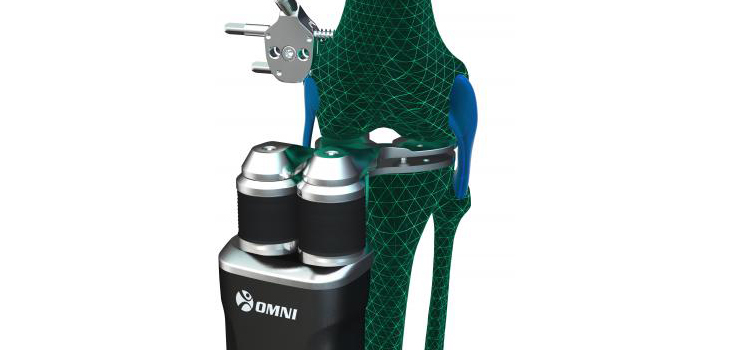
The BalanceBot receives feedback from soft tissue and ligaments through the whole range of joint motion, thus aiding accurate knee joint balancing.
According to the Corin, The BalanceBot, when used in the Predictive Balance technique, accurately predicts the effect that implant positioning will have on knee gaps in flexion, extension and mid-flexion. Because of this more precise ligament balancing, surgeons can target knee gaps that correlate with better outcomes and less pain. The platform can also be used intra-operatively to assess the patient’s overall knee stability throughout the full range of motion with the joint in situ.”
Jeffrey H. DeClaire, M.D. of the DeClaire LaMacchia Orthopedic Institute, in Rochester, Michigan, is one of the first orthopedic surgeons to use BalanceBot. In his opinion, “OMNIBotics, and the use of the BalanceBot device, is a significant improvement to the field of knee replacement. The ability to plan implant position to best balance the knee’s soft tissues using the Predictive Balance software, on top of the consistency and reproducibility that comes with robotics, is remarkable. The immediate results are noticeable and I’m excited to continue monitoring my patients and track their recoveries.”
Chris Plaskos, Ph.D., Corin’s VP of Global Clinical Innovation said: “The experience gained from over 5,000 surgeries with the BalanceBot has been invaluable to understanding soft tissue balancing and its effects on patient outcomes and future advancements. As a company, we are proud to have reached this major milestone and we continue to provide our customers with innovative technologies which are revolutionizing joint replacement for patients and surgeons.”
Furthermore, said Plaskos to OTW, “We know that patients undergoing knee surgery are sometimes not as satisfied with the results of their surgery, in comparison to those patients receiving hip surgery. Corin’s innovation team saw this opportunity to not only improve patient outcomes but also surgical technique. There is still room for improvement within total knee arthroplasty, but the OMNIBotics and BalanceBot technologies mark a notable step forward.”
“The OMNIBotics BalanceBot platform provides surgeons with the ability to address and balance the soft tissues surrounding the knee in a predictable and reproducible manner. The system demonstrates how robotics can be used to simplify the surgical process, and to help plan for challenging cases and adapt procedures while in the OR as necessary.”
Author
React:
Discussion
This is a fascinating development. In my practice we've seen similar outcomes with the revised protocol. The key differentiator seems to be patient selection criteria. Has anyone else noticed the correlation with BMI thresholds?
Great point. I'd push back slightly on the conclusion, the sample size in the cited study is too small to draw population-level inferences. That said, the directional signal is compelling and worth a larger RCT.
We implemented a similar approach last year. Early results are promising but we're still gathering 12-month follow-up data. Happy to share our protocol if anyone is interested.
Join the conversation
Orthopedic professionals are discussing this. Sign in and upgrade to read every comment and add your voice.