
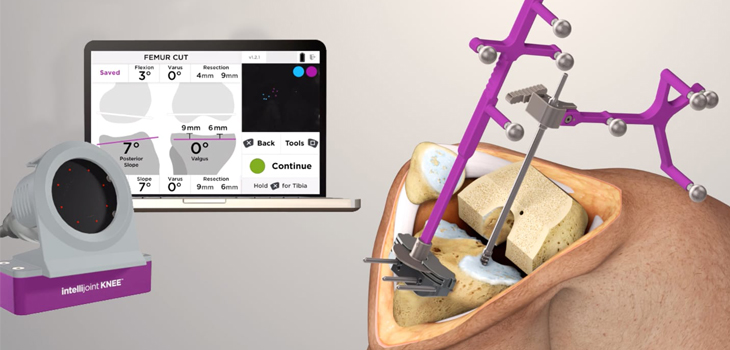
Intellijoint Surgical, based in Kitchener, Canada, has released its second application, Intellijoint KNEE.
Intellijoint Surgical Releases Intellijoint KNEE
2 min read Premium comments
Secondary#intellijointsurgicalIntellijointhip#intellijointknee
Intellijoint KNEE is an imageless, open platform surgical navigation system which is now able to provide surgeons “…quantitative measurements of knee varus/valgus, flexion and slope angles, and resection depth.” With that information, says the company, surgeons can more “…accurately align their cutting guides in the sagittal and coronal planes.”
The company explained to OTW that the new Intellijoint KNEE “allows surgeons to use any implant from any vendor of their choosing. It supports a femur- or tibia-first workflow and has no learning curve for registration. The systems varus/valgus angular measurements are accurate to within less than two degrees, femoral flexion and tibial slope angular measurements are accurate to within less than one degree, and resection depth measurements are accurate to within two millimeters.”
One surgeon user of Intellijoint knee, Sebastian Rodriguez, M.D., Humber River Hospital and Centric Health Surgical Centre, Toronto, Canada, described his experience by saying: “Intellijoint KNEE allows me to easily integrate navigation into my total knee arthroplasty cases and delivers confidence that my distal femoral and proximal tibial cuts are done accurately. This sets my implant specific cuts up for success. As an original Intellijoint HIP user adopting Intellijoint KNEE, I can now offer all my patients the assurance that navigation helped accurately restore their mobility.”
Dr. Rodriguez explained how Intellijoint KNEE was different from other systems, in his view. “Immediately, there were several features about Intellijoint KNEE that stood out to me. It is a sleek, compact system that does not require any extra incisions and does not interfere with my surgical workflow. Its open platform allows me to use the jigs, guides and implants of my choice. Compared to other knee navigation systems, it is very fast and easy to use.”
In addition to speed, Dr. Rodriquez also noted that his patients appreciate his use of advanced technology like Intellijoint KNEE, “I am always excited to tell my patients that I will be using Intellijoint KNEE on their total knee replacement. I explain that it is a small positional camera that allows me to more accurately position their implants which is very important. My commitment to using technology to ensure the best possible patient outcome gives them confidence.”
“Since releasing our flagship product—Intellijoint HIP—in 2016 and completing over 15,000 total hip replacements Our company was created in 2010 out of a need for more accurate, accessible navigation for total hip replacements,” explained Armen Bakirtzian, CEO and co-founder, Intellijoint Surgical. “we heard from our customers the desire for the same user experience with knee navigation. We are pleased to respond to the market requests through the release of Intellijoint KNEE using the design principles of fast, easy and affordable.”
Author
React:
Discussion
This is a fascinating development. In my practice we've seen similar outcomes with the revised protocol. The key differentiator seems to be patient selection criteria. Has anyone else noticed the correlation with BMI thresholds?
Great point. I'd push back slightly on the conclusion, the sample size in the cited study is too small to draw population-level inferences. That said, the directional signal is compelling and worth a larger RCT.
We implemented a similar approach last year. Early results are promising but we're still gathering 12-month follow-up data. Happy to share our protocol if anyone is interested.
Join the conversation
Orthopedic professionals are discussing this. Sign in and upgrade to read every comment and add your voice.