
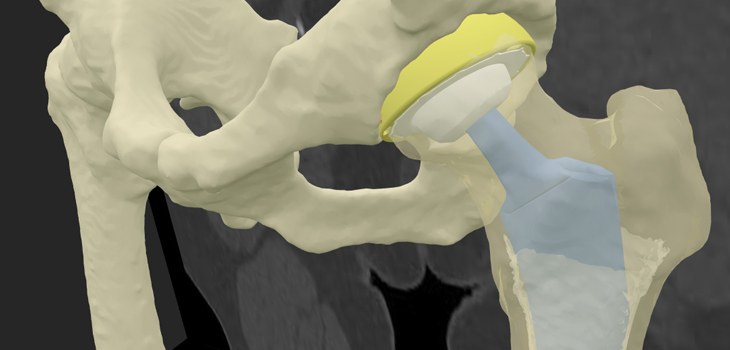
Formus Labs, an orthopedic software development company based in Auckland, New Zealand, has begun clinical evaluations of its Artificial Intelligence – automated 3D preoperative planning software for primary total hip arthroplasty.
First Look at Deep Learning, AI Pre-Op Software
2 min read Premium comments
#totalhiparthroplastySecondary#formuslabs#preopsoftware
The software, which uses deep learning and population modelling to facilitate the preoperative planning process, is being tested across five centers around Australasia in conjunction with the Formus Labs clinical advisory board, led by Dr. Paul Monk, an associate professor at the University of Auckland.
“We’re excited to be moving forward with these clinical evaluations, and we look forward to proving the value of this software in real-world cases. We’re eager to give surgeons a hands-on look at our software, which will improve both their workflow and the lives of their patients”, enthused Formus CEO Dr. Ju Zhang.
The company anticipates that these evaluations are the final phase of the development cycle and plans to seek regulatory approval prior to a late 2020 product launch.
According to the company, “The Formus platform is the first pre-op planning software to fully automate the 3D planning process, from CT [computed tomography] image processing to finding the optimal implant selection and positioning, while still giving the surgeon direct control of the final plan through a web-based 3D interface. To do this, we’ve leveraged a fusion of machine-learning and computational biomechanics fine-tuned using data from hundreds of individuals and input from high-volume surgeons.”
Asked what sort of surgeon feedback they have received, Dr. Zhang told OTW, “Through the development process and now in clinical evaluation, we’ve received much enthusiasm from the surgeons we are working with. Some key messages we’ve received:
- By planning in 3D, the Formus platform is providing a range of measurements that the surgeons have thought much about before but have not been able to obtain, especially in 2D planning.
- The automatic plans predict the 3D positions of implants the surgeons see in reality but are impossible to ascertain from 2D planning.
- Surgeons would much rather use planning software where they are in control than rely on someone else to plan for them. This has been a focus for us, so that while the Formus platform automatically generates an optimized plan, the surgeon can easily make changes and see the effects immediately. We are continuously improving the information we provide to the surgeon so that they have faith in our calculations.”
Highlighting surgeon involvement, Dr. Zhang commented, “Surgeons find the workflow intuitive and in line with their thinking about the surgery. This has come about because we have involved our users through the development process, iterating on designs that have converged to their needs.”
Dr. Monk, chair of the company’s clinical advisory board, told OTW, “The Formus platform provides valuable peace of mind to both surgeon and patient, adding an extra level of sophistication to the pre-op planning process. The software facilitates a more personalized approach, with improved accuracy of not only the size of the cup but also the anteversion and inclination that are unique to each patient’s dynamic loading.”
Author
React:
Discussion
This is a fascinating development. In my practice we've seen similar outcomes with the revised protocol. The key differentiator seems to be patient selection criteria. Has anyone else noticed the correlation with BMI thresholds?
Great point. I'd push back slightly on the conclusion, the sample size in the cited study is too small to draw population-level inferences. That said, the directional signal is compelling and worth a larger RCT.
We implemented a similar approach last year. Early results are promising but we're still gathering 12-month follow-up data. Happy to share our protocol if anyone is interested.
Join the conversation
Orthopedic professionals are discussing this. Sign in and upgrade to read every comment and add your voice.