
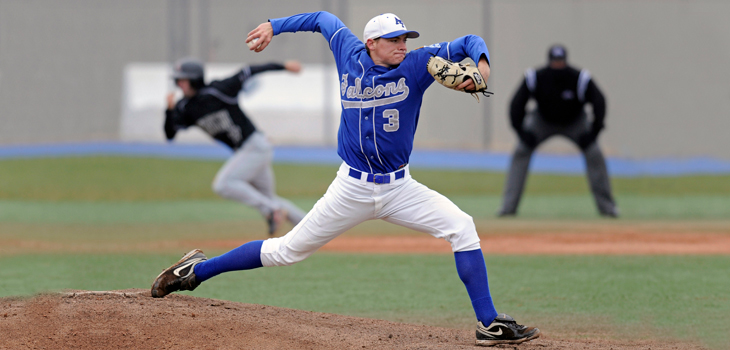
A professional baseball player’s jump can tell a lot about his or her risk for an elbow injury, a new study finds.
A Baseball Pitcher’s Jump Predicts Elbow Injury Risk
1 min read Premium comments
Secondary#baseballpitcher#elbowinjury
In “What Can a Jump Tell Us About Elbow Injuries in Professional Baseball Pitchers?” published online in The American Journal of Sports Medicine, researchers evaluated whether countermovement jump (CMJ) tests can be used as a diagnostic tool for pitcher conditioning.
CMJ tests measure lower-body strength. These tests are commonly used by strength and conditioning coaches and sports scientists. CMJ performances have been linked with maximal speed, maximal strength and explosive strength.
In this study, over 500 pitchers at one professional baseball organization underwent preseason CMJ assessments on a force plate before the 2013 to 2018 seasons.
Researchers collected data on eccentric rate of force development (ERFD), average vertical concentric force (AVCF), and concentric vertical impulse (CVI). Elbow and shoulder injury rates as well as pitch count were also collected throughout the season.
They found that ERFD, CVI, and AVCF were all significant predictors of elbow injury risk, specifically low ERFD, a combination of low AVCF and high CVI, and a combination of high AVCF and low CVI.
No connection between these measurements and shoulder injury risk, however, was discovered.
The researchers wrote, “This study supports the hypothesis of the entire kinetic chain’s involvement in pitching by establishing a link between CMJ test performance and elbow injury risk in professional baseball pitchers.”
“CMJ assessment may be a powerful addition to injury risk alert and prevention protocols. Pitchers in high-risk groups can be prescribed specific exercise plan to improve movement imbalances.”
Author
React:
Discussion
This is a fascinating development. In my practice we've seen similar outcomes with the revised protocol. The key differentiator seems to be patient selection criteria. Has anyone else noticed the correlation with BMI thresholds?
Great point. I'd push back slightly on the conclusion, the sample size in the cited study is too small to draw population-level inferences. That said, the directional signal is compelling and worth a larger RCT.
We implemented a similar approach last year. Early results are promising but we're still gathering 12-month follow-up data. Happy to share our protocol if anyone is interested.
Join the conversation
Orthopedic professionals are discussing this. Sign in and upgrade to read every comment and add your voice.