
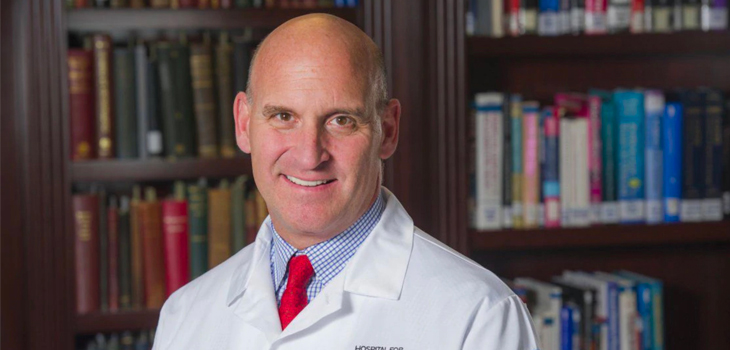
Todd Albert, M.D., Surgeon-in-Chief Emeritus at Hospital for Special Surgery (HSS), astutely and deftly led two of the preeminent orthopedic programs on the planet (Rothman Institute in Philadelphia and HSS in New York City) these past couple of decades.
Todd Albert, M.D., Perspective and Irrepressible Optimism
8 min read Premium comments
#hospitalforspecialsurgery#toddalbert#hss
While he is probably best known for his leadership and superb surgical techniques, he also trained hundreds of budding orthopedic surgeons. Dr. Albert has, we’re sure, a dash of alchemical wizardry in his toolbox.
But who made his success possible?
“My parents, children of immigrants from Eastern Europe, they constantly reminded my three sisters and me of the role of education in altering our lives. If I brought home a 95 on a test, my Dad would ask me what happened to the other 5 points. Overall, they were incredibly supportive parents—and they had to manage the mayhem of six people sharing one bathroom.”
As an undergraduate at Amherst College, Todd Albert was often on the football or rugby field. Traveling to the University of Virginia (UVA) for a rugby tournament during a spring break, Albert became enthralled with that institution and set his sights there for medical school.
Before college, Todd Albert was initially drawn to family medicine. But a day with his good friend and teammate from Amherst’s renowned father would change Albert’s mind. “Dr. Mac Evarts, my friend’s dad, was the Chair of Orthopedics at the University of Rochester. He welcomed me into the OR, where I stood transfixed watching my first knee replacement. While being a family doctor would surely have its rewards, I came to see that being an orthopedic surgeon had so many more elements—patient care, surgery, administration, mentorship, and research. And his patients seemed so happy. I was hooked.”
Finishing medical school in 1987, the newly minted M.D. headed to Philadelphia on a recommendation. “I didn’t know anything about Thomas Jefferson University, but my medical school roommate was from Philadelphia and he returned there for a 4th year elective. He came back just exuberant, saying that the residents at Jefferson and The Rothman Institute were so happy. I applied, interviewed, and instantly connected with Dick Rothman and Bob Booth. They actually offered me a spot the day after the interview (there was not a universal match at that time).
Zeroing in on Spine
Although he was intrigued by many subspecialties, he soon zeroed in on spine. “I just fell in love with the subspecialty because at the time, so little was known about spine care. One of my mentors at Rothman, a spine surgeon named Rich Balderston told me, ‘If you want to become a spine surgeon then we’ll support you.’ I was only a second-year resident and doors were already opening for me.”
Dr. Albert on Dr. Rothman: “One of the things that stood out about Dick Rothman was that he treated everyone so well. He was just like a good friend—never judgmental and constantly supportive. He was very generous with his time and his connections, regardless of one’s age or station in life. I will never forget how he would frequently nab me in the hallway and say, ‘Come to this meeting with me. It will be good for you.’ It was during that time when I first met the president of the university and other individuals in decision making positions.”
“Jefferson had an extremely busy spinal cord injury center, so I had great exposure to a lot of trauma. I had a growing interest in cervical spine and went headlong into it academically and clinically.”
What grabbed Dr. Albert about the cervical spine? “It’s the complexity of the intersection of neural anatomy and the pathology, as well as the fact that no matter how complex or dangerous it is, if it goes well, then the patients recover so quickly. This is in stark contrast to the lumbar spine and thoracolumbar deformity.”
“With cervical spine issues, surgeries can be accomplished on an outpatient basis or with a very short stay. If someone has a complication, of course, then that can be devastating. Overall, cervical spine is almost like the sports medicine of spine. We don’t ruin the patient’s normal anatomy and they feel good after the surgery.”
Albert’s Minnesota Connection
Dr. Albert’s mentors at Jefferson offered three suggestions when it came to a fellowship. “They pointed me toward the University of California – San Diego (UCSD), the Bohlman program at Case Western, and the Minnesota Spine Center. While I would have gained so much from the iconic Bohlman program and UCSD, I turned them down because the Minnesota program was tackling unusually complicated deformity cases, including revision scoliosis cases. I wanted that level of complexity so that I would be ready for anything.”
To enhance his leadership development just after returning to Thomas Jefferson University and The Rothman Institute in 1993, Albert participated in a five-week North American Travelling Fellowship sponsored by the American Orthopaedic Association (AOA). “Our group visited Toronto, New York, Philadelphia, Baltimore, the Carolinas, and Miami. I believe so much in this program that I have personally donated funds to it. Surgeons who participate in this program during their formative career years gain immeasurable value from the contacts and friendships that they would not otherwise have an opportunity to develop.”
Eventually named Chairman of the Department of Orthopaedics at Thomas Jefferson University Medical College in Philadelphia, in 2006, Dr. Albert would go on to be named the Richard Rothman Chair of Orthopaedics. “My time in that role was very instrumental in my development as a leader. When I began, I didn’t completely understand the importance of caring more about the people you are leading than you care about yourself.”
“I also held the naïve belief that people just inherently care about the group. And being patient with that was something I had to learn.”
“Of all the great accomplishments our team was able to achieve at Rothman Institute during my tenure, I am most proud of our tremendous growth from 30 surgeons to over 100 practitioners while maintaining surgical excellence and our culture of academic pursuits (a leading NIH funded lab and a point system for measuring academic contribution). We developed two orthopedic hospitals and multiple ASC’s [ambulatory surgery centers]. All this while growing a culture of team and a group mentality.”
Transitioning to be Surgeon in Chief at HSS in 2014, Albert continued on his quest to build a historically independent group of very talented surgeons into a unified team. “We grew from approximately 70 surgeons to 120 and nearly doubled the revenue of the institution during my five-year tenure. We also created a unique alliance between the hospital and 80 surgeons called HS2 whereby the surgeons and institution share in the benefit of the institution’s out of market growth by participating in quality improvement and recruitment.”
During his tenure leading HSS, Albert oversaw development of two Ambulatory Surgery Centers and maintained HSS’s number one ranking in US News and World Reports as well as the #1 ranking for residencies (Doximity).
Optimism, Mentorship and the Next Generation of Surgeons
“I always say that I will die of optimism, but I truly believe that mentorship in orthopedics is improving. From the perspective of our national societies both the AOA and the American Academy of Orthopaedic Surgeons (AAOS) are very interested in fostering mentorship and have added related programs. At HSS we have increasingly tried to intertwine mentorship opportunities into our traditional training. For example, we have developed a leadership curriculum and support for those early career surgeons who want to participate in a travelling fellowship.”
Fundamentally, says Dr. Albert, mentorship means caring more about those you lead than yourself. “Dick Rothman’s words are always with me, namely, ‘Institutions have no loyalty. People have loyalty.’”
“When I am sitting in a meeting wondering how to incentivize physicians, I draw upon that wisdom.”
What does mentoring look like from Todd Albert’s perspective? “First of all, it needs to be individualized to the person’s specific goals. When someone steps up to be a mentor, he or she must first get to know the person so they can determine what motivates them. If I can do that then I can help them motivate themselves.”
“People are byproducts of how they were raised, so it is important to know how they were raised. If I can see that someone is motivated by superficial things that are not going to be helpful to them, then I can steer them in the right direction. We typically think that once people are past kindergarten their personalities aren’t so malleable. But I have seen people change over time, which gives me hope for the medical profession.”
“I have had mentees who started with the sole goal of doing as many cases as they can, thinking along the lines of, ‘I can crank out a lot of surgeries an make a ton of money.’ But then they got turned on to the potential for leadership and are now leaders in various departments and societies throughout our profession.”
“I derive a great deal of satisfaction from guiding younger members at our institution in terms of spine, orthopedics and where HSS should be going. Also intellectually stimulating is my fairly recent involvement with private equity. These investors have turned their sights on orthopedics and want to partner with individuals, practices and services and be on board as our field grows.”
Todd Albert Looks Ahead…For All of Us
And growing it is, with the global orthopedic device market estimated at $50 billion in 2018 and some projections saying it will reach $65 billion by 2026.1
“The burden of orthopedic disease is exploding thanks to the worldwide aging population and other factors. I am concerned about the potential homogenization of orthopedics. Because of all of the consolidation that is occurring due to outside pressures, I fear that we will no longer recognize and cultivate excellence.”
“Dick Rothman used to say that large institutions tend to not value individual talent and often regard orthopedic surgeons as fungible commodities. This might be more true than ever.”
“I think that we must value talent differently. If an institution is determined to achieve a bigger footprint, but then it stops honoring the individuals who are superstars then that is troublesome.”
“Another observation is about my children’s generation. While we older people are bemoaning what we see as a problematic work ethic, they actually have a great attitude about life. They will say, ‘I’m not doing that 90 hours a week thing! I have a life.’ Given all of our talk about burnout these days, we should recognize that we sound like hypocrites when we criticize them. But the fact remains that the field is very demanding…and that is not going to change.”
When not solving orthopedic issues, Todd Albert relaxes with his friends from his history book club and the New York Historical Society. He enjoys routine exercise on his Peleton and in the gym. He can also be found spending time with his wife Barbara and his three children. They enjoy travel, movies, Broadway shows and regular Sunday family dinners with two of their three children who live in Manhattan.
Dr. Todd Albert…celebrating the individual in order to support the institution.
1 Orthopedic Devices Market to Achieve US$65,000 Million by 2026, Says TMR; https://www.prnewswire.com/news-releases/orthopedic-devices-market-to-achieve-us65-000-million-by-2026–says-tmr-300813077.html
Author
React:
Discussion
This is a fascinating development. In my practice we've seen similar outcomes with the revised protocol. The key differentiator seems to be patient selection criteria. Has anyone else noticed the correlation with BMI thresholds?
Great point. I'd push back slightly on the conclusion, the sample size in the cited study is too small to draw population-level inferences. That said, the directional signal is compelling and worth a larger RCT.
We implemented a similar approach last year. Early results are promising but we're still gathering 12-month follow-up data. Happy to share our protocol if anyone is interested.
Join the conversation
Orthopedic professionals are discussing this. Sign in and upgrade to read every comment and add your voice.