
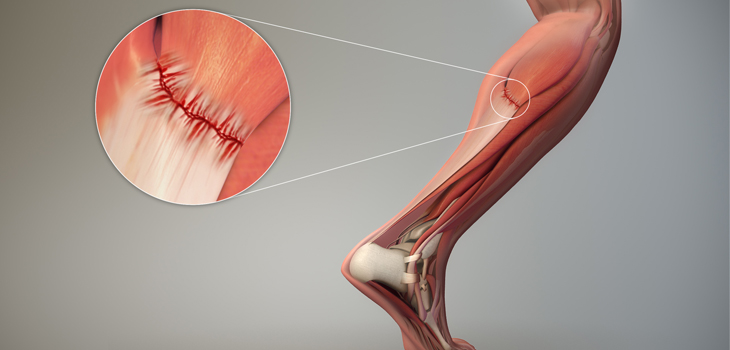
In a 23-year study of professional Australian rules football, “Fifteen-week window for recurrent muscle strains in football: a prospective cohort of 3600 muscle strains over 23 years in professional Australian rules football,” published online in the British Journal of Sports Medicine on February 05, 2020, researchers found that recent injury, within 15 weeks of returning to the game, is the greatest risk factor for the four major muscle strains: hamstring, quadriceps, calf and groin.
Risk for Recurrent Muscle Strain Can Last for 15 Weeks
1 min read Premium comments
Secondary#hamstringinjury#musclestrains#quadriceps
The Australian researchers analyzed data from Australian Football League players from 1992 to 2014 for rates of hamstring, quadriceps, calf and groin muscle strain injuries.
According to the data collected, 3,647 muscle strain injuries occurred in 272,759 player matches. Broken down there were 1932 hamstring, 418 quadriceps, 458 calf and 839 groin muscle strains.
For all types of muscle strains, the risk of injury recurrence gradually lessened but remained elevated for 15 weeks after return to play. At the first match back, the risk was 9% for hamstring, 5% for quadriceps, 2% for calf and 6% for groin.
While a recent history of the same injury (hamstring: adjusted OR 13.1, 95% CI 11.5 to 14.9; calf OR 13.3, 95% CI 9.6 to 18.4; quadriceps: OR 25.2, 95% CI 18.8 to 33.8; groin OR 20.6, 95% CI 17.0 to 25.0) was the strongest risk factor, non-recent history of the same injury was a close second.
Different types of injury also increase the risk of re-injury. A recent hamstring injury was found to increase the risk of a later quadriceps or calf strain injury.
The researchers wrote, “Recent injury is the greatest risk factor for the major muscle strains, with increased risk persisting for 15 weeks after return to play.”
Author
React:
Discussion
This is a fascinating development. In my practice we've seen similar outcomes with the revised protocol. The key differentiator seems to be patient selection criteria. Has anyone else noticed the correlation with BMI thresholds?
Great point. I'd push back slightly on the conclusion, the sample size in the cited study is too small to draw population-level inferences. That said, the directional signal is compelling and worth a larger RCT.
We implemented a similar approach last year. Early results are promising but we're still gathering 12-month follow-up data. Happy to share our protocol if anyone is interested.
Join the conversation
Orthopedic professionals are discussing this. Sign in and upgrade to read every comment and add your voice.