
For faster procedure adoption, it’s time for traditional training strategies to move aside, says Vancouver, British Columbia-based Precision OS Technology, a company with a virtual reality training platform for orthopedic surgeons.
Precision OS Trained 300+ Reps in 30 Minutes Using VR
2 min read Premium comments
Secondary#precisionostechnology#virtualreality
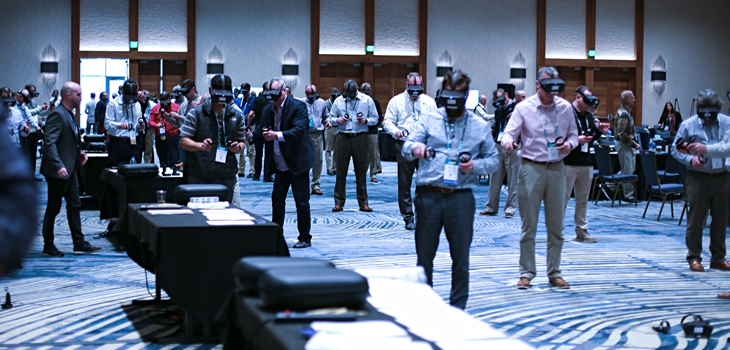
The company has announced that it carried out its first-ever—and largest virtual reality training event ever—of its kind for medical device representatives. More than 300 medical device reps gathered from January 22-25, 2020 to use the training module on a complex surgical procedure.
“Our educational approach has always been to deliver content that includes and goes beyond the implant,” said Danny Goel, M.D. an orthopedic surgeon and CEO of Precision OS.
Dr. Goel said, “When considering how best to influence care and the transfer of appropriate knowledge to care providers, we must think along different models of education. Given these representatives provide an important role in the operating room, equipping them with advanced skills, implant comprehension and support capabilities efficiently and effectively is critical during multistep implantation of devices.”
Touting its training on-the-go capacity, the company stated, “The Precision OS training uses the mobile Oculus Quest and can be completed anywhere at any time. The virtual reality educational modules built by Precision OS provide a much-needed alternative to the time-intensive and costly exercises associated with traditional sales training. These reps have also historically resorted to flying to cadaver labs, listening to lectures, utilizing non-interactive training sessions via tablet and learning on-the-job during actual cases.”
Precision OS collaborated with the Canadian Shoulder and Elbow Society (CSES) on a study—scheduled for publication in the Journal of Bone and Joint Surgery (American) in the coming weeks—finding that after comparing its training with traditional training methods, there was a 570% gain in efficiency in learning with its approach among senior orthopedic surgical residents.
In Dr. Goel’s view, this technology is only the beginning. “The potential for this technology to impact how we as surgeons teach and learn is boundless. It will make the world of surgery smaller while providing equitable and a higher quality care in areas beyond comprehension.”
We asked Dr. Goel about the types of questions they received from reps and he said, “We mainly received comments about how they’ve never had this kind of teaching before. Some of the questions the team usually gets from sales reps during meetings are:
- If our equipment is being used, how can we get a second headset?
- What training modules are completed and available for use today?
- Will my surgeons receive CME credits for completing these training modules?
- What new training modules are you currently working on?
- Do we have a Direct Anterior hip training module?
- Is your technology commercially ready?”
“Having exposure to this technology will allow us to safely, effectively and efficiently learn from and teach the next generation of surgeons.”
Author
React:
Discussion
This is a fascinating development. In my practice we've seen similar outcomes with the revised protocol. The key differentiator seems to be patient selection criteria. Has anyone else noticed the correlation with BMI thresholds?
Great point. I'd push back slightly on the conclusion, the sample size in the cited study is too small to draw population-level inferences. That said, the directional signal is compelling and worth a larger RCT.
We implemented a similar approach last year. Early results are promising but we're still gathering 12-month follow-up data. Happy to share our protocol if anyone is interested.
Join the conversation
Orthopedic professionals are discussing this. Sign in and upgrade to read every comment and add your voice.