
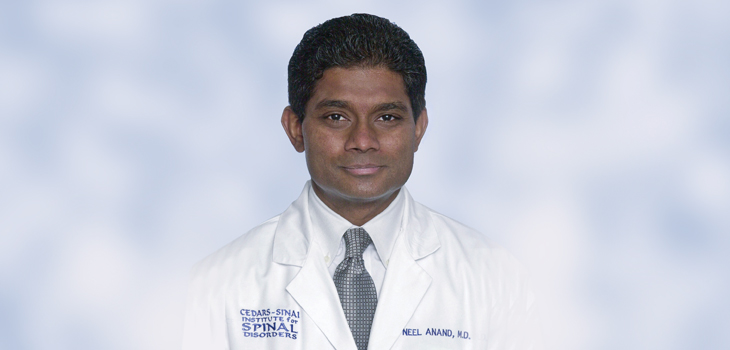
He has treated at least one film legend and more than a few of his patients have stars on the Hollywood Walk of Fame…but you will never hear him talk about those patients. “For me, every patient deserves the respect of my time and attention. It shouldn’t be any other way,” says Neel Anand, M.D.
Neel Anand, M.D: Spine Surgeon to the Stars
10 min read Premium comments
#hospitalforspecialsurgery#cedarssinai#neelanand
And yet, at the Academy Awards (film, not AAOS) a couple years back, one of the winners specifically called out, from the podium, to Dr. Neel Anand saying that he was the reason they were able to get back to work and, ultimately, win the Oscar.
It’s been a long, incredible journey for this humble, remarkable man from India.
Years ago, time and attention were what the unpretentious Dr. Anand sorely needed from the orthopedic training world. He came to the United States as a foreign medical graduate in 1993 and was immediately at a disadvantage. This was not going to stop him. This gentleman, who applied to over 135 residency programs and received 135 “we regret to inform you” letters, is now Professor of Orthopaedic Surgery and Director of Spine Trauma at the Cedars-Sinai Medical Center in Los Angeles.
Training on 200 Patients per Day
“Growing up in India, I didn’t have ready access to many things, thus I had to use my ingenuity. In several aspects of my life, I had to find faster and better ways of doing things. Functioning like this basically became second nature.”
Driven by an interest in biology, a young Neel Anand attended college, medical school, and residency in India. “I was always intrigued by the process of building things…Legos, cranes, etc., orthopedics was a natural fit.”
As for why he zeroed in on spine, he says, “It made me feel like a real doctor. With hip, knee, etc., there is not a wide diagnostic range. Complex spine issues, however, involve deciding on a diagnosis, planning for treatment, and very interesting surgeries.”
Describing his (first) orthopedic residency—in India, Dr. Anand recalls how different it was from his experience in the United States. For example, Dr. Anand recalls, “There were few limitations as to work hours. We met with roughly 200 patients and did 10-20 cases daily. I was heavily influenced by Professor D.D. Tanna, an orthopedic spine surgeon who demanded excellence at every level. I was indoctrinated to believe that when you set your mind to something, nothing is impossible. And in stark contrast to training here in the U.S., we residents had complete responsibility for patients—we ran the program.”
In 1989, Dr. Anand, who would go on to train on three continents and at six universities, received a scholarship to the Royal College of Surgeons of England, enrolling in the University of Liverpool and earning a master’s degree in orthopedics. There, he was awarded a gold medal for clinical distinction.
From India to Sunset Boulevard
Dr. Anand: “In 1993 I headed to the U.S., completing my first spine fellowship in Gainesville, Florida, with Drs. Chet Sutterlin and Gary Lowery. My interest in deformity surgery heightened, I then undertook a scoliosis fellowship at Hospital for Special Surgery (HSS) where I was Dr. Oheneba Boachie’s first fellow. This extraordinary surgeon taught me that if you make a meticulous plan then nothing is impossible.”
That faith in planning would be tested, however, when Dr. Anand received those 135 rejection letters.
“At that point my options were to return to England or get another fellowship and apply again for an orthopedic residency spot in the States. Dr. David Helfet, HSS’ head of orthopedic trauma at the time, saw how sincere—and frustrated—I was, and offered me a spot in his fellowship.”
“Dr. Helfet impressed upon me the value of a superb work ethic. He stressed that you must have detailed discussions with patients, not just be good at technical execution. ‘You can’t just read the X-ray,’ he would say. ‘You must understand the fracture pattern.’”
Thrilled to be in the fellowship but still pining for a residency, Dr. Anand continued to send out applications.
Alas, zip, nada, crickets…
“He approached Dr Helfet and discussed the situation, whereupon he promptly reached out to several colleagues and I was accorded five interviews. I ranked in each one.
Then it was a veritable Groundhogs Day, with Dr. Anand matching at Albert Einstein College of Medicine where he did his third orthopedic residency. “I loved it! This was a high-volume center where we were allowed to work independently and had the opportunity to travel to other centers for our spine rotation. Part of this rotation was a three-month residency at the Texas Back Institute, where I got to learn from the venerable Dr. Stephen Hochschuler.”
Joining the MIS Spine Revolution
“I heard that Cedars-Sinai in Los Angeles was building a spine center and when I interviewed, I felt confident that this would be my new professional home. It was there that I was mentored by Dr. Robert Bray, who opened up a window into the nuances of neurosurgical techniques for spine—something that the majority of orthopedic surgeons never get the opportunity to incorporate into their practices.”
At the time, 2003, minimally invasive spine surgery was at an inflection point. A number of innovations were just coming through the FDA gauntlet and Cedars-Sinai was one of the most active centers for bringing these innovative procedures and technologies to patients. Dr. Anand found himself at the right place at the right time. Looking back, he recalls, “We were trying so many different technologies for the minimally invasive (MI) treatment of scoliosis because it is the most challenging surgery we do in spine. In 2003 we were using a lateral tubular approach to interbody fusion that I helped develop with NuVasive. But this option had two issues. First, we could not access L5-S1 from the lateral position because the pelvis was in the way. Two, you still had to put screws in the back so that still required a traditional open procedure.”
“TranS1 had developed the AxiaLIF, a truly novel and minimally invasive way of fusing L5-S1, so now the laterals we could do from L1-2,2-3,3-4, and 4-5 and L5-S1 use AxiaLIF. So, we adopted this early on and started to treat adult deformity patients in a MI fashion.”
But there remained the unsolved issue of the posterior screw and rods.
“In 2004 I approached Medtronic, which at the time had a minimally invasive system for one or two levels. When I asked them, ‘Why not multiple levels?’ they brought me on to help design a multilevel percutaneous screw and rod system that we could place MI throughout all of the spine.”
“At the time this was used and designed for trauma because there was no other MI way to place the screws. All that was available was a lordotic rod with the sextant system for use in thoracolumbar junction. So, in 2005 we developed a system for trauma that could stabilize patients in a MI way and yet be able to contour the rod into the appropriate sagittal contour. At that point, we had the technology and then started using it for spinal deformity. Hence, we are now able to truly perform circumferential minimally invasive surgery for adult spinal deformity—the lateral MI technique, the L5-S1 AxiaLIF and the MI trauma system for deformity. It made sense and we started doing smaller cases (3/4 levels) and built our experience over the years.”
Good, but still not perfect…
Dr. Anand: “It soon became apparent that we needed a more robust system to correct big deformities. Specifically, we needed more force for the correction. In children you do not need a tremendous force but in adults, you do.”
“So, then I worked with Medtronic on refining the system, going through a couple of iterations and finally developing the Longitude I. We did the first major spinal deformity case T10 to pelvis, completely minimally invasively in 2008 with the Longitude I. This was further refined to what is now the Longitude II, and all cases since 2010 have been done with Longitude II.”
“As we followed our patients and critically analyzed their outcomes, we realized that the AxiaLIF was not a great option for L5-S1 because the healing (fusion) was not going well. And we were losing the ability to get spinal alignment (lordosis) at L5-S1 (we were just locking the patient in at L5-S1). It was safe, mind you, just not perfect.”
A New Approach – OBLIQUE Lateral
In 2010, Dr. Anand and his team took another look at the anterior lumbar interbody (ALIF) approach. “Approaching with an ALIF procedure gave us a better chance of lordosis at L5-S1, which is the location of natural lordosis. We did the tubular transpsoas lateral approach at other lumbar levels, then at L5-S1 did an ALIF, then put percutaneous minimally invasive screws in the back.”
“With continued critical analysis of my patients it became apparent that even though we were keeping an eye on the lumbar plexus in the psoas muscle and relied on nerve monitoring, there was still the possibility of nerve injury and this could be devastating.”
“We were used to doing open lateral surgeries in front of the psoas muscle…so I said, ‘Why not drop the tube in front of the psoas, not go through the psoas?’ Thus, we did an oblique lateral interbody fusion (OLIF). That has become a turnkey procedure today…a safe turnkey procedure.”
The last alternation, says Dr. Anand, was in 2014 when he realized he could do L5-S1 too, in a lateral position. He and his team had been going lateral and relying on small incisions and using tubes from L1-2 to L4-5, but to get to L5-S1 had to turn the patient into a supine position to perform an ALIF. Dr. Rick Hynes, a vascular surgeon in Melbourne, Florida, clued Dr. Anand into doing the L5-S1 ALIF in the same lateral position, which made for a much more efficient surgery.
A Straight Arrow…
Don’t ask Neel Anand what he thinks if you don’t want straight answers.
“One problem in spine is the ongoing issue with incorrect diagnoses. So many surgeons want to rush to the OR when it comes to spine problems. They get attached to something on an X-ray or MRI, but what they see is not necessarily the problem. They’re operating on the MRI rather than the person. Be a doctor first.”
And his thoughts on the state of medical training?
“Some people have sufficient natural talent, and some do not. At a certain point, that is not trainable. And some young people are closed off, making it difficult to communicate your thought processes if the trainee is not able to widen his or her horizons and think beyond what they already know. Medicine is not 1+1=2. You have to be a detective in search of nuances.”
Not afraid to display his “personal gripe,” Dr. Anand told OTW, “There is too much focus on academic facts as well as technology. Robots, navigation, monitoring…there is no one asking the fundamental question, ‘Do we really need that?’ Is navigation going to change someone’s life? We don’t know. Any technology only makes a good surgeon better…it never makes a bad surgeon good.”
And, the next generation of spine/neurosurgeons?
“Orthopedic trainees must develop the ability to ‘think in a more critical fashion.’ People need to take time to analyze problems, asking themselves, ‘What could I have done to avoid this problem? Did I make the wrong diagnosis, do the wrong operation, etc. How exactly could I have done better?’”
“I spend an hour on every new patient and get to know them very well. And, for example, if someone comes back after surgery saying that they are still hurting and there is now pain down their leg, because I have interacted so much with them, I am better positioned to help them.”
“I had a patient who came to me following a lateral surgery. He was having pain down one leg and weakness in one foot. By then it was known that lateral surgery can cause weakness but that it typically improves on its own. But the orthopedic resident and internist didn’t realize that it was his foot that was weak, not his quads. The lumbar plexus is involved in transpsoas approaches and usually affects L3 or L4 nerve. In this instance it was L5 creating foot weakness, the issue being that the prior lateral surgery at L4-5 had pushed disc material into the spinal canal and squeezed the L5 nerve, creating the foot weakness. The patient needed a decompression. As surgeons, we shouldn’t be creating new problems for the patient! Knowing your patient allows you to recognize and correct a problem early on rather than later when someone is falling apart.”
Dr. Anand’s advice to younger surgeons? Don’t ignore a word of what a patient says…they are not making things up.
Oh, but that is A LOT of listening, you may think…I will get burned out if I listen to everything.
No, you will get burned out if you don’t do the right thing, says Dr. Anand.
“Don’t chase the money. Do the right thing you’ll never be wrong. You will have a peace of mind that you did your best. And if you don’t know something, ask and don’t be embarrassed.”
And what gives Neel Anand hope for the future of the spine? “I think the way we manage patients has changed immensely, and we have a better understanding of what we are doing. Technology—the right technology—will make things easier and will hopefully translate into better outcomes.”
Oh yes…Dr. Anand has a family. “My nineteen-year-old daughter is in her first year of college. My fifteen-year-old son is in 9th grade. As for me, to relax I try to spend whatever free time I have with my kids doing or accompanying them to activities they enjoy.”
Neel Anand, M.D.…for whom, every patient is a star.
Author
React:
Discussion
This is a fascinating development. In my practice we've seen similar outcomes with the revised protocol. The key differentiator seems to be patient selection criteria. Has anyone else noticed the correlation with BMI thresholds?
Great point. I'd push back slightly on the conclusion, the sample size in the cited study is too small to draw population-level inferences. That said, the directional signal is compelling and worth a larger RCT.
We implemented a similar approach last year. Early results are promising but we're still gathering 12-month follow-up data. Happy to share our protocol if anyone is interested.
Join the conversation
Orthopedic professionals are discussing this. Sign in and upgrade to read every comment and add your voice.