
Maryellen Keenan, a 22-year veteran at the Hospital for Special Surgery (HSS) and Michele Mauzerall, who launched and grew multiple businesses over the years, are about to revolutionize sterilization in the hospital.
Keenan and Mauzerall Revolutionize Ortho Tray Sterilization
11 min read Premium comments
#highpowerlabs#multipletraysterilization#stericube
It’s no secret that the medical establishment is engaged in a type of biological warfare in the OR. And with precious few advances in the sterilization realm over the past 30 years—and the projected rise in total joint and spine surgeries—it is about time for one.
It’s been a long time coming, but, for Kennan, it all started at HSS. “I was both fortunate and privileged to learn the orthopedic ropes from pioneers such as John Insall, Chit Ranawat and Russ Warren. I saw every new implant and technology you can imagine. And because I arranged for the vendor contracts, I became well versed in all of them. I required each vendor to submit FDA clearance and contraindications for all new implants and medical devices coming into the hospital. On top of that, every time the SPD (sterile processing department) management position was vacant, I was asked to help fill in. That allowed me to really observe workflow and productivity reports to see where the inefficiencies occurred.”
“During my years at HSS I cultivated great relationships with industry leaders. After leaving HSS the CEO of an orthopedic company gave an entrepreneur my name, promising that I was the one to assist him with bringing his product to the market. This was the original owner of the intellectual property (IP) on what would become the SteriCUBE System.”
Mauzerall Joins the Sterilization Revolution
It was a true “Eureka” moment says Keenan. “At the first meeting with this entrepreneur I knew that this technology would forever alter how we sterilize trays. I asked Michele Mauzerall, who had years of entrepreneurial experience with launching and growing businesses including marketing, medical practices and ambulatory surgery centers (ASCs), to collaborate on this with me. At the time she was in the process of launching an OR efficiency business. This sterilization technology was so promising, however, that we both decided to solely focus on bringing it to market. We obtained exclusive rights from the IP owner and began distributing the first version of a multiple tray sterilization system in the U.S.”
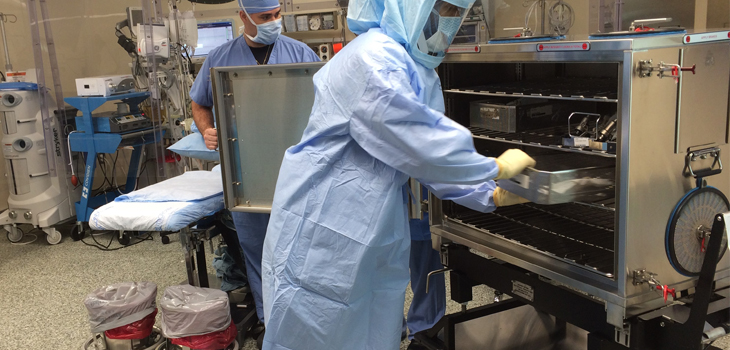
The SteriCUBE System is a portable multiple tray sterilization container that drastically reduces contaminated trays from the OR. Manufactured by PMBS, LLC of Gulfport, Florida, this mobile sterilization system also does away with the tons upon tons of wrappers that end up in landfills each year.

Imagine all of the trays for one procedure being sterilized at once: trays from outside vendors, trays owned by the hospital, and power equipment. And because none of the items needs to be individually wrapped, there is no possibility of contamination via holes or tears or undetected wicking of germs through the paper when inappropriately handled.
FDA Clearance: DONE
But here is the latest news. The SteriCUBE System has just received a new FDA clearance that includes smaller, narrower and longer lumen sizes than any other container on the market. It is the only container that can steam sterilize .7mm by 500mm or 1.0mm by 850mm lumen sizes. There was no FDA-imposed limitation to the quantity of these tiny diameter and extra-long lumens because the testing was done with a higher quantity that would ever be used in a single procedure. What does that mean? That when Mr. Jones’ surgeon uses a cannulated screw, the gentleman on the table will not be exposed to some nefarious organism during his spine surgery.
The Long Slog Toward FDA Clearance
Keenan and Mauzerall had to invest heavily in design upgrades to get the SteriCUBE System ready for FDA review. “With the original design, known as the SCORES Units, we found that some moisture could be retained inside the cabinet, usually on the lower filters, due to a design flaw. The original inventor wasn’t keen on making the necessary design changes, so we ultimately purchased the company from him, did testing for another year, all the while pulling the original product off the market.”
“One prototype design with filters only on the main door left cold spots in the back corners of the container. The next one had filters on two sides of the cabinet and there were cold spots in the middle of the cabinet. With the assistance from a third party, Sterile Services of Houston, Texas, they used a tool called a Datalogger to help us confirm or reject our design changes. Their tool has multiple sensors that can be placed anywhere within the cabinet to determine steam quality. They usually use these tests for autoclave validation. Every two seconds these sensors relayed to a computer the exact temperature and pressure from their various locations within the cabinet. That information was then interpreted by their technician to determine whether or not we were achieving optimal steam saturation. With our final design, and the one we ultimately launched as the SteriCUBE System, not only did they find no cold spots, but they discovered the steam quality within the cabinet was actually superior to an empty autoclave. They reported ‘enhanced steam stabilization’ making for highly effective steam saturation with less temperature variability. In addition, the floor is pitched downward to a filtered drain, and this design improvement allows all moisture to be removed incredibly quickly.”
Finding the Contaminated Needle in the Haystack…
“Rigid containers can only steam sterilize down to a certain lumen level,” says Keenan. “But this is ineffective, particularly for spine and trauma surgeons, who are working with a cannulated hole for the guidewire. This wire is usually 1mm in diameter. The cannulation of micro screws can be as small as .8mm in diameter. When using a traditional blue wrap, you are only able to steam sterilize down to 3.0mm by 400mm lumens. With our product, sterilization reaches the level of .7mm by 500mm and 1.0mm by 850 mm.”
And they have the blessing of the medical mothership…the FDA. Keenan: “The agency has cleared the SteriCUBE System for these new lumen sizes as well as cleared our product for offsite processing. Specifically, the FDA cleared us for our ability to maintain sterility for 30 days following rigorous outdoor transportation and storage outside the sterilization facility. Trays can be sterilized in the SteriCUBE System off site and then transferred by vehicle to a hospital or an ASC. Or hospitals can sterilize their trays in the SteriCUBE System and then transfer them to an offsite ASC. We have set the new bar for offsite sterilization, something that we hope will become a benchmark in the near future.”
Sterile Processing Departments Getting No Respect…Or Extra Funds
“Sterile processing departments (SPDs) really lag behind other areas of the hospital, sometimes with dangerous consequences,” adds Mauzerall. “Fortunately, there is a movement to get SPD staff certified. At the present time, however, we remain at a point where an SPD employee could well have never worked in the medical field before and they may have only received a small amount of on the job training. One facility in Georgia told us they were losing SPD employees to a Target warehouse that offered a higher hourly wage. Another big issue that occurs every time a hospital expands is that the concentration is often only on increasing the OR capacity, which is the money maker for the hospital, yet they rarely do anything to augment sterile processing. And with hip, knee and spine surgeries on the rise, how can they process a growing number of trays with the same resources?”
“While the majority of manufacturers call for a 4-minute sterilization with a 30-minute dry cycle,” says Keenan, “the SteriCUBE System is able to safely outpace that norm.”
“The SteriCUBE System is FDA cleared for a 4-minute sterilization cycle followed by a 10-minute minimum dry time. This product can dry up to 300 pounds of instruments in 10 minutes with no remaining moisture whatsoever. Now we need all the instrument manufacturers to validate this shorter dry time in the SteriCUBE System so they can change their IFUs (Instructions for Use) when using our container. While all manufacturers’ trays are FDA cleared for use in the SteriCUBE System, an abbreviated dry time would allow the facilities to greatly increase their throughput. A few vendors have already validated their devices for this 10-minute dry time.”
Emphasizing the role of the instrument manufacturers, Keenan adds, “Our constant refrain is that hospitals must use the sterilization cycle dictated by the instrument manufacturer’s IFU and should not follow those of the container. Some hospitals say, ‘What if we just want a 10-minute drying cycle?’ We always instruct them to follow the instrument manufacturer’s IFU.”
“There are instances when a hospital has taken, for example, a Stryker product and performed a 4-minute sterilization cycle followed by 10 minutes of drying time, but the Stryker instructions called for 30 minutes of drying time. If that patient gets an infection this could end up in court. When the sterilization records are compared against the manufacturer’s IFU then the vendor is off the hook and the hospital is 100% on the hook.”
SteriCUBE Saves Significant Time
Keenan: “We save approximately 1.5 hours in processing time by eliminating the need to wrap or individually containerize each tray, plus time saved by eliminating pre-heating instruments in the autoclave, running longer than needed cycles, and cracking the door of the autoclave post sterilization. Sometimes hospitals run full loads of mixed sets of instruments on extended cycles as a precaution and to ensure everything comes out dry. Unfortunately, not only does that hinder throughput but sometimes there are delicate instruments or even power equipment that may become damaged or wear out faster from these extended cycles. Manufacturers’ IFUs are critical for the proper care and maintenance of instruments and devices.”

“Surgical delays waiting for instruments, late start times, and overtime expense are just some of the reasons that saving time in the OR is critical. On top of decreasing the instrument processing time we then save about 10 minutes opening time in the OR. The problem comes in convincing the hospital that the extra 10 minutes saved in the OR is valid. Hospitals tend to respond with, ‘That’s great if this will allow us an extra case per day, but what if you can’t find the surgeon for the on-time start?’ In an ASC [ambulatory surgery center], however, we expect the surgeon will be present, or at least easier to find…and if you can add another orthopedic case per day per room in an ASC, the surgeons will be quite pleased.” Keenan notes that they have a smaller version SteriCUBE for ASCs that was just cleared as well by the FDA.
Less Handling, Less Risk
Too many cooks can spoil the broth and too many touches can spoil the implant. Keenan: “Research has shown that a wrapped container is handled on average 14 times between the time it is removed from the autoclave and when it is opened in the OR, meaning that it is not surprising how many times trays are rejected due to holes or tears. Rigid containers are a great alternative to wraps when it comes to being greener but research has shown that they do not help with throughput, minute for minute there are no time savings associated with their use, and there have been several publications concerning compromised sterile barriers when these containers are not re-validated.”
Locking Down Safety
Mauzerall told OTW, “Our container has been called a ‘Giant Rigid Container’ or a ‘Sterilizable Case Cart.’ There is a tremendous amount of pressure applied to our filters, unlike other rigid containers, so each time the filters are inspected one can visually confirm a significant seal has been made. Each filter port—as well as both front door locks—is secured with an integrity lock, complete with indicator dot, prior to sterilizing the instrument trays. When the indicator dots change color from blue to black that shows that the contents underwent sterilization.”
“Before we release a SteriCUBE System from the production line it goes through a series of internal tests including a pressure test. This is one of several ways we confirm the welds are solid and that the reusable gaskets are sealing properly. The cabinet must maintain a specific amount of pressure over a specific amount of time in order to pass our final inspection analysis. Once in the market we teach our customers how they can confirm the repeated seal ability of each cabinet as well.”
“For each new customer, we spore test to verify that the facility’s steam is capable of achieving the needed parameters for sterilization within the SteriCUBE prior to putting it into clinical use. This is when we set up each SteriCUBE System and in-service the SPD and OR staff. The transfer carts are adjusted to lock onto the sterilizer for a smooth transition of the cabinet from the cart into the autoclave chamber. Following the sterilization cycle, the cabinet is returned to the transfer cart where it can be brought to the OR (or stored for up to 30 days in the event of a cancellation or patient delay).”
Future? Better Wear Shades…
Hospitals are hearing about the SteriCUBE. Particularly with the new FDA clearance and increased versatility. “We will also begin making smaller containers as well to be able to have cannulated instrument sets, power equipment, and a retractor set for small trauma cases so as to be able to bring safety to those patients as well,” states Keenan.
“We are currently in discussions with several large companies about licensing distribution,” she adds.
As for an imprimatur, the company has all of its equipment tested at Highpower Labs. “They do all of our validation studies for our FDA submissions,” says Mauzerall. “There are several reputable medical device validation labs in the industry, and we chose Highpower Labs to perform our studies. They have considerable knowledge with packaging systems and do these types of tests routinely. We will continue to invite instrument manufacturers to validate a shorter dry time within our containers so that they may change their IFUs to include an abbreviated dry cycle when sterilized in the SteriCUBE System. This will allow for an increase in throughput that is greatly needed in both hospitals and ASC settings.”
Mauzerall adds, “Also critical is that we have the FTO (freedom to operate), i.e., we are not infringing on any existing intellectual property.”
This sets the SteriCUBE System apart from any possible competitors in the multiple tray sterilization space. With thirteen (13) granted patents and many more to come, it is clear this company has spent considerable resources securing the intellectual property rights to this technology. This has likely been one of the factors leading this Women-Owned company to secure contracts with large GPOs within the U.S.
Safer, faster, cheaper…Maryellen Keenan and Michele Mauzerall have a winner on their hands…and so will hospitals that make the SteriCUBE System an integral part of their process.
To find out more about the SteriCUBE, please visit their website at www.thestericube.com.
Author
React:
Discussion
This is a fascinating development. In my practice we've seen similar outcomes with the revised protocol. The key differentiator seems to be patient selection criteria. Has anyone else noticed the correlation with BMI thresholds?
Great point. I'd push back slightly on the conclusion, the sample size in the cited study is too small to draw population-level inferences. That said, the directional signal is compelling and worth a larger RCT.
We implemented a similar approach last year. Early results are promising but we're still gathering 12-month follow-up data. Happy to share our protocol if anyone is interested.
Join the conversation
Orthopedic professionals are discussing this. Sign in and upgrade to read every comment and add your voice.