
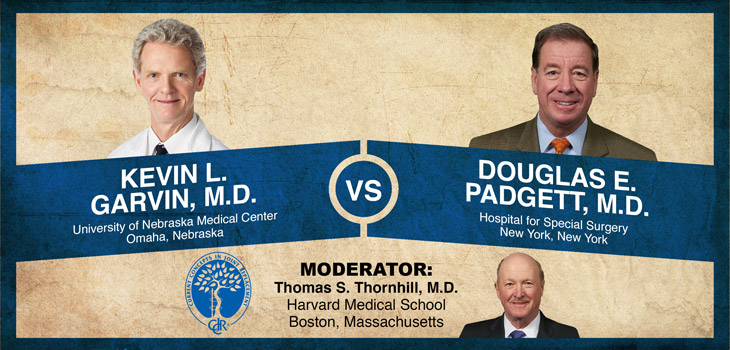
This week’s Orthopaedic Crossfire® debate was part of the 35th Annual Current Concepts in Joint Replacement® (CCJR®), Winter meeting, which took place in Orlando. This week’s topic is “Dual Mobility: First “Choice” for the High Risk Primary & Recurrent Dislocator.” For is Kevin L. Garvin, M.D., University of Nebraska Medical Center, Omaha, Nebraska. Opposing is Douglas E. Padgett, M.D., Hospital for Special Surgery, New York, New York. Moderating is Thomas S. Thornhill, M.D., Harvard Medical School, Boston, Massachusetts.
Garvin v. Padgett: Dual Mobility: First “Choice” for the High Risk Primary & Recurrent Dislocator
9 min read Premium comments
#kevingarvin#douglaspadgettGreat Debates#dualmobility
Dr. Garvin: I think we will all agree that hip instability is among the most common reasons for revision surgery and it’s still unacceptably high. We’ve known this for 35-36 years. Excellent study out of the Mayo Clinic by Ron Woo and Bernie Morrey (JBJS, 1982), looked at 10,000 hips. Over 300 dislocations; about 3% dislocation risk. One-third of those were re-operated. They were able to follow about 90 of those patients; 28 failed further surgery, or about 31%. Leading them to conclude, “Instability after total hip arthroplasty is a complex, multifactorial phenomenon.”
We have very little control over these very high-risk factors—prior hip surgery, alcoholism, cognitive impairment, neuromuscular disorders (Parkinson’s), female gender, avascular necrosis, obesity, hip dysplasia and infection as well as surgical factors: approach, component position, leg length, offset and abductors.
What are the effective choices for us at this time for those patients at high risk or recurrent hip dislocators? First, it’s large heads, constrained devices—and then I’m going to make the argument for non-constrained dual mobility.
In the primary setting, we have pretty good data that larger heads do decrease the risk of dislocation from about 4% to 2% (Goel, et al., JOA, 2014).
A prospective, randomized controlled trial from Howie, et al. (JBJS, 2012), looked at 28mm versus 36mm heads and showed a decrease in dislocation from 5% to just over 1%. I ask the question: Is 1% acceptable to us?
And in the revision situation, Garbuz, et al. with a multi-institutional study from seven different centers, looked at the difference in dislocation from large heads to 32mm or standard heads. And sure enough, the risk of dislocation was lessened considerably, down to 1.1% with the larger heads. (CORR, 2012).
But in that study, they excluded those who had revision for recurrent dislocation. They also excluded revision of the acetabulum, requiring a cage. Revision of the acetabulum with a cemented polyethylene liner and, finally, when they have the intraoperative dilemma of instability, they choose a constrained liner (Garbuz, et al., CORR, 2012).
But if you look cumulatively at several studies, up to 10 years, the risk of recurrent dislocation or revision of the components because of the stresses can be as high as 20-30% (Guyen, et al., JBJS, 2008).
Let’s now look at the non-constrained dual mobility. I think it’s interesting, and this dates back to 1974 in a study by Bousquet and Rambert, and they wanted to combine the low friction, small head popularized by Charnley with a very large diameter of McKee and Farrar. The goal of dual articulation was to achieve the greatest possible range of motion in a stable environment in addition to reducing wear (DeMartino, et al., WJO, 2014).
An excellent study by the Mayo Clinic, which won the Otto Aufranc Award at the Hip Society, looked at non-constrained dual mobility group and compared it to large femoral heads. They found a lower dislocation rate of 3% compared to 10%. But they also had a lower revision for dislocation of 1% compared to 6%. Finally reoperation for any cause was 6% compared to 15%. All statistically significant (Hartzler, et al., CORR, 2018).
There are some problems with dual mobility. Older designs have up to a 5% risk of intraprosthetic dislocation displacement. Modern designs, it’s much lower—0-2%. Dual mobility should not be a substitute for a malpositioned component.
There is also a slight risk of damage and wear of the dual mobility. At Doug’s institution they found predominant motion was in the inner bearing area and there was damage to the surface, but its significance is completely unknown (D’Apuzzo, et al, JOA, 2016).
Finally, a wear study found that median annual wear of the dual mobility is as low as the wear of cemented polyethylene liners and lower than cementless liners. Keep in mind that these were not highly-crosslinked polyethylene liners (Boyer, et al., SICOT, 2018)
To summarize, the short- and mid-term results strongly support the use of the dual mobility construct in patients at high risk for dislocation and those undergoing revision. Intraprosthetic dislocation and material wear are risks associated with this construct in our young, more active patients.
Dr. Padgett: Kevin, I think you’re losing it.
We know instability is a problem (Bozic, et al., JBJS, 2009). We know that it represents a big burden in the revision realm. And we’re certainly concerned. We know at this point that there are lots of factors associated with instability. Patient factors, surgeon factors and implant factors. But all these, again, are associations.
We’ve overreacted. The tendency is to constrain and I think that is wrong.
Kevin’s given a little background about the dual mobility designed in the 1970s. Our group has demonstrated that it works from a computational standpoint. And the clinical track record in Europe has been excellent with increasing adoption in the United States.
In the designer series, 16-year follow-up; 1% dislocation and no described lysis (Vielpeau, et al., International Ortho, 2011). Certainly, that gives us some enthusiasm to essentially use this device, especially perhaps, in high-risk groups.
Our understanding of the mechanism of instability has changed…dramatically changed. What we assumed previously was that alignment was static. We used AP and lateral radiographs to determine radiographic success. And, our surrogate for clinical success in terms of socket position was always stability.
It was all about the Lewinnek safe zone and hitting the target. I would submit that when we revisited that history about hitting that safe zone we found a 2% dislocation rate, but that the rate of dislocation was the same whether you were in or out of that static safe zone.
Why is this? There must be something going on. Static assessment of implant position is not indicative of what happens in daily life. We started thinking that pelvic motion might, in fact, influence functional position. And I’d like to thank Larry Dorr who has really been the champion for this whole concept and has been a big mentor of mine.
Looking at different types of pelvic motion, ranging from the stiff spine, and the stiff pelvis, to that being the hypermobile pelvis. Understanding interplay between the spine and pelvis during sitting. I think it’s crucial for our understanding. And looking at the effect of pelvic tilt on functional version. When we get anterior pelvic tilt, it results in a significant reduction in functional anteversion making that patient at risk for instability.
I would propose that we’re in a new era of understanding functional implant positioning. And I’m going to present to you a 12-step program…in 3 steps.
Step 1: Like any 12-step program, admit that you have a problem. Admit that the patient with spinopelvic disease or hypermobility presents a real barrier to success.
Step 2: Determine the extent and amount of change in that pelvic position; recognizing the impact on functional position. How do you perform? Perhaps, using an EOS machine if you happen to have one. Looking at images from standing or sitting. Or if you don’t have an EOS machine, you can use simple, plain radiographs as outlined by Larry in the 2017 article (Dorr, et al., BJJ, 2017).
Step 3: Execute your plan. Do you need a robot or navigation? Your call. But, adjust your cup accordingly.
Why not just throw in a dual mobility? Kevin alluded to this a bit. Dislocation can occur. Wear can occur. And perhaps with the modular version, a source of metal and possible corrosion.
The problems we’ve talked about—intraprosthetic dislocation where a smaller head dislocates within the shell, typically due to poly wear and skirted heads have been implicated.
Problems with true dislocation where patients with dual mobility can, in fact, truly dislocate.
There are two bearing surfaces that we need to be concerned about. There is certainly a risk for bearing wear/backside wear. And early generations noted lysis at 7 years. Yes, osteolysis at 7 years follow-up. Something that we typically don’t see with fixed bearings at this point.
Finally, this whole thing about corrosion—I think we’re still trying to figure this out—but I think many were shocked to read the report by Peter Sharkey and his group, looking at 100 modular dual mobilities with elevations in metal ions in 4 patients and 2 consistent with adverse local tissue reaction (Sharkey, et al., JOA, 2016).
What about dual mobility in revision? Otto Aufranc Award winner Matt Abdel did a wonderful job pointing out the positive aspects of the use of dual mobility in a somewhat complicated cohort (Abdel, et al., AAOS, 2017). But it’s not a substitute for suboptimal position. Again, I would submit, think functional position.
In the abductor or trochanteric deficient femur, dual mobility is not sufficient enough to provide stability.
In summary, if we look at the risk benefit analysis of dual mobility, I believe we’re in an era of enhanced planning. This information will allow us to deliver a better product and hit the true target. In my summation, dual mobility is a rarely needed solution.
Moderator Thornhill: Let me get that—just a yes or no answer from both of you—Doug, do you believe that dual mobility is the first choice for the high-risk primary and recurrent dislocator?
Dr. Padgett: No.
Dr. Garvin: Yes.
Moderator Thornhill: Okay, good. Whew. You guys would both agree that not all dual mobilities are the same.
Dr. Garvin: Yes.
Dr. Padgett: Correct.
Moderator Thornhill: If you look at things like a constrained liner doing an anterior hip, doing a big head—36mm or 40mm—and the concerns associated with trunnionosis with that or even doing a resurfacing with a thinner poly, how would you rate those options?
Dr. Padgett: So, I think the evidence is quite in favor of using the largest diameter head that you can use, commensurate with the size of the socket you’ve put in. I’m in favor of using that with high-risk individuals, whether or not they’re high risk because their hypermobile or the patient who has the stiff spine. I think we can actually get better information to determine what the optimized position of that component should be both on the femur and on the cup. I think that you should avoid using this as your primary resource. I would, in fact, be in favor—of using an acetabular component that has a dual mobility option should, in fact, the need eventually arise. Because there are other issues that provide stability.
Moderator Thornhill: Same question to you, how do you rate the other sort of things—constrained, big head…
Dr. Garvin: I think both approaches, when done well and the components are in good position, I think are going to have that 1-2% risk of dislocate. I think it’s an important factor. Surgical technique is a very important factor to minimize your risk of dislocation.
Moderator Thornhill: We’ve talked about trunnionosis and stuff in a big head like a 40mm head. You’ll use a 40mm head, because I don’t anymore.
Dr. Garvin: I rarely use a 40. My standard would be a 36.
Moderator Thornhill: What’s your standard?
Dr. Padgett: Standard—I think—is 36 which is the new 32, which used to be the old 28.
Moderator Thornhill: You guys have said most everything. If you’re using a big head, let’s say you’re using a 40mm head, how thick poly do you want?
Dr. Garvin: I’m still a 4mm. I like to see 4mm of thickness, roughly. That 40mm is going to put you up in the high 50’s, probably a 60mm cup, so that’s why usually I’ll use a 36.
Moderator Thornhill: If you are going to use a dual mobility, do you think there is an added advantage to using an anterior approach?
Dr. Garvin: No.
Moderator Thornhill: Because it’s harder to do or just it isn’t necessary?
Dr. Garvin: I think the anterior approach is not without a risk of dislocation.
Moderator Thornhill: Very good discussion. I think this is something that’s on the rise in the United States and I think it’s going to be a while before we really know. Thank you both very much.
Please visit www.CCJR.com to register for the 2020 CCJR Spring Meeting — May 17-20, in Las Vegas.
React:
Discussion
This is a fascinating development. In my practice we've seen similar outcomes with the revised protocol. The key differentiator seems to be patient selection criteria. Has anyone else noticed the correlation with BMI thresholds?
Great point. I'd push back slightly on the conclusion, the sample size in the cited study is too small to draw population-level inferences. That said, the directional signal is compelling and worth a larger RCT.
We implemented a similar approach last year. Early results are promising but we're still gathering 12-month follow-up data. Happy to share our protocol if anyone is interested.
Join the conversation
Orthopedic professionals are discussing this. Sign in and upgrade to read every comment and add your voice.