
The first-ever national consensus-based best practices for the treatment of femoroacetabular impingement has been published under the title, “Best Practice Guidelines for Hip Arthroscopy in Femoroacetabular Impingement: Results of a Delphi Process,” in the January 15, 2020 edition of the Journal of the American Academy of Orthopaedic Surgeons.
First Best Practices Guide for Femoroacetabular Impingement
3 min read Premium comments
#hiparthroplastySecondary#delphiprocess#femoroacetabular
Co-author Shane Nho, M.D., director of the Hip Preservation at Rush University Medical Center in Chicago, explained the genesis of this work to OTW, “The treatment of femoroacetabular impingement syndrome (FAIS) has varied considerably in recent years with hip arthroscopy as the most recent evolution in the treatment of this condition. However, there is relatively little evidence in the literature to properly guide patient selection and the appropriate intervention for patients presenting with signs and symptoms of FAIS.”
“Most surgeons doing hip arthroscopy must rely on expert opinion. This results in considerable variability in treatment protocols for FAIS. In this study, we attempt to standardize the treatment of FAIS between institutions and surgeons using both published literature and the experience of a national group of hip arthroscopists.”
The team’s research methodology was based on the Delphi process which, noted Nho, is a “Well-validated method of establishing a formal consensus from experts. A series of questions are developed based on the objectives of the study. Then a panel of experts is established, and the survey questions are administered, and results analyzed. Iterative rounds of this process are performed until a consensus is reached based on participant feedback, collaborative discussions, and by revising the recommendations.”
“Due to the lack of high-quality studies on assessing interventions in FAIS, this study required the inclusion of consensus-based expert opinion. Since this study is not solely derived on published evidence, it is likely that a better version of these guidelines will eventually become available.”
“There are a number of best practice recommendation that were established in this study. In particular, all surgeons agreed that hip arthroscopy is the standard of care for surgical management of FAIS. In addition, several recommendations were established for preoperative management, which was previously poorly described. Avoidance of opioids preoperatively was unanimously encouraged. Contraindications to surgery are based on radiographic measures with demonstrated negative effects on postoperative outcomes, such as requiring revision surgery or conversion to total hip replacement. This includes decreased joint space, hip osteoarthritis, elevated Tonnis grade, and obesity which prevents arthroscopic access.”
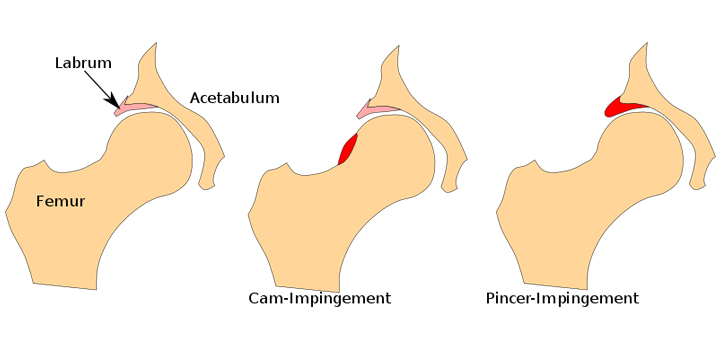
“Early surgical management before completion of conservative treatment was recommended when an alpha angle >65˚ was found. Intraoperatively, universal consensus was reached for labral repair, as opposed to only labral debridement. Additionally, in case of cam impingement, consensus was reached for bone-resection to re-establish a normal femoral head-neck junction as this is unlikely to increase the risk of femoral neck fracture. Finally, experts reached consensus on capsular plication (or closing the capsule) in patients at high risk for capsular instability. These patients are those with borderline hip dysplasia, severe ligamentous hypermobility, or Ehlers-Danlos syndrome.”
“Postoperatively, the evidence for management in the literature was even more sparse. However, consensus was reached on rehab protocols focused on four phases over a minimum of three months: maximum protection and mobility, controlled stability, strengthening, and finally return to sport at minimum four months post-operatively.”
“This consensus statement is based on published studies with a focus on mid-term outcomes but is limited as it necessitated the inclusion of expert opinion due to the lack of high-quality studies. This emphasizes the need for higher quality long-term randomized studies on the treatment of FAIS. Nonetheless, these are the first formal guidelines for hip arthroscopy in FAIS, which is a great start in a rapidly evolving and exciting field.”
Author
React:
Discussion
This is a fascinating development. In my practice we've seen similar outcomes with the revised protocol. The key differentiator seems to be patient selection criteria. Has anyone else noticed the correlation with BMI thresholds?
Great point. I'd push back slightly on the conclusion, the sample size in the cited study is too small to draw population-level inferences. That said, the directional signal is compelling and worth a larger RCT.
We implemented a similar approach last year. Early results are promising but we're still gathering 12-month follow-up data. Happy to share our protocol if anyone is interested.
Join the conversation
Orthopedic professionals are discussing this. Sign in and upgrade to read every comment and add your voice.