
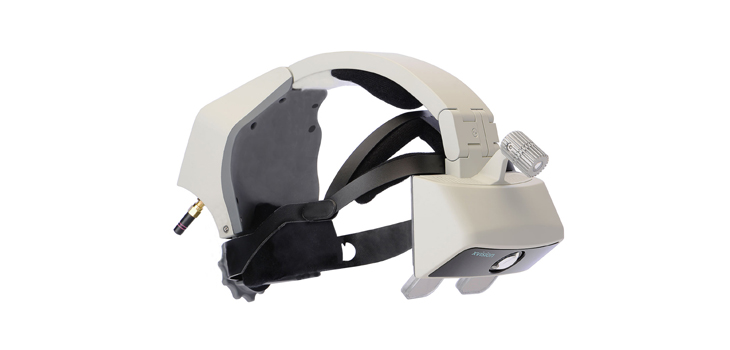
Chicago-based Augmedics Ltd, says its Xvision Spine augmented reality (AR) guidance system is the first AR guidance system to allow surgeons to visualize the 3D spinal anatomy of a patient during surgery as if it were “X-ray vision”. The “vision,” according to the company, allows the surgeon to navigate instruments and implants while looking directly at the patient instead of a remote screen.
“X-ray Vision” Guidance System Cleared for U.S. Distribution
2 min read Premium comments
#surgicalnavigationSecondary#augmedics#virtualreality
On December 23, 2019, the company announced FDA 510(k) clearance for the system. it took the agency over eight months to review the clearance request.
Game-Changing
“Game-changing” is how Frank Phillips, M.D., director of Rush University Medical Center’s spine division, described the technology’s ability to “visualize the patient’s spinal anatomy in 3D, coupled with live CT images as a retina display.”
The company said a study at Rush positioned 93 screws in the thoracic and sacro-lumbar areas of five cadavers, comparing the actual screw tip position and trajectory to the virtual. “Results revealed 98.9% accuracy using the Heary (thoracic) and Gertzbein (lumbar) scales.”
The platform consists of a transparent near-eye-display headset and all elements of a traditional navigation system. It determines the position of surgical tools, in real time, and a virtual trajectory is then superimposed on the patient’s CT data. The 3D navigation data is then projected onto the surgeon’s retina using the headset, allowing the surgeon to simultaneously look at the patient and see the navigation data without looking at a remote screen during the procedure.
Phillips added that the efficiency and accuracy this AR technology “enables in placing spinal implants without looking away from the surgical field—as well as the ability to ‘see the spine’ through the skin in minimally invasive procedures—differentiates the Xvision from conventional spinal navigation platforms. The economics of the Xvision system are also compelling in both the hospital and the surgicenter environment.”
Company Founder & CEO, Nissan Elimelech, said in the release that Xvision “is our first product of many to follow that will revolutionize surgery, as it gives surgeons the information they need, directly within their working field of sight, to instill technological confidence in the surgical workflow and help them do their jobs as effectively and safely as possible.”
To see this Israeli-developed technology in action, click here.
Founded in Israel in 2014, the company was funded by $8.3 million from Swiss-based AO Invest (headed by former Synthes President and CEO Michel Orsinger), Israeli Innovation Authority, Terra Ventures and other undisclosed investors. Distribution of the headsets are expected to begin in the U.S. in early 2020.
Author
React:
Discussion
This is a fascinating development. In my practice we've seen similar outcomes with the revised protocol. The key differentiator seems to be patient selection criteria. Has anyone else noticed the correlation with BMI thresholds?
Great point. I'd push back slightly on the conclusion, the sample size in the cited study is too small to draw population-level inferences. That said, the directional signal is compelling and worth a larger RCT.
We implemented a similar approach last year. Early results are promising but we're still gathering 12-month follow-up data. Happy to share our protocol if anyone is interested.
Join the conversation
Orthopedic professionals are discussing this. Sign in and upgrade to read every comment and add your voice.