
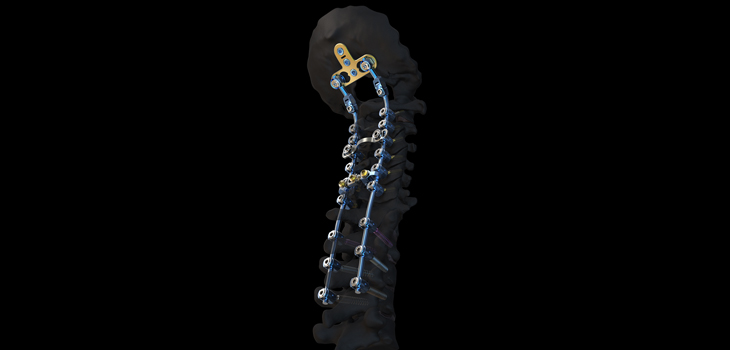
DePuy Synthes, headquartered in Raynham, Massachusetts, has launched the SYMPHONY Occipito-Cervico-Thoracic System for stabilization of the spine in patients undergoing posterior cervical fusion surgery.
SYMPHONY Occipito-Cervico-Thoracic System Launched
2 min read Premium comments
Secondary#depuysynthes#cervicalspinesurgery#symphonyoccipitocervicothoracic
According to the team at DePuy Synthes, “The SYMPHONY System helps streamline procedures and create efficiencies for the surgeon and operating room staff who are treating patients with complex cervical spine disorders.”
“Guided by research conducted in association with the International Spine Study Group, the SYMPHONY System is designed to improve surgeon experience in four key areas: fixation, alignment, targeting and extensions. The range of instrumentation offers options for surgeons to choose from and is compatible with navigation software to aid in targeting in challenging anatomy.”
“The SYMPHONY System was designed to improve fixation in patients with suboptimal bone quality, to address a potential cause of screw failure which may lead to revision surgery. By enabling crossing of the cervical to thoracic junction with one system, the SYMPHONY System reduces the number of instrument trays from six to two, which may provide cost savings in processing and sterilization as well.”
“The system is one of the first posterior cervical systems to be offered with the option of sterile packed implants, which may also reduce processing costs.”
“The most interesting aspect of the SYMPHONY System is its ability to address highly complex needs that we face at the front lines of cervical spine surgery,” said spine surgeon Christopher Ames, M.D. “It also takes into account ways to create efficiencies for healthcare systems, making it a truly comprehensive offering.”
“The SYMPHONY System builds on the deep expertise of DePuy Synthes in treating diseases that affect the cervical spine, and we are excited to elevate our existing portfolio by offering this new enhanced solution for the treatment of these debilitating conditions,” said Nadav Tomer, worldwide president, Spine, DePuy Synthes. “This launch represents an incredible global opportunity to bring a differentiated solution to surgeons looking for reduced complexity, streamlined procedures and more flexibility in treatment options for their patients.”
Nadav Tomer explained the goals of SYMPHONY to OTW, “With SYMPHONY, we had a goal of developing a next generation spine system designed to help patients undergoing posterior cervical fusion surgery while creating efficiency for spine surgeons and the team in the OR. As a result of SYMPHONY’s 4.0 diameter rods and Cortical Fix pedicle screws, a single system can be used to create long constructs spanning the cervico-thoracic junction resulting in less complexity in the OR.”
Author
React:
Discussion
This is a fascinating development. In my practice we've seen similar outcomes with the revised protocol. The key differentiator seems to be patient selection criteria. Has anyone else noticed the correlation with BMI thresholds?
Great point. I'd push back slightly on the conclusion, the sample size in the cited study is too small to draw population-level inferences. That said, the directional signal is compelling and worth a larger RCT.
We implemented a similar approach last year. Early results are promising but we're still gathering 12-month follow-up data. Happy to share our protocol if anyone is interested.
Join the conversation
Orthopedic professionals are discussing this. Sign in and upgrade to read every comment and add your voice.