
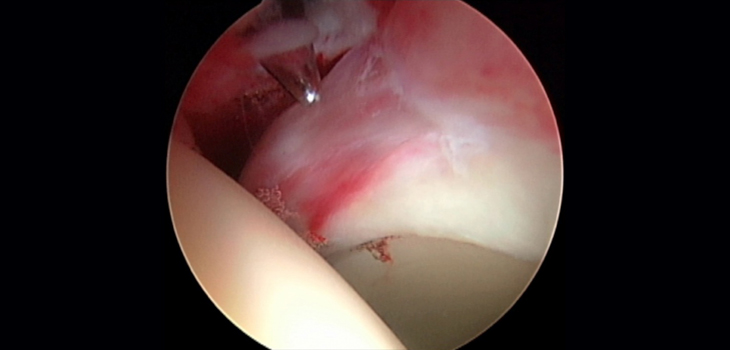
Researchers from Rush University Medical Center in Chicago have dug into the possibility of a link between an incompetent capsule and hip instability. Their work, “Two-Year Patient-Reported Outcomes for Patients Undergoing Revision Hip Arthroscopy with Capsular Incompetency,” was published in the January 2020 edition of Arthroscopy.
Study Tackles Capsular Incompetency in Revision Hips
1 min read Premium comments
Secondary#capsularincompetency#impingementdeformities#shanenho
Shane J. Nho, M.D., M.S., assistant professor, director of the Hip Preservation Center at Rush and study co-author explained to OTW why capsular incompetency as a cause of revision hip arthroscopy deserves a second look, “It has been well published that the most common reason for revision hip arthroscopy is residual impingement deformities. Capsular incompetency in the hip joint after arthroscopy is less well known.”
“In our clinical practice, we began to notice that MR [magnetic resonance] arthrograms after hip arthroscopy could show either capsular defects or incomplete healing of the capsule even if there was not any evidence of residual femoroacetabular impingement. Our concern was that an incompetent capsule might suggest hip instability.”
“When a patient is not progressing after hip arthroscopy as expected, my work up involves X-rays, MR arthrograms, CT scans and injections. Based on these diagnostic tests, I try to determine what is the most likely source of pain—bone, labrum, cartilage or capsule. Osseous anatomy or global deformities should be identified on post-operative X-rays and/or CT scans. The soft tissues (i.e., cartilage, labrum, and capsule are best visualized with MR arthrograms. If post-operative imaging shows a capsular incompetency, the surgeon should have a low threshold for revision surgery.”
“If post-operative imaging is not convincing, but the rest of the work up suggest soft tissue instability, then diagnostic arthroscopy may help to decipher the source of pain. With revision surgery, I tell patients that our goal is to evaluate and address any abnormalities related to cartilage, labrum, residual impingement and capsule. I will order allograft tissue for the labrum and capsule if needed based on intra-operative inspection.”
“Our study reports that capsular incompetency is a very common finding in revision surgery, and patients that undergo revision surgery for the primary indication of capsular incompetency perform as well as revision surgery for other reasons.”
Author
React:
Discussion
This is a fascinating development. In my practice we've seen similar outcomes with the revised protocol. The key differentiator seems to be patient selection criteria. Has anyone else noticed the correlation with BMI thresholds?
Great point. I'd push back slightly on the conclusion, the sample size in the cited study is too small to draw population-level inferences. That said, the directional signal is compelling and worth a larger RCT.
We implemented a similar approach last year. Early results are promising but we're still gathering 12-month follow-up data. Happy to share our protocol if anyone is interested.
Join the conversation
Orthopedic professionals are discussing this. Sign in and upgrade to read every comment and add your voice.