
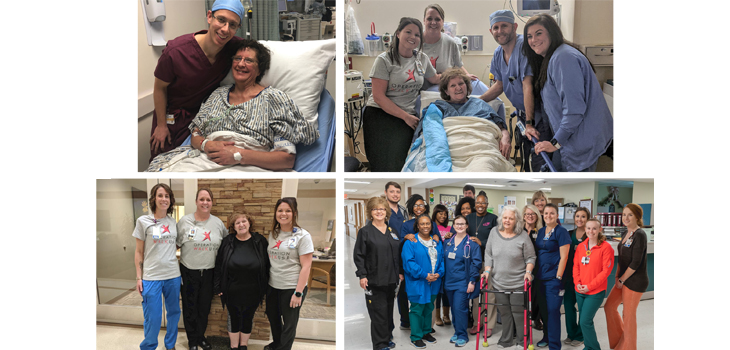
Each December a cadre of caring surgeons open their ORs to suffering patients in need of hip and knee replacements…and they do so via Operation Walk USA. Now celebrating its 10th anniversary, from December 2-7, 2019, approximately 60 patients received free joint replacements from 35 volunteer orthopedic surgeons at 23 hospitals.
Operation Walk USA: 10 Years and Still Giving
1 min read Premium comments
#hipreplacement#kneereplacementSecondary#operationwalk
All aspects of treatment are covered—surgery, hospitalization, and pre- and post-operative care—at no cost to patients who may not qualify for government health coverage, have insurance or afford surgery on their own.
According to the organization, “Operation Walk USA began in 2010 following the tremendous success of Operation Walk, an international volunteer medical service organization that provides treatment for patients with arthritis and joint conditions in developing countries. To date, 802 patients received help through Operation Walk USA, held in the month of December, annually since 2010. Since its inception, Operation Walk USA has provided knee and hip replacement surgeries valued at more than $21.6 million.”
DePuy Synthes, DJO, Smith & Nephew, Stryker, Total Joint Orthopedics, and Zimmer Biomet have donated the hip and knee implants for the 2019 Operation Walk USA.
New Albany, Ohio orthopedic surgeon Adolph V. Lombardi, Jr., M.D., president and co-founder of Operation Walk USA, told OTW, “As we celebrate the successful return to active and pain-free life of the dozens of patients who have benefited from Operation Walk USA this year, we are also celebrating the 10th anniversary of this initiative.”
“Our continued success is attributed to the extraordinary volunteer efforts of orthopaedic surgeons, their staff, hospitals, surgery centers and implant manufacturers who have dedicated their time and resources to giving the gift of mobility to deserving patients. Many consider this program a highlight of their professional year; it is impossible to describe in words the joy and gratitude of Operation Walk USA patients and their family members upon receiving the great gift of mobility. With the tremendous support and collaboration of so many involved we remain inspired and dedicated as we look ahead.”
Author
React:
Discussion
This is a fascinating development. In my practice we've seen similar outcomes with the revised protocol. The key differentiator seems to be patient selection criteria. Has anyone else noticed the correlation with BMI thresholds?
Great point. I'd push back slightly on the conclusion, the sample size in the cited study is too small to draw population-level inferences. That said, the directional signal is compelling and worth a larger RCT.
We implemented a similar approach last year. Early results are promising but we're still gathering 12-month follow-up data. Happy to share our protocol if anyone is interested.
Join the conversation
Orthopedic professionals are discussing this. Sign in and upgrade to read every comment and add your voice.