
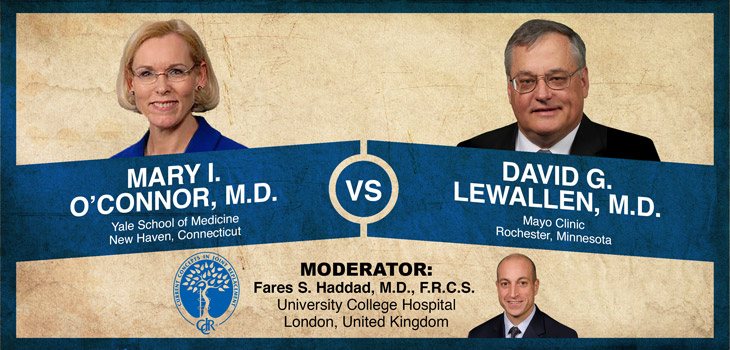
This week’s Orthopaedic Crossfire® debate was part of the 35th Annual Current Concepts in Joint Replacement® (CCJR®), Winter meeting, which took place in Orlando. This week’s topic is “Patient Specific TKA Provides Improved Satisfaction.” For is Mary I. O’Connor, M.D., Yale School of Medicine, New Haven, Connecticut. Opposing is David G. Lewallen, M.D., Mayo Clinic, Rochester, Minnesota. Moderating is Fares S. Haddad, M.D., F.R.C.S., University College Hospital, London, United Kingdom.
O’Connor v. Lewallen: Patient Specific TKA Provides Improved Satisfaction
10 min read Premium comments
#maryoconnorGreat Debates#davidlewallen#patientspecifictka
Dr. O’Connor: My disclosure is that my institution receives support from ConforMIS, Inc., which is the company that manufactures the custom total knee I’ll be referring to.
A lot of our patients sing this song…”I Can’t Get No Satisfaction.” Right? Numerous studies show that a high percentage of our patients are dissatisfied with their total knees. They complain of lower than anticipated functional improvement potentially related to subtle instability and suboptimal kinematics. Incomplete pain relief – component malrotation and suboptimal fit can cause that. We know improper fit leads to residual pain. Femoral overhang can cause pain (Mahoney, et al., 2010; Bonnin, et al., 2013).
Component malrotation and internal rotation errors are 5 times more likely to cause anterior knee pain (Nicoll, et al., 2010; Bonnin, et al., 2013; Berger, et al., 1998, Barrack, et al., 2001; Martin, et al., 2012).
Poor kinematics, we know, lead to suboptimal function and there is a high frequency of paradoxical motion (Dennis, et al., 2003).
Let’s talk about anatomy. In a series of 24,000 patients, the variation in distal offset ranged from 1mm up to 6mm with 1/3 of the patients neutral, 1/3 moderate, and 1/3 with a high degree of joint line varus (Beckmann, et al., 2017).
So, can a custom total knee that takes that into account variation in anatomy produce a better result?
How is a custom total knee made? Patient gets a CT scan from the hip to the ankle. That’s sent to the company. They use that information to create a custom implant. They set alignment at the neutral mechanical axis. They recreate each patient’s individual J-curves.
An off-the-shelf component cannot do that.
A custom knee can give you offset polys, different thicknesses medial and lateral that allow you to maintain normal offset while having a horizontal tibial resection. And the medial insert is more conforming to facilitate rollback.
How do these implants perform clinically? Are patients better satisfied?
Looking at survivorship data, the UK Registry (Beyond Compliance iTotal G2 XE 11-Feb-2018; Northgate Publish Services (UK) Limited) found that ConforMIS knees at a 0.5% revision rate at 4 years which compares favorably to off-the-shelf implants at 1.9%.
Let’s look at alignment. Neutral mechanical axis alignment. Customized knees are like doing all the navigation pre-op. You don’t need to do any planning. It’s already computer-planned for you. Customized knees are 1.8 times more likely to be within 3 degrees (Ivie, et al., JOA, 2014; Levengood, et al., J Knee Surgery, 2017).
Better fit. Significantly less underhang, and no overhang (Schroeder, J Knee Surgery, 2018).
No lift-off in early to mid-flexion (Zeller, et al., JOA, 2016). We know this is an indicator of mid-flexion instability.
Data on 740 patients from 11 centers showed improved walking time, timed up and go, and timed up and down stairs. When we take this data and combine it into the ALF [Aggregated Locomoter Function] score, we see that custom knee outperforms off-the-shelf components as well, which is a validated measure (O’Conner, ICJR Pan Pacific 2016).
Better fit translates into higher patient satisfaction. A 70 patient study using the Knee Injury and Osteoarthritis Outcomes Score reported higher patient satisfaction (Katthagen, et al., ICJR WAC 2015). Again, 70 patients, so we do need bigger numbers, but this is really strong data.
Finally, another study, this time 360 patients with custom implants—92% satisfaction at 1 year, 90% at 2 years (Tait, et al., ICJR Pan Pacific 2016).
Fascinating data from Dr. Dan Dunaway’s practice in Ohio. Forty-seven of his patients received an off-the-shelf first knee and then he did their second knee with a customized implant. Here are the outcomes in these bilateral patients. Improved KOOS Jr. and Forgotten Joint Scores for the customized implant. When he asked his patients which knee felt more normal, 70%, serving as their own control, favored the custom knee. Overall, 72% of them favored the custom knee compared to 6% favoring the off-the-shelf and the rest were neutral.
Finally, about the cost. Three studies show that custom knees can drive savings for both hospitals and insurance providers. If you’re in a bundle and looking at the economic implant, this is another reason to consider custom knees (O’Connor, et al., AHDB, 2018; Buch, et al., Culler, et al., Arthroplasty Today, 2017).
There is no debate. Custom made total knees produce superior function and patient satisfaction. Patients as their own controls feel the difference and favor their custom total knees. And there is a growing body of evidence for increasing patient satisfaction, while lowering the economic burden of total knees.
Dr. Lewallen: I can always count on Seth (the founder and organizer of CCJR) to give me a curmudgeon talk. He counts on me to be opposed and hostile, so I’ll try to do that.
We keep hearing about the high rates of dissatisfaction with total knee arthroplasty. The theory—which is completely unproven—is that this is due to compromises in implant design, size and shape options. It’s all about the hardware, right? If we could just optimize this a little more, then we’d reach nirvana.
First of all, bad outcomes compared to what? Primary total hip? Ok, maybe a little. Internal fixation of plateau fractures? My total knees look pretty good compared to my plateau fractures. Lumbar fusion for back pain? Anybody else think that’s a superior procedure? Limb salvage for malignant tumors? Pancreatic cancer?
It’s really the expectations you set and we’ve been complicit on moving the dial and creating really unreasonable expectations for many of our patients. Part of the problem is the rapid recovery thing, the minimally invasive procedures, outpatient, marketing hype.
“Come see me and we’ll have you bowling in 3 days.” I think it’s the wrong message for many of patients and it really sets them up for failure.
The other thing is the patient’s state of mind. We all know that depression has an adverse effect on outcome. My wife ran off with the tennis coach; my dog died; my truck quit—I’m depressed. A year from now new girlfriend, new dog, bought a new car. I’m not depressed anymore.
If you’re optimistic, you’re going to live longer; you’re going to better with cancer therapy; you’re going to have less pain after total knee arthroplasty. That’s in the literature.
If you’re a pessimist like me, you curl up and die when you get cancer because bad things happen and you don’t even go for your chemo, right? It makes a difference. And we’re not going to fix that with metal.
Yes, implant design is important. We’re all for that. But remember there’s been a change in the increasing fidelity and choices of sizes with off-the-shelf implants. It’s improved over the last 10 years.
Ask yourself, is it the arrow or the archer? Implant design or surgical technique? Why do implants fail? I can tell you, having dealt with overhang, I’m an expert on overhang. It’s painful psychologically, but it doesn’t really cause pain symptoms, I don’t think.
The social, psychological, medical comorbidities aren’t going to be helped, I think, by covering the bone a little bit better. What about all of the problems that we know increase the risk of complications? How are we going to fix those with implant design and J-curves?
A lot of the painful knees I see have no sign of arthritis on the pre-op X-ray. You’re not going to fix that with improved implant design.
Surgical technique is a common cause of failure in my practice. I’m not going to fix surgical technique with a new implant design.
Is there an advantage to improved implant design? I think there is. Can it be done in all or most patients? And will the benefits of a new design justify the extra costs in time and money?
We’ve seen some of these studies (Schwartzkopf, et al., 2015; Arab, et al., 2018; Ogurs, 2018; Zeller, et al., 2017). There are some apparent benefits. But does it matter? Are all of those differences between customized implants and off-the-shelf implants clinically significant?
The literature shows that customized implants really don’t make a difference.
In one study on bicompartmental, 5% converted, 29% re-operated (Ogus, 2018). A prospective multicenter study showed no difference in pain relief or Knee Society scores (Dirks, et al., Orthopaedic Journal of Sports Medicine, 2017).
Do the benefits of a customized implant justify the extra radiation for the CT, the time, the effort and the expense? I think the answer is clearly “No.”
We need, at this point, validated designs, improved poly, instruments that allow you to get it in straight. Learn to do soft tissue balancing. Take advantage of the increases in fidelity of choices. And find what works with you and stick with it.
As far as customs, for me it’s simple. It’s like shoes. Expectations have a lot to do with satisfaction, perceived fit, pain level, functional limitations. There was a day when people paid a lot of money for torture and took it because it was the expectation. We’re in a new era and I will admit that we need to stay tuned. While there may be customization in all our futures, it’s not right now.
Moderator Haddad: Mary, going to war with one bullet. That’s pretty hard isn’t it. What happens if someone drops the implants or what happens to that patient?
Dr. O’Connor: You always have to have your back-up plan. In the knees that I’ve done, I’ve never had to convert to an off-the-shelf. We did drop one poly insert and had to go to a second one, which was a 1mm size difference so it wasn’t anything horrible. But it wasn’t my first choice. One of the points that I want to make is the difference in one of the studies that Dave showed…if you’re talking about patient-specific instrumentation, that is not a custom total knee. That is you spending a lot of money, in my opinion, on cutting guides that are just putting in an off-the-shelf component. I really don’t see any benefit to that.
Moderator Haddad: David, before you come back, just for me to understand…the customized knee design is based on the disease state on a supine CT and you’re hitting everybody with neutral alignment. Is that right?
Dr. O’Connor: Yes, so it’s neutral mechanical axis alignment and looking at the anatomy, so the implant is made based on the anatomy of the patient, modeling away the osteophytes and areas where there is disease. This implant is not something that I use for patients that have significant deformity. I would put that caveat in there. But for the vast majority of your knees, in my hands it is superior. Cost, in our institution, has been minimized with aggressive negotiation. Implants come in one box with your cutting guides, so there is a lot of OR efficiency that can also be gained.
Moderator Haddad: David, if you’ll answer the questions…what’s your thought about the translatability of this process?
Dr. Lewallen: There’s no question that this can be done and be done well with good results in the hands of experienced surgeons, high volume folks. And importantly, people have a mental image of what a total knee is supposed to look like and are willing to bail and correct something if it doesn’t look right. Right? You need to have some operator control. This isn’t auto pilot. Fifty percent of surgeons are below average—it’s a math problem. So, the trouble is how are we going to translate this generally…is this appropriate for general use…and I think at the current time the answer to that is no. I’m willing to yield, perhaps with data and enhancements in the future, perhaps this will have a role in some way, but I don’t think now it’s right for primetime.
Dr. O’Connor: Fundamentally I think this is a better implant design A custom knee is able to reproduce the patient’s anatomy. I believe that when I’m putting those components in, my risk of some subtle malrotation of the femur versus the tibial component is minimized because this is essentially all computer planned and navigated prior to me entering the operating room. Fundamentally it’s an improvement over what we’ve been doing for decades with off-the-shelf components. Yes, there have been improvements with off-the-shelf with greater variations in size. We have different appreciation of AP and ML ratios.
But it doesn’t fundamentally address the question that one individual’s knee is shaped differently than another’s. I truly believe that this is the next step in the evolution of how we’re going to have better outcomes with total knees. Some of our knees off-the-shelf do great. And we say, “See, it’s fabulous. Look how great this patient is.” But when you look at the data, it shows the variation in distal femoral offset in the joint line, you can envision that those patients who are doing great are the ones where their anatomy is so suitable for an off-the-shelf.
That’s not all our patients. We know this from the functional data and the patient satisfaction. In my opinion the superiority of customized components is clear and convincing.
Dr. Lewallen: We look forward to the prospective randomized, blinded trials, which will convince the curmudgeons like me that it’s actually true. I’m concerned we’re seeing a placebo effect. You tell somebody you’ve got something new and great; they’re going to have a better result if they believe that.
Dr. O’Connor: The placebo effect does not translate into better function. The functional data that we have shows these patients can walk faster, timed up and go, up and down stairs is better. Their functional level is higher. And I believe that translates into why they have higher degrees of satisfaction.
Dr. Lewallen: The Schwarzkopf data and the author concluded that it didn’t make a difference clinically.
Moderator Haddad: We’re not going to get agreement here. Great passion, great arguments and debate to continue.
Please visit www.CCJR.com to register for the 2020 CCJR Spring Meeting — May 17-20, in Las Vegas.
React:
Discussion
This is a fascinating development. In my practice we've seen similar outcomes with the revised protocol. The key differentiator seems to be patient selection criteria. Has anyone else noticed the correlation with BMI thresholds?
Great point. I'd push back slightly on the conclusion, the sample size in the cited study is too small to draw population-level inferences. That said, the directional signal is compelling and worth a larger RCT.
We implemented a similar approach last year. Early results are promising but we're still gathering 12-month follow-up data. Happy to share our protocol if anyone is interested.
Join the conversation
Orthopedic professionals are discussing this. Sign in and upgrade to read every comment and add your voice.