
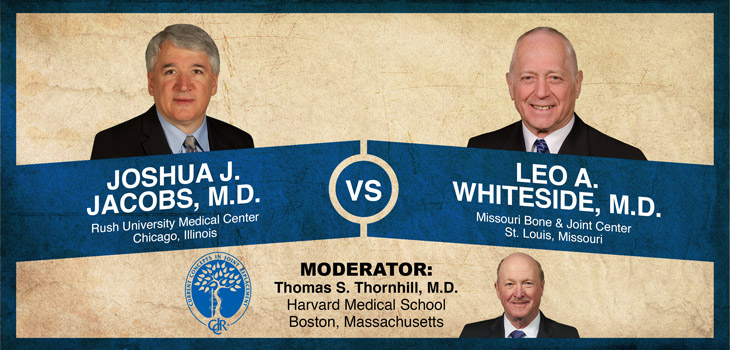
This week’s Orthopaedic Crossfire® debate was part of the 35th Annual Current Concepts in Joint Replacement® (CCJR®), Winter meeting, which took place in Orlando. This week’s topic is Metal Sensitivity: A Clinical Bridge Too Far.” Affirming is Joshua J. Jacobs, M.D., Rush University Medical Center, Chicago, Illinois. Opposing is Leo A. Whiteside, M.D., Missouri Bone & Joint Center, St. Louis, Missouri. Moderating is Thomas S. Thornhill, M.D., Harvard Medical School, Boston, Massachusetts
Jacobs v. Whiteside: Metal Sensitivity: A Clinical Bridge Too Far
10 min read Premium comments
Great Debates#joshuajacobsmd#leowhiteside#metalsensitivity
Dr. Jacobs: This is a morass. This is a tough area. Do metal allergies really exist? How prevalent is it if it does? How might it present? How can you make the diagnosis?
I’m going to try to address each of these issues.
Does metal allergy really exist? I think the answer is a definite “Yes” based on case reports, not only on orthopedic devices, but on other devices. There’s a clear temporal association in some cases with the implantation of a metal device and a subsequent reaction.
If you recall from Microbiology 101, this is how you prove whether an organism is associated with disease. Where you implant a metal implant, you might get, for example, a skin reaction. Take the implant out, the reaction goes away. Re-implant, the reaction comes back. Those cases exist in literature.
Why? Because metal ions can be released from wear and corrosion. They interact with serum proteins and initiate the delayed type hypersensitivity response.
Hypersensitivity can be Types I through III, which is antigen antibody, but typically in orthopedics it’s a delayed type response which is cell-mediated and usually is antigen specific.
How prevalent is this? In the general population it’s about 10%. This is by patch testing. If you have an implant, it’s about 25%. And if you have a poorly functioning implant, it’s 60%. There is no cause and effect here. There’s an association. It’s just as likely that people with loose implants—they’re not loose because they’re allergic, but because the loose implants are generating more debris, so they have more patch test positivity.
Let’s do the math and see if this makes any sense. Let’s say there’s about 700,000 total hip replacements done annually in the U.S. With a 25% prevalence of nickel allergy in patients with implants, that would mean that 175,000 total knee replacements annually have an allergic reaction to the implant. Does that make any sense? I don’t think so. That’s why I think this is a clinical bridge too far.
Let’s explore this. How might metal allergy present? The most compelling cases are where there is a skin reaction—dermatitis, urticaria (hives), vasculitis. Patients may or may not have a history of intolerance to jewelry. It’s much more difficult to sort this out when a patient comes in a chronic effusion or synovitis, stiff knee, unexplained pain. This is obviously very non-specific, but nonetheless, this is how patients will present to me typically.
Now the reason I’m focusing on knees is that bye and large this is a problem that comes in patients with symptomatic total knees. As a surgeon that sees a lot of patients referred to me for metal allergy issues, for every 1 hip replacement patient with metal allergy concerns, there’s about 25 knee replacement patients with similar concerns.
How do you make the diagnosis? This is very difficult. Sometimes you get a history. You can do patch testing. This is tried and true. There’s pros to this. It’s easy to perform. It’s historically the most common. There are several cons, including potential to induce sensitivity. But the real problem with it, it’s not clinically validated. Stay tuned.
You can do in vitro testing such as lymphocyte transformation testing, where you take advantage of the fact that lymphocytes may proliferate when exposed to their antigen.
There are some pros to in vitro. It bypasses the skin. It avoids the potential for sensitization; quantitative results. But you have the same cons, in particular that it’s not clinically validated.
There is a Mayo Clinic study showing no increased risk of failure with a positive patch test, looking at the registry (Brovo, et al., J Arthrop, 2016). A study from Bologna, the Rizzoli Orthopaedic Institute, a meta-analysis where they concluded that for hypersensitivity testing…a predictive value was not proven (Granchi, et al, BJJ, 2012). Additional data from the Danish Arthroplasty Registry looking at 356 patients from their registry and 712 from the Gentofte Patch Test data base in that country, no increased risk of revision for metal allergy patients (Thyssen, et al, Acta Orthop, 2009).
You also have to ask yourself is the metal bioavailable? And the results of metal ion testing patients with knee replacements…it’s kind of all over the place. Some studies show no elevations (Garrett, et al., Acta Orthop Belg, 2010); some studies show slight elevations. But recall in the typical cobalt-chrome implant, nickel is less than 1%. Actually, it’s less than 0.5% (Luetzner, et al., CORR, 2007). So just because it’s in the alloy doesn’t mean it’s bioavailable. It has to be released and it would have to be a very aggressive situation of metal release in the total knee replacement to get the nickel bioavailable.
In fact, the stainless steel surgical tools, which have 12% nickel, are a much more likely source of nickel than the actual implant. And how do we deal with that?
What are the results of revision surgery? There is only anecdotal case reports and uncontrolled studies showing that there is a benefit to revising for metal allergies. And if the patients do get better…why? Were you correcting a subtle instability? Subtle malrotation? Soft tissue impingement? One-stage revision for an indolent infection? Or do they get better because you’re putting in a hypoallergenic implant?
A study from Tom Schmalzried’s group in the JBJS (2019) where they actually looked at this issue. All 27 patients were revised for metal allergy with a hypoallergenic implant. But it turns out, while they did get better, the histology simply did not correlate to an allergic response.
In summary, metal allergy to orthopedic implants has been well documented in isolated cases. It is real. However, the true prevalence is unknown, but clinically significant symptomatology due to metal allergy is most likely very rare in total knee replacements.
Current diagnostic methods, both cutaneous and in vitro, have not been clinically validated. Conservative management of symptomatic patients with positive allergy testing is recommended. In very rare cases, device removal may be considered but should be a last resort, and the patients need to be informed of the unpredictability of revision in this setting.
Dr. Whiteside: Thanks a lot Seth for giving me the opportunity to speak in opposition to one of the giants in this field, and one of the giants in orthopedics. Thanks a lot. I’ll do my best. And I will tell you that some people are way too smart to be in orthopedic surgery and I think we’ve just seen an example of that.
Let me simplify things a little bit. Metal is toxic stuff. Especially cobalt-chromium alloy. And so is PMMA cement. We need to learn to stop it.
Metal toxicity has been going on since the 1950s or earlier when we started putting in so-called vitallium. Recall the Smith-Petersen vitallium nail—eczema, urticaria, multiple strokes, hemiplegia.
Then it really took off when we started using metal-on-metal. It actually generates metal debris and metal ions and continues to. We found that there is a strong association between skin allergy and loosening (Evans, et al., JBJS, 1973). Back when I was studying things and doing laboratory research, this is what I found—dozens of papers on the subject.
Swanson, Freeman and Freeman’s associates were very prominent in this. Metal particles, toxicity of ions, and hypersensitivity back in the 1970s. And also increase in frictional moment (Swanson, et al., JBJS, 1973).
A lot of studies were done on this looking at patch testing to see if allergy was a big issue. Seemed to be somewhat of an issue. Nine out of 14 with loosening were allergic; and the ones that didn’t loosen, didn’t tend to be allergic (Evans, et al., JBJS, 1973).
Freeman, in his gentlemanly ways, said, “We conclude that prostheses in which metal articulates with polyethylene should be preferred.” And the problem was solved. It went away. The entire literature disappeared on this subject. People lost interest until we started to look into it again with metal-on-metal. We got metal toxicity, metal allergy. What’s the problem here? Not really too hard to figure out.
And I was glad to see Hallab and Jacobs get into this. They wrote in 2001…”Until the roles of delayed hypersensitivity and humoral immune responses to metallic orthopaedic implants are clearly defined, the risk to patients may be considered minimal” (Hallab, et al., JBJS, 2001).
What? Are you serious? This was from the two leaders.
In 2004, when we were starting to really wonder what the hell we were doing Hallab writes…”The prevalence of dermal sensitivity…” then we go down to the bottom of this: “…the risk to patients may be considered minimal” for putting in metal-on-metal bearings (Hallab, et al., JOA, 2004).
Really? Are you serious?
By 2005 Willert was starting to yank ‘em out and report on what he found. He revised the ones with ceramic and they all did well. Revised the ones with metal-on-metal again because he didn’t know what the problem was yet, none of those got better (Willert, et al., JBJS, 2005).
Other people found higher and higher risk instances of osteolysis. Now maybe it’s not sensitivity…toxicity I would say yes for sure (Park, et al., JBJS, 2005).
Then in 2005 the “…elevated level of lymphocyte reactivity supports a metal-specific adaptive immune response and suggest involvement in the pathogenesis of poor implant performance, e.g. aseptic osteolysis (Hallab, et al, J Orthop Res, 2005).” My reaction is “I think I understand that. I’m not so sure.”
There is a growing consensus that metal particles are more inflammatory than polymers (Hallab, et al., Bull NYU Hosp Jt Dis, 2009).
My personal experience during this time was 8 patients referred for pain after metal-on-metal total hip arthroplasty. Normal X-rays and, yet, I revised every one of them. Revised every one of the metal-on-metal to metal-on-polyethylene or ceramic-on-polyethylene. Cured all of them.
We still have a problem. And that’s the knee. The knee is where we’d better start looking hard. All knees scratch up. Some of them scratch a whole lot. Most femoral components roughen and release metal. These scratches are significant.
Metal toxicity is a significant issue in total knee replacement—chronic pain and swelling with no sign of loosening, malalignment or infection; stiffness and pain that do not resolve with manipulation and cortisone injection; hemorrhagic synovitis with negative workup for clotting disorder; eczema that appears shortly after total knee; hair loss after total knee, and vitiligo after total knee.
So if you think we’re done…you’re wrong. What I would suggest is now is the time for us to start looking for a way to get rid of the toxic bearing surfaces in orthopedic surgery. Switch them to ceramic as best and as fast as we possibly can. And then we’ll look back this as the old ages, the middle ages of using metals in arthroplasty.
Moderator Thornhill: Seems to me part of the problem with this whole concept is we have trouble differentiating immunoglobulin allergy to toxicity to a non-specific granulomas result of particulate wear. You agree with that and how do you differentiate?
Dr. Jacobs: Yeah, I think I agree with that wholeheartedly and, in fact, this really goes to my comments on Leo’s presentation, which was excellent. And that is you really do have to make a difference between toxicity and allergy. They really are two different phenomena. The allergy is the adaptive immune response. It’s mediated by the lymphocyte, it’s antigen dependent, it’s usually delayed, and there’s immunological memory.
Hyperreactivity can also be up by virtue of up-regulation of the innate immune response. That’s mediated by the macrophage, it’s immediate, there’s no immunologic memory, and it’s not antigen-specific.
Sometimes this can get confusing where a patient might have a hyperresponsiveness, but it’s not because they’re allergic to the implant, it’s not an adaptive immune response, but it’s that their innate immune system is all up-regulated. The reason that distinction is important is that simply avoiding the metal to which they’re supposedly allergic to is not going to fix the problem.
I think that allergy and toxicity are two separate issues and I agree with Leo that we do want to minimize the toxic burden. And that can be done by virtue of making more wear and corrosion resistance metals. I don’t think we have to through away all metals in joint replacement because we have many decades of a successful use of metal containing implants.
Moderator Thornhill: I think it’s really true. You said something that I think I support and that is if you have a true Type IV delayed hypersensitivity reaction to an implant, you usually have an overlying skin reaction. Is that fair?
Dr. Jacobs: It’s what has been reported. I think that’s probably the most compelling presentation. The problem is the correlation between the ALTR [adverse local tissue reaction] score of the lymphocyte response and the recurrence of adverse local tissue reactions is not very strong. There’s not a 1-to-1 correlation between those adverse tissue reactions and implant hypersensitivity.
Moderator Thornhill: Leo, are you concerned about polyethylene wear? You’ll get pinocytosis and stimulation of macrophages and stuff. Is that an issue?
Dr. Whiteside: Polyethylene wear is a significant issue. Small particles are especially irritating and inflammatory. I’ve never heard of a case, however, where it incited a generalized immune response. Metal particles are very different. For one thing metal particles are much more inflammatory locally, but they’re also releasing humeral agents that are immunogenic peripherally. They do both. Local inflammation, local cytokine stimulation, and they stimulate the entire immune system.
Moderator Thornhill: There’s a movie on Netflix called “The Bleeding Edge.” It starts out looking at metal-on-metal sensitivity and basically saying get rid of the cobalt. Should we get rid of cobalt, Leo?
Dr. Whiteside: Absolutely.
Dr. Jacobs: That Netflix documentary is horrible journalism. There’s an irresponsible claim being made in that movie that there is an epidemic of cobalt encephalopathy in patients that have cobalt containing implants. It’s just not supported by data. And it’s frightening patients. And I think that movie does a disservice to our profession.
Moderator Thornhill: Gentlemen, thank you very much. Great job.
Please visit www.CCJR.com to register for the 2020 CCJR Spring Meeting — May 17-20, in Las Vegas.
React:
Discussion
This is a fascinating development. In my practice we've seen similar outcomes with the revised protocol. The key differentiator seems to be patient selection criteria. Has anyone else noticed the correlation with BMI thresholds?
Great point. I'd push back slightly on the conclusion, the sample size in the cited study is too small to draw population-level inferences. That said, the directional signal is compelling and worth a larger RCT.
We implemented a similar approach last year. Early results are promising but we're still gathering 12-month follow-up data. Happy to share our protocol if anyone is interested.
Join the conversation
Orthopedic professionals are discussing this. Sign in and upgrade to read every comment and add your voice.