
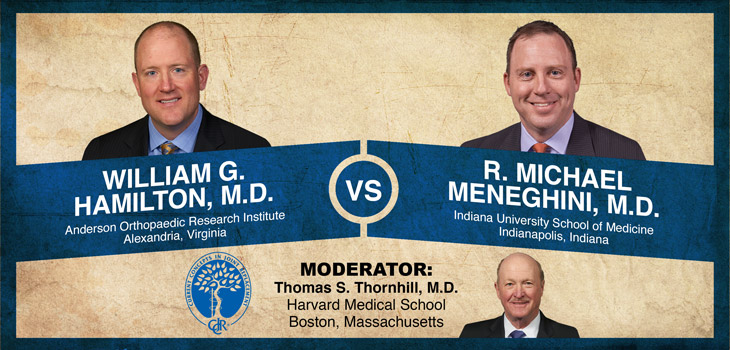
This week’s Orthopaedic Crossfire® debate was part of the 35th Annual Current Concepts in Joint Replacement® (CCJR®), Winter meeting, which took place in Orlando. This week’s topic is “The Anterior Approach: Better, Faster, Cost Effective.” For is William G. Hamilton, M.D., Anderson Orthopaedic Research Institute, Alexandria, Virginia. Opposing is R. Michael Meneghini, M.D., Indiana University School of Medicine, Indianapolis, Indiana. Moderating is Thomas S. Thornhill, M.D., Harvard Medical School, Boston, Massachusetts
Hamilton v. Meneghini: The Anterior Approach: Better, Faster, Cost Effective
10 min read Premium comments
#totalhiparthroplasty#michaelmeneghini#directanteriorapproachGreat Debates#williamhamilton
Dr. Hamilton: For those of you naysayers out there who thought that the anterior approach was a flash in the pan, a survey found that 40% of AAHKS [American Association of Hip and Knee Surgeons] members now use this as their primary approach.
Why is it so popular and so attractive?
Well, it’s intermuscular, avoids violation of the abductor, minimal detachment of the posterior stabilizing structures, low dislocation rate, and facilitates the use of fluoroscopy in the supine position. And it preserves the hip deltoid, the combination of gluteus maximus and tensor fascia lata. Maybe this is why patients seem to have a little bit better post-op functional recovery.
There is a learning curve. So, if you’re a 50-year-old surgeon and you adopt this in your practice, we know that there’s an issue with longer operative times, wound complications, increased blood loss and femur fracture.
But…newsflash…if you take on a new activity in life and you do not possess the skills set and you don’t practice, catastrophe can result.
What happens after the learning curve when you reach steady state in your practice? I participated in a study with 5,000 consecutive anterior approach total hips, I reported low rates of femur fracture and infection, and extremely low rates of dislocation (Barnett, et al., JOA, 2015).
In my fellowship they get 6 months of anterior approach training, 6 months of posterior approach training, over the last 10 years I’ve trained 40 fellows and of those 40 fellows 39 are currently using the anterior approach as their primary approach of practice. I guess there is something in the Kool-Aid.
The supine position makes using fluoroscopy quite easy. Can also help to improve implant position. When I looked at my own data, by switching from posterior approach where 21% of our cases were outliers of the safe zone, we went to 10% outliers in my first 100, 4% outliers in my second 100 (Goodman, et al., Hip International 2017). And now with the addition of this onscreen positioning software over the last 200 cases, 99% of my cases are within the safe zone in both anteversion and abduction This is relatively easy to employ and fairly cost effective.
Does it result in a better recovery? Let’s look at some of the head-to-head comparative studies. A 2015 meta-analysis that looked at 17 studies and 2,300 patients found that 9 of those reported short-term pain in functional outcomes; 4 of them favored the anterior approach and 5 really showed no difference. In secondary outcomes the anterior approach was favored in length of stay and dislocation with significant reduction of those measures (Higgins, et al., JOA 2015).
In a systematic review of 64 studies by 2 examiners, the conclusion was that there was strong evidence for faster post-op recovery and less need for assistive devices when going anteriorly (den Hertog, et al., Hip International, 2016).
What I tell patients is that, when compared to the posterior approach, the anterior approach yields either equivalent or slightly better pain scores and slightly improved short-term functional recovery. I really emphasize to the patient that the approach is not the most important thing. The most important thing is doing the surgery correctly, so I make sure the patients understand that.
What about cost advantages? Is it cheaper? In a 2016 prospective study which looked at anterior, posterior and lateral approaches, the anterior approach in-hospital costs were about $1,000 less per patient (Petis, et al., JOA, 2016).
Another study looked at Medicare claims data from 2012-2014; 1,800 patients were matched. The anterior approach patients had lower length of stay, higher percentage of discharge to home; and lower post-acute payments by 50% compared to the control (Kamath, et al., J Med Econ, 2018).
In this era of value, I think this can be quite compelling.
In summary, the anterior approach is becoming the approach of choice for total hip arthroplasty in the United States. I believe it results in lower pain and faster functional recovery. I think there is a lower dislocation rate, although you could debate that with some of the available data. I think there’s a shorter length of stay and the reduced utilization of services makes this more cost effective. About 1/3 of my patients currently are doing this on an outpatient basis.
Dr. Meneghini: The title of my talk is Direct Anterior Approach: A Grim Future in the Modern Healthcare Environment.
Is the direct anterior approach clinically better?
Probably the best study to date was done at the Mayo Clinic. Won the John Charnley Award. It showed that the direct anterior approach has marginally faster recovery at a mean of about 5 days. (Taunton, et al., CORR, 2018) I think we know that is pretty good data. No studies to date have been able to avoid the inherent bias of patients exposed to the internet and marketing when they come to the practice.
And now we have consistent reports of complications unique to the approach, both from single center, multi-center and registry studies.
Choose your complication. Posterior approach, the Achilles heel is instability. The direct anterior approach, femoral loosening and potentially femoral fracture, depending on some factors.
By the way, the direct anterior approach has also been shown to have increased wound complications in obese patients. A 13% anterior pain associated with iliopsoas impingement (Rodriquez, et al., Orthopaedic Proceedings, 2018). An 11% anterior parathesias and pain that persisted out to 6-8 years (Patton, et al., JOA, 2018). Femoral nerve palsy, which is a devasting complication, as we all know. And it’s 14x the incidence of a posterior approach surgeon (Fleischman, et al., JOA, 2018). And we know, as Bill alluded to, increased blood loss, operative time and complications during the learning curve if you happen to be on one of those.
There is no doubt that the marketing for direct anterior approach is way better. Patients are seeking it. Hospitals are seeking it. Fellowship applicants are demanding it (Shofoluwe, et al., JOA, 2018). No doubt that it wins in that day after day.
But is the direct anterior approach more efficient? There are numerous high-quality studies that demonstrate either equal or longer operative time compared to the posterior approach.
Resource consumption—you have to have a special table. Maybe you don’t have to, but most people do. You have to have staff to run the table. And at our institution, they do not let the industry reps touch the table because of liability issues, so that requires more staff. You have fluoroscopy, which requires more time and additional software and then staff to run the fluoroscopic machine.
Cost of staff and personnel, as we know in any business is a big cost.
Is it cost effective? And if it is more expensive, who bears that cost burden? The hospital? The payor? The patient?
At Indiana University Health, where I work, we pulled some of the data to look at this cost question. We looked at mean operative time. Posterior approach was 80 minutes. Direct anterior approach was 89 minutes. Not that much difference.
In-room time was about 30 minutes greater for the direct anterior approach. Set-up of the table. And our anesthesiologist uses 3x the dosages of spinal bupivacaine in those patients—because we all share the same anesthesiologists as a large group-due to the long set-up time. When you look at the mean variable direct cost, no dramatic difference.
When you tease out the 2 high volume surgeons, because I think high volume surgeons can streamline their processes, you see operative time pretty similar. Both about 68 minutes. Both of them did over 100 cases during the 6-month period where the data was collected so not surprising.
The mean in room time is where you start to see some difference. It’s that set-up time we talked about. Almost 30 minutes.
The mean variable direct cost difference, which we now look at all the time, with implants excluded, the direct anterior approach costs $1,000 more per case than the posterior approach.
There have been claims of decreased cost, and I will tell you the one publication that’s in the Journal of Medical Economics, was based on length of stay, which we know is not really related to approach. And the percentage of discharge to home, which is much more related to social issues (Kamath, et al., J Med Econ, 2018).
There were multiple fatal flaws in that publication despite propensity of matching.
The trend to outpatient…that’s something to consider…there’s no doubt that’s not going away and by 2026 they expect over half of our hip replacements to be done in the outpatient setting.
Is the direct anterior approach the optimal approach for an ambulatory surgery center (ASC)? I would say, “Is a freestanding ambulatory surgery center a place for a learning curve?”
What complications are more stressful for a smaller staff, anesthesia and the surgeons? Is it intra-operative proximal femoral or trochanteric fracture? Or excessive intra-operative blood loss?
ASCs typically have more limited staff, resources and square footage to run the table, store the table and run the fluoroscopy machines. And you don’t need any of those with the posterior approach.
The direct anterior approach is not better, it’s just different. The direct anterior approach is not more efficient. It’s not less costly. It consumes greater resources.
Every day in my office I get asked the question: “You don’t use the direct anterior approach?” And when I tell them no, they start to get angry because they’ve been on the internet and they say, “How can you not do that? That is the best approach. Don’t you read?”
I would say to the posterior approach surgeons, don’t be ashamed. You’re not a bad surgeon because you don’t do the direct anterior approach.
When all of our data is compared, I want to stand at the top—and I’m pretty competitive—and I’d like to be the cheapest, highest quality surgeon that exists.
Moderator Thornhill: Show of hands, how many people routinely in primary hips do a direct anterior approach? That’s 63. How many people do a direct posterior approach? That’s 12. (more laughter) Bill, in primary hips, when would you not do the direct anterior approach?
Dr. Hamilton: I’m basically doing this on all primary hip arthroplasty patients with the exception of a Crowe 4 dysplasia where I have to do a subtrochanteric osteotomy. Maybe if I’m taking out a screw and side plate, DHS hardware that I would need to use a different incision. These are few and far between. Basically, I do all patients through the anterior approach.
Moderator Thornhill: Mike, do you think there are any people who should have a direct anterior approach rather than a mini muscle sparing posterior approach?
Dr. Meneghini: I think you could make an argument that it might be advantageous for the hyper-mobile female. We haven’t teased that out in the literature. That might be the one case where really preserving the entire posterior structures makes sense. But again, with larger heads and good technique, I think you can do those patients very well without.
Moderator Thornhill: Interesting. I have the same cost questions that Mike did in terms of the personnel and stuff. Because at our institution length of stay is no different. The complications are more in terms of fractures and stuff like that. And these guys have at least done over 300-400. How long is the learning curve?
Dr. Hamilton: It’s not short. The first 10 to 30 are the cases you need to do to get through the extreme stress. It’s probably 200-300 until you feel real comfortable taking on all comers. And I still learn tricks today and I’m at 3,000 or more. But isn’t that life? Isn’t that hip replacement? We’re always learning tricks on how to do it. So, the learning curve never stops. But to get to the point where everything is equivalent to the posterior approach, somewhere around 100 cases or more.
Moderator Thornhill: I’d hate to be in that 100. (laughter)
Dr. Hamilton: Once again, let me emphasize that the learning curve does not exist for the residents and fellows. All the residents felt most comfortable with the anterior approach. They had little exposure to the posterior approach. The learning curve is going away as we’re training patients and residency and fellowship.
Moderator Thornhill: Do you think the anterior approach should sort of get rid of the anterolateral approach?
Dr. Hamilton: Maybe.
Moderator Thornhill: We don’t use maybe. We use “Yes” or “No.”
Dr. Hamilton: I think it’s dropping significantly.
Moderator Thornhill: Mike, we talk about dislocation. What are your usual posterior precautions in somebody you do a mini posterior approach, which I assume you do?
Dr. Meneghini: We still tell them to take it easy for 4 weeks or so. I think one of the things that this rapid recovery has pushed us to realize is that maybe some patients need to take it easy for awhile just to recover better.
I use range of motion precautions as a way to slow patients down. Have them behave for a number of weeks.
Moderator Thornhill: I do a mini posterior approach and I generally put people, depending upon their rotation with their components in, or their trial components in, on no precautions. And then they go home, and the physical therapist puts them on full posterior precautions like they did 25 years ago.
Both of these were excellent lectures. I thank you both.
Please visit www.CCJR.com to register for the 2020 CCJR Spring Meeting — May 17-20, in Las Vegas.
React:
Discussion
This is a fascinating development. In my practice we've seen similar outcomes with the revised protocol. The key differentiator seems to be patient selection criteria. Has anyone else noticed the correlation with BMI thresholds?
Great point. I'd push back slightly on the conclusion, the sample size in the cited study is too small to draw population-level inferences. That said, the directional signal is compelling and worth a larger RCT.
We implemented a similar approach last year. Early results are promising but we're still gathering 12-month follow-up data. Happy to share our protocol if anyone is interested.
Join the conversation
Orthopedic professionals are discussing this. Sign in and upgrade to read every comment and add your voice.