
The FDA’s Center for Devices and Radiological Health (CDRH) announced on January 16, 2020, that it will host a public workshop on March 5 to discuss virtual and augmented reality in medicine.
FDA Schedules Virtual Reality Workshop in March
2 min read Premium comments
Secondary#augmentedreality#orthopedictraining#virtualreality
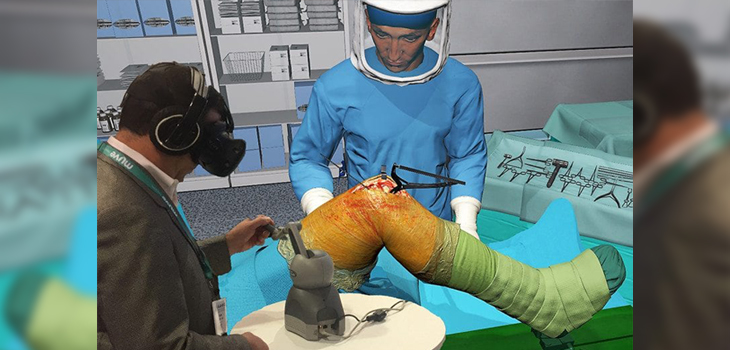
Virtual and augmented reality technologies are gaining use in such areas as surgical training and planning and providing surgeons with hands-free access to patient data during procedures.
For instance, Intuitive Surgical, won FDA clearance last year for augmented reality product IRIS. It’s designed to help surgeons before and during procedures by showing them 3D images of patient anatomy. At Medtronic, each of its divisions is reportedly experimenting with extended reality devices, for a total of more than 80 projects across the company.
Last June we reported that Vancouver, Canada-based Precision OS signed up 10 North American universities and medical institutions, including The Mayo Clinic and McGill University, to provide surgical residents with high-fidelity virtual reality orthopedic surgery training systems.
Precision OS is also collaborating with John Costouros, M.D., an orthopedic surgeon and assistant professor at Stanford University, to trial virtual reality in training soon-to-be graduating surgeons.
Just last December we reported on an Orthopaedic Crossfire® simulation training debate where Kenneth A. Gustke, M.D., of the Florida Orthopaedic Institute, Tampa, Florida, stated the advantage of simulation training “is that you’re able to learn new skills with no impact on patient care. You can practice as often as you want. You have no time pressures. You can make mistakes and you get feedback. You can also improve your performance prior to actually working on patients. These also can be adjusted for fidelity so that the skill level of the learner can be appropriate for that particular training.”
“The classic example of a simulator—a flight simulator—there’s no pilot in the world that’s flown a plane without going through a simulator first. And they have to keep retraining on simulators.”
The purpose of the public workshop, according to the FDA announcement, “is to discuss evaluation techniques for hardware, standards development, and assessment challenges for applications of Extended Reality (XR) in medicine. The goal is to identify critical gaps that may impede medical XR device development, innovation, and to advance the evaluation of medical XR devices and applications, thus accelerating the development of safe and effective medical XR devices benefiting patients and healthcare.”
The meeting will be webcasted live and the archived link will be posted on the website for viewing after the workshop. Click here to get all the information you need to see the webcast.
Registration
If you want to attend this workshop, you have to register by 4:00 p.m. on February 28, 2020. There is no fee to register for the workshop and registration will be on a first-come, first-served basis. Early registration is recommended because seating is limited.
Author
React:
Discussion
This is a fascinating development. In my practice we've seen similar outcomes with the revised protocol. The key differentiator seems to be patient selection criteria. Has anyone else noticed the correlation with BMI thresholds?
Great point. I'd push back slightly on the conclusion, the sample size in the cited study is too small to draw population-level inferences. That said, the directional signal is compelling and worth a larger RCT.
We implemented a similar approach last year. Early results are promising but we're still gathering 12-month follow-up data. Happy to share our protocol if anyone is interested.
Join the conversation
Orthopedic professionals are discussing this. Sign in and upgrade to read every comment and add your voice.