
This is clearly a sign of the times and a very cool announcement.
AAOS Grants Accreditation for Virtual Reality TKA
2 min read Premium comments
#totalkneearthroplastySecondary#surgeontraining#virtualrealitysimulation
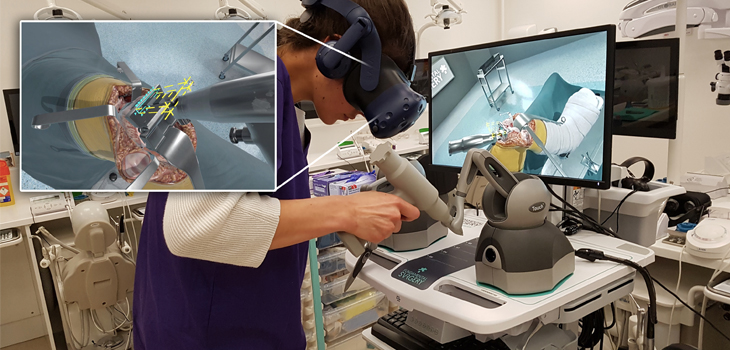
Fundamental Surgery, a developer of virtual reality simulation programs, just announced that its total knee arthroplasty (TKA) simulation program was reviewed by the American Academy of Orthopaedic Surgeons (AAOS) and then awarded accreditation status.
According to AAOS, the award “demonstrates the Academy’s commitment to innovation in medical education and will allow orthopaedic surgeons to collect CME credits while utilizing the cutting-edge haptic VR [virtual reality] platform.”
According to the press release, “With this accreditation, Fundamental Surgery’s TKA simulation is confirmed as an activity that meets the stringent criteria set by the AAOS for learning modalities that qualify for CME credits. The combination of VR and haptics, along with data around knowledge and performance analysis, allows Fundamental Surgery to provide a ‘surgical skills score.’”
“Specifically, the system and its haptics enable measurement of an orthopaedic surgeon’s ‘hands on’ knowledge through assessing correct angles, depths, attention to the surgical site and more, all producing key data points. This scoring methodology is cross referenced with AAOS’ requirements for competency. Once completing and passing the procedure, a trainee can obtain three CME credits.”
Anna Salt Troise, chief education strategist for AAOS explained that “AAOS strives to ensure that educational programs designed for orthopaedic surgeons meet the criteria of the accreditation requirements of the Accreditation Council for Continuing Medical Education [CME].”
“For the first time, we’re expanding these programs into the VR space to help our members and residents experience and navigate the same visuals, sounds and feelings they would during a real surgical procedure while obtaining CME credits. The Fundamental Surgery TKA simulation does just that by offering both an exciting training opportunity, as well as a look at how VR training is guiding the future.”
Fundamental VR Chief Learning Officer Peter Rainger provided additional details about the total knee arthroplasty VR system to OTW, “Our TKA simulation provides training in procedural knowledge covering both pre- and post-operative knowledge which is essential for developing proficiency and becoming competent in the procedure.”
“The simulation additionally provides skills training for hands-on key steps in the procedure which have been developed with key opinion leaders in surgery to establish the standard for passing the step. In line with developing definitions of competence in simulation, the trainees are required to pass the simulation at least twice before they are able to claim their CME credits.”
“As a quality assured enduring online activity our simulations fulfil the requirements of training for the award of CME credits and the scoring methodology was reviewed by the AAOS as part of their expert panel review process.”
Author
React:
Discussion
This is a fascinating development. In my practice we've seen similar outcomes with the revised protocol. The key differentiator seems to be patient selection criteria. Has anyone else noticed the correlation with BMI thresholds?
Great point. I'd push back slightly on the conclusion, the sample size in the cited study is too small to draw population-level inferences. That said, the directional signal is compelling and worth a larger RCT.
We implemented a similar approach last year. Early results are promising but we're still gathering 12-month follow-up data. Happy to share our protocol if anyone is interested.
Join the conversation
Orthopedic professionals are discussing this. Sign in and upgrade to read every comment and add your voice.