
On the basis of a recent FDA 510(k) clearance, OrthoGrid Systems, Inc., will be adding a trauma application to its PhantomMSK image distortion correction software platform.
Trauma Indication Added to OrthoGrid’s Fluoroscopic Imaging System
1 min read Premium comments
Secondary#orthogridsystems#imagingsystem
PhantomMSK Trauma was cleared after previous clearances for company’s hip replacement and hip preservation technology in February 2019.
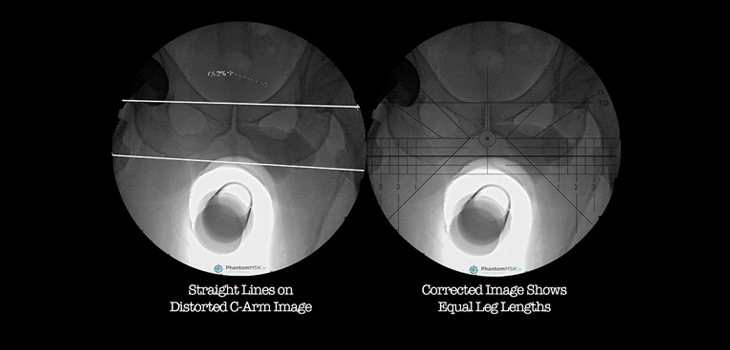
According to the FDA clearance document, PhantomMSK Trauma is a non-invasive software system that provides “image analysis tools for Orthopedic Trauma procedures that use fluoroscopic imaging to assist with implant, instrument and anatomic alignment.”
Image Distortion Correction
The company says the platform is used during surgery to support “crucial placement and alignment decisions, including correcting the phenomenon of image distortion, which can impact consistency in outcomes and patient satisfaction.” The system uses software features in conjunction with its radiopaque calibration array, which attaches to the C-arm image intensifier, to calculate and correct for fluoroscopic distortion.
“To operate PhantomMSK Trauma, a fluoroscopic image is acquired from a C-arm and displayed outside the sterile field, where the image analysis tools can be used at the surgeon’s discretion.”
The company claims the PhantomMSK is unique in that it is the “only AI-powered [artificial intelligence] intraoperative alignment technology on the market to correct image distortion, is one platform with multiple procedure applications (thus more cost effective) and, works within the existing surgical workflow and with all devices.”
The system “…does not include any custom computer hardware and is a software-based device that can be run on a ‘commercial off-the-shelf’ system (i.e. PC, keyboard, mouse, touchscreen monitor etc.) that meet minimum performance requirements.” The system also “operates on image principles that are not vendor specific.”
The device is not for primary image interpretation and the software is not for use on mobile phones.
Cofounders Edouard Saget and Richard Boddington, said “This milestone represents years of scientific research and data, product development…” and they will continue to innovate in the market.
Founded in 2012, the company is based in Salt Lake City, Utah, with research facilities in Strasbourg, France.
Author
React:
Discussion
This is a fascinating development. In my practice we've seen similar outcomes with the revised protocol. The key differentiator seems to be patient selection criteria. Has anyone else noticed the correlation with BMI thresholds?
Great point. I'd push back slightly on the conclusion, the sample size in the cited study is too small to draw population-level inferences. That said, the directional signal is compelling and worth a larger RCT.
We implemented a similar approach last year. Early results are promising but we're still gathering 12-month follow-up data. Happy to share our protocol if anyone is interested.
Join the conversation
Orthopedic professionals are discussing this. Sign in and upgrade to read every comment and add your voice.