
The House of Representatives, that is.
The System Is Sick, so Dr. Choi Made a House Call
6 min read Premium comments
#capitolhill#patientprotectionandaffordablecareact#surprisebilling
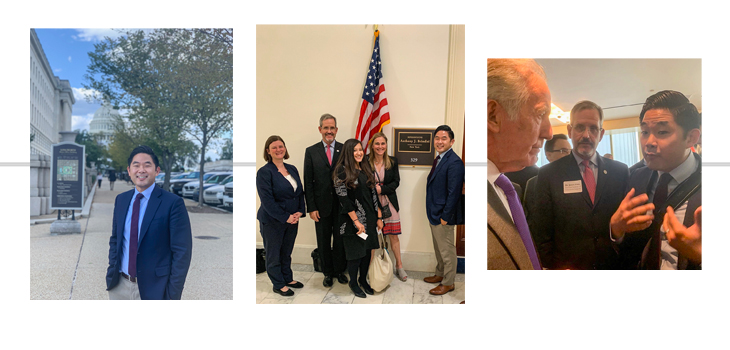
Young Daniel E. Choi, M.D., Diplomate, American Board of Orthopaedic Surgery and Chair, Young Physicians Section, Medical State Society of New York went to Washington, DC in November to do whatever he could to protect orthopedic physician’s interests in the fight over “surprise billing.”
His timing could not be more urgent.
“The system is very sick right now,” Dr. Choi explained to OTW. And, for a variety of reasons, the issue of surprise billing has become the battlefield where Dr. Choi and other physicians are pushing back on insurance company encroachment.
In addition to his other accolades, Dr. Choi is a Founding Member and sits on the Board of Directors of the Association for Healthcare Social Media (AHSM) and has created a website dedicated to this cause. This website was created “as a grassroots effort by physicians concerned about insurance companies hijacking surprise billing legislation to increase their profits.”
Dr. Choi is not alone.
Joining him are Dustin Corcoran, CEO of the California Medical Association, and Phil Schuh, Executive Vice President and CFO of the Medical Society of the State of New York and the full force of American Academy of Orthopaedic Surgeons (AAOS), led by Dr. Kristy Weber.
Dr. Choi believes that the insurance company’s proposals to address surprise billing will actually push healthcare costs higher, threaten the survival of physician practices, contribute to physician burnout, and ultimately lead to fewer available healthcare clinics for consumers.
Choi, joining with 20 doctors from various specialties, created a video about the upcoming federal surprise billing law decisions. It went viral on Twitter.
It’s a Race to Control Billing – and Patients
“Surprise billing,” as most physicians know, refers to invoices patients receive for out-of-network medical care services that they believed were covered at the time of care but, surprise! find they are not.
Surprise billing is the surprise healthcare issue in this funding cycle.
Everyone, Republicans and Democrats alike, are against it.
“Surprise billing” itself is not the battle. The fight is whether the insurance “fix” or the physician “fix” becomes law.
One compromise piece of legislation on the table is a median in-network rate, with an arbitration option for bills above a certain benchmark.
AAOS is in favor of the Independent Dispute Resolution (the arbitration option) but they maintain that this will be undermined by the median in-network rate, which is determined by insurers.
Most observers expect the fix debate to extend into 2020—if not indefinitely. Which benefits the insurance companies.
Surprise Billing is an Insurance Company Fabrication
Surprise bills happen when insurance companies choose to deny all or part of bill coverage for an unscheduled or emergency medical service provided by an out-of-network doctor, often at an in-network facility. According to Project HOPE, a global health and humanitarian relief organization, up to one in five emergency visits results in a surprise medical bill.
The Patient Protection and Affordable Care Act of 2010 (ACA) has provisions to protect against surprise billing. The ACA specifically requires insurers to pay these bills. However, insurance companies are also allowed to determine “usual and customary rates” (UCR) for out-of-network services.
It turned into a loophole.
The American Medical Association (AMA) told lawmakers at the time that leaving payment details up to insurers would lead to inflated costs. The AMA was right. As Dr. Choi and his lobbying physician colleagues make clear, the insurers have driven a truck through this ACA loophole at the expense of both patients and doctors.
The Insurer “Fix” for Surprise Billing
Private insurance companies are lobbying lawmakers to employ a “benchmark” billing process, which would give insurance companies the power to determine a fixed charge based on their determination of what an average cost for those services would be.
Dr. Choi and his colleagues, on behalf of all orthopedic physicians are advocating for arbitration to negotiate costs to consumers at no expense to the consumers themselves. Choi argues that the arbitration approach can prevent insurance companies from putting a finger on the scale of healthcare costs for the sole benefit of insurers.
In December, American Association of Orthopaedic Surgeons President Kristy L. Weber, M.D., FAAOS, released a statement saying, “The AAOS thanks Congress for its dedication to finding a solution that removes patients from the middle of medical billing disputes.”
“We appreciate that the new version of the bill includes Independent Dispute Resolution (IDR) as well as a lowered threshold for access to this critical process. These positive improvements, however, are overshadowed by the committees’ continued use of the median in-network rate—a number controlled by insurers…Even when filtered through arbitration, the use of this rate as a benchmark is tantamount to government rate-setting.”
“It will allow insurers to systematically drive down in-network rates to serve their bottom line, consequently harming patient access to care throughout the country. Furthermore, the new 90-day waiting period between disputes for the same procedure type undermines the effectiveness of the IDR process which sole purpose is to bring both sides to the table and incentivize fair, reasonable offers.”
Weber went on to communicate AAOS concerns, saying that “As Congress evaluates this proposal and considers passing legislation before the end of the year, AAOS urges it to incorporate proven solutions like the fair market IDR standard employed successfully in New York. Using an independent database outside of physician or insurer control is the only way to protect access to care while saving consumers millions of dollars and taking patients out of the middle.”
Senate Bill Supports the Insurers “Fix”
In June 2019, a Senate Bill was approved, with full backing by Health, Education, Labor and Pensions Committee Chairman Lamar Alexander (R-Tennessee.) If this bill passes, benchmarking will be used to resolve surprise bills. Out-of-network providers would be forced to accept a payment based on local median rates for similar services provider by other in-network physicians.
Physician lobbyist groups, like Doctor Patient Unity, argue that insurers are being given the ability to unethically manipulate out-of-service medical fees. The surprise billing issue exists as a byproduct of favoring insurance profits over patient well-being, so a balanced solution that does not concentrate power with the insurance companies is needed to effect lasting change. A group of orthopedic surgeons (allied with medical providers from a list of other specialties) have been calling for change that benefits patients. These groups have gone to Capitol Hill and spread the word via social media, using the hashtag #patientsbeforeprofits.
The American Medical Association and the American Hospital Association think benchmarking is a form of price fixing. Benchmarking, they say, puts control of the financial aspects of doctor patient care in the hands of private insurance companies, to the benefit of only those companies. An increasing number of lobbyists representing medical providers are opposing this bill, as there is significant concern it will decrease doctor compensation by giving insurers an advantage in negotiations.
The Physician/Patient “Fix” – The New York Model
New York was one of the first states to address surprise billing by implementing in 2015 a “baseball-style” arbitration model. It cut out-of-network billing 34% and resolved an estimated 57% of consumer complaints.
Under the so-called “baseball-style” arbitration system, any physician’s bill and insurance company coverage offers are reviewed by a third-party arbiter. That arbiter sets the healthcare costs using an independent charge database called FAIR health. Not the insurance company.
The loser in the New York process pays arbitration costs. It’s called the Independent Dispute Resolution (IDR) process.
AAOS is on the record supporting the IDR process.
Georgetown University reviewed the effects of New York’s surprise billing law, almost five years after its enactment, through interviews with state regulators, insurance companies, doctors, hospitals, consumer advocates, insurance company representatives, physicians, and expert observers. It reported that, overall, the law was “working as intended to protect consumers from a significant source of financial hardship.”
Dr. Choi’s and Dr. Weber’s Fight on Behalf of All Orthopedic Physicians
If federal law does not allow arbitration in cases of billing surprises, said Dr. Choi, it will hurt doctors, the vitality of private practices and clinics, and the number of providers available nationwide.
In addition, said Dr. Choi, surprise billing exacerbates already urgent problems of physician burnout and the increasing suicide rates among orthopedic doctors—in part due to the pressures of massive amounts of student loans, along with decreased time for patients and increased time required for electronic documentation.
“People are really just not happy practicing medicine,” said Choi. He fears that benchmarking laws could cause more and more doctors to abandon the field, limiting the availability of care for those in need.
Dr. Weber went on to communicate AAOS concerns in their December statement, saying that “As Congress evaluates this proposal and considers passing legislation before the end of the year, AAOS urges it to incorporate proven solutions like the FAIR market IDR standard employed successfully in New York. Using an independent database outside of physician or insurer control is the only way to protect access to care while saving consumers millions of dollars and taking patients out of the middle.”
Will Congress listen to the physician advocates or the insurance company lobbyists?
Let’s lend AAOS and Dr. Choi our support.
Author
React:
Discussion
This is a fascinating development. In my practice we've seen similar outcomes with the revised protocol. The key differentiator seems to be patient selection criteria. Has anyone else noticed the correlation with BMI thresholds?
Great point. I'd push back slightly on the conclusion, the sample size in the cited study is too small to draw population-level inferences. That said, the directional signal is compelling and worth a larger RCT.
We implemented a similar approach last year. Early results are promising but we're still gathering 12-month follow-up data. Happy to share our protocol if anyone is interested.
Join the conversation
Orthopedic professionals are discussing this. Sign in and upgrade to read every comment and add your voice.