
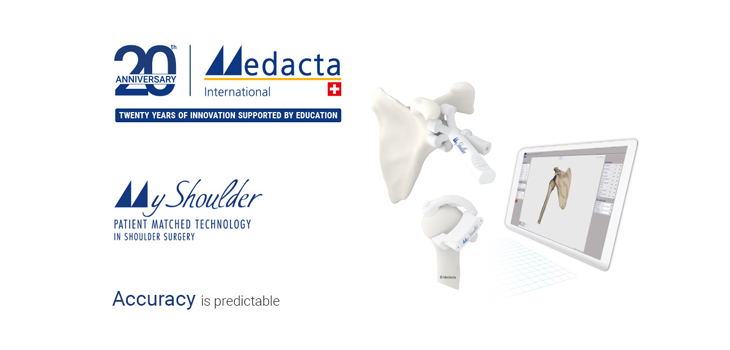
On December 13, 2019, the FDA granted 510(k) clearance to Medacta USA’s MyShoulder Placement Guides, a shoulder prothesis system with anatomical guides for a single patient anatomy.
FDA Clears 1st Patient-Specific Humeral-Glenoid Shoulder Guides
2 min read Premium comments
#fda510kclearanceSecondary#shoulderreplacement#medactausa
It took the agency almost nine month to find the device substantially equivalent to WrightTornier’s Blueprint. The clearance follows regulatory approval in Japan earlier this year.
The clearance document states the guides are patient-specific surgical instruments, “that allow for guided shoulder implants placement of both Medacta Shoulder Reverse System and Medacta Anatomic Shoulder Prosthesis and the additional products Glenoid Polyaxial Non-locking screws, Short Humeral Stem and Threaded Glenoid Baseplate.”
The device uses the patient’s CT Scan to perform a 3D planning of the glenohumeral joint replacement surgery. Then the humeral and glenoidal guides are created.
The company says this is the first patient-specific offering in the U.S. to provide both humeral and glenoid guides.
MyShoulder Placement Guides
According to the clearance document, the guides consist of the humeral guide, which is used to define the level and orientation of the humeral head resection cut, and, a glenoidal guide which is used to position and orient the K-wire that will subsequently guide the glenoidal reaming. Both anatomical and reverse total joint configurations are acceptable. Both humeral and glenoid guides are suitable for a delto-pectoral approach only.
The guides are single use, external communicating devices with limited (<24 hours) contact duration and are only provided in a non-sterile version.
Medacta Spine, Hip and Knee Offerings
The company has similar technologies for the spine, hip and knee. Company CEO Francesco Siccardi stated in a press release that the company has received “incredibly positive feedback from surgeons using our patient-matched solutions in joint and spine and are thrilled to bring this level of precision and collaboration to U.S. surgeons practicing shoulder arthroplasty as well.”
Matthew D. Saltzman, M.D., Associate Professor of Orthopaedic Surgery at the Northwestern Memorial Hospital in Chicago, Illinois, stated that working with the guides enables him “to play a key role in the surgical process from start to finish. Access to pre-operative planning and the support of a dedicated technician are key aspects of the platform and ensure the resulting guides are optimized for each procedure and patient.”
The company was established in 1999 in Switzerland.
Author
React:
Discussion
This is a fascinating development. In my practice we've seen similar outcomes with the revised protocol. The key differentiator seems to be patient selection criteria. Has anyone else noticed the correlation with BMI thresholds?
Great point. I'd push back slightly on the conclusion, the sample size in the cited study is too small to draw population-level inferences. That said, the directional signal is compelling and worth a larger RCT.
We implemented a similar approach last year. Early results are promising but we're still gathering 12-month follow-up data. Happy to share our protocol if anyone is interested.
Join the conversation
Orthopedic professionals are discussing this. Sign in and upgrade to read every comment and add your voice.