
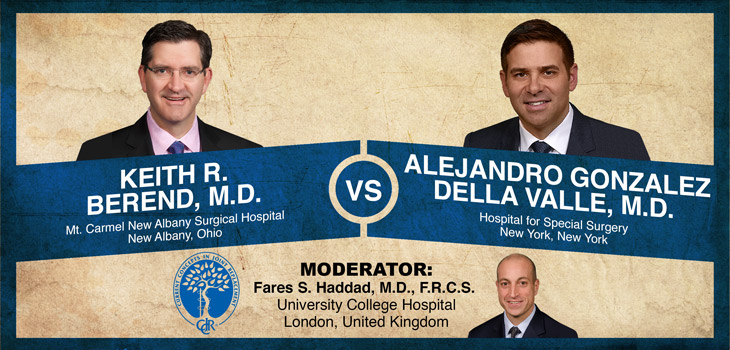
This week’s Orthopaedic Crossfire® debate was part of the 35th Annual Current Concepts in Joint Replacement® (CCJR®), Winter meeting, which took place in Orlando. This week’s topic is “Outpatient TJA Surgery: The Best Sum of All Things.” For is Keith R. Berend, M.D., Mt. Carmel New Albany Surgical Hospital, New Albany, Ohio. Opposing is Alejandro Gonzalez Della Valle, M.D., Hospital for Special Surgery, New York, New York. Moderating is Fares S. Haddad, M.D., F.R.C.S. University College Hospital, London, United Kingdom.
Berend v. Gonzalez Della Valle: Outpatient TJA Surgery: The Best Sum of All Things
9 min read Premium comments
Great Debates#alejandrogonzalezdellavalle#keithberend#outpatienttotaljointarthroplastysurgery
Dr. Berend: The best sum of all things is really illustrated by my partner’s, Dr. Lombardi, experience. The length of stay in his practice starting in 1986 through roughly the teens of the 2000s gradually declined from over a week to where the majority, if not ALL patients, are simply staying overnight.
The fact is that we didn’t just decide to wake up Monday morning and send patients home the same day. We were looking at efficiencies. We were looking at safety. We were looking at protocols.
When we started looking at outpatient surgery, we really boiled it down to the three barriers: fear/anxiety; risk; and the side effects of our treatment.
I will predict that my opponent in this conversation is going to talk mostly about risks, side effects/complications. I’m a simple country bone doctor and I think what risk really boils down to is exposure to danger. What we need to do is mitigate that danger.
How do we do that? We don’t have a complex algorithm, we don’t have an app on the phone, we don’t have 45,000 different variables. It boils down to this question: does the patient have an ongoing medical issue that cannot be optimized? If they do then they shouldn’t have surgery at all, let alone outpatient surgery.
If the patient does not have any ongoing medical issues, then do they have organ failure? Yes? Then the patient is not a candidate for outpatient surgery.
If the patient does not have organ failure, then do they have adequate support at home to be safe at home after discharge? No? Then they probably need the support of a hospital system.
But if you answer, “Yes,” then the surgery can safely be performed as an outpatient procedure.
How simple is that?
No need to figure out whether they have this ASA score or that ASA score. We do need to consider the patient’s co-pays, their deductibles, things like that…because we don’t want to penalize the patient for having outpatient surgery.
We started our outpatient program conservatively. We used a “Go, no go” checklist. Now, after 5 years, we’ve eliminated things like prior revascularization, arrhythmia and pacemakers, BMI [body mass index] of over 40, if they’re on chronic coumadin, history of ileus and history of urinary retention.
The issue we continue to use on our “Go, no go” checklist is hemoglobin less than 13. That is a predictor of needing a transfusion, which is very difficult to do at a freestanding ambulatory surgery center.
Once again…no organ failure, hemoglobin greater than 13, good support at home, you’re having an outpatient joint replacement.
It is the best sum of all things. Outpatient surgery reduces healthcare cost, increases control of care, increases patient satisfaction and surgeon satisfaction. Everyone wins and it the best sum of all things.
At our outpatient surgery center, in a little over 4 years, the 5 of us have performed 6,000 outpatient hip and knee procedures. Evenly split female and male. Age range between 18 and 90. Some are partial knee replacements, but my oldest patient was a hip replacement.
The BMI ranges from very thin (16), to not very thin with a BMI of 66. BMI is not a contraindication.
These are not healthy patients. These are optimized patients without organ failure. Almost half of them—44%—had at least 1 major co-morbidity. Of those 94% were able to be discharged to their home the same day; 6% stayed overnight. About half of those, or 3.8%, stayed for a medical reason that needed to be managed overnight in our facility. Nineteen, or 0.3%, required transfer to an acute care hospital at the time of their surgery. And if you include those 19 and any complication that required unforeseen care within 48 hours, the rate was 1%. If you look at unplanned care, including all of those, it was 137 patients or 2.3%.
That is one-quarter of the rate that’s reported and that you will hear next from my colleague who is going to talk about opposing outpatient surgery.
By optimizing patients—call it cherry picking; call it skimming the cream—who cares? The rate of complication is one-quarter that of doing this within a healthcare system.
The post-op phone calls…are we just pushing the patient’s care out? Well, we’re not. We saw a statistically significant reduction in post-op phone calls to my clinic from outpatient patients versus patients who received care at the specialty hospital.
Are patients dissatisfied with this? No, they’re not. The rate of patients giving good to excellent is 98%, with zero patients saying they felt like they were pushed out of the surgery center too soon.
Yes, it is the best sum of all things.
In our experience, 2.3% 90-day readmission or complication rate, literally a quarter of what’s reported in the Medicare database; 98% good to excellent satisfaction on behalf of the patient and I guarantee you 100% satisfaction on the part of the surgeon.
Dr. Gonzalez Della Valle: There’s no question that patient joint replacement can be done in an outpatient setting. The question is can Keith’s experience be extrapolated to other patient populations, urban or rural settings, or institutions with different practicing conditions—and do so without increasing the perioperative risks like readmission, local and general complications, but predominately life threatening ones and perioperative mortality.
The last 2 are very difficult to eliminate.
We will review these, their timing, who suffers them and the implications when patients sustain these complications outside the hospital. The majority of patients who die after a joint replacement do so of a heart attack, a pulmonary embolism, or a stroke.
A recent nationwide study demonstrated that time has to pass for the complications to happen—somewhere between 2 and 3 days. You have to wait 5 days to capture 75% of them (Gonzalez Della Valle A, et al., JBJS-BR, 2012; Bohl, HL, et al., CORR, 2017).
This nationwide data mimics that reported by Jay Parvizi in his own institution back in 2007 (Parvizi, J, et al., JBJS, 2007). What is most telling about this paper is that 58% of patients have those life threatening complications and had no identifiable preoperative predisposing factors. The steepest portion of a perioperative mortality curve occurs during the first 7 days (Jones, M, et al., JOA, 2014).
Hence, as Dr. Berend highlighted, they need to risk stratify patients to diminish mortality, which in my view, excludes a large proportion of total joint replacement candidates.
What’s not said are a number of underdiagnosed conditions we don’t routinely test for like coronary artery disease, genetic predispositions for thromboembolism and other sub-clinical conditions that can increase perioperative morbidity. In addition, anemia and progressive organ dysfunction can develop sometimes after the first 23 postoperative hours (Memtsoudis, S, Anesthesiology, 2009).
If you suffer a cardiac arrest out of the hospital in the U.S. the likelihood of surviving is only 10%. If a cardiac arrest occurs in the hospital, the survival rate is 25%. The feasibility of outpatient total joint replacement depends on a number of factors including current length of stay; your population’s general health, living conditions; availability of proficient visiting nurse services and the number of quality metrics of your emergency medical services.
With pulmonary embolism, which can have symptoms that linger, but are mild over a course of a few days, patients will present with over 3 days of the onset of symptoms, have worse right ventricle dysfunction and 4.3 times higher mortality rate (Yaser, J, et al., J Emerg Med, 2014).
With stroke, particularly ischemic of large vessels, there are only 7.3 hours from the onset of symptoms to the catherization suite if endovascular thrombectomy is needed for the patient to be less disabled (Saver, JL, et al., JAMA, 2016). Postoperative stroke has a 25% 1-year mortality rate (Mortazavi, J, JBJS, 2010).
I would finish by asking you to exercise caution in creating very high expectations for patients and payers. At the end of the day, hip and knee replacements are not minor surgeries.
The term “ambulatory” may give some patients a false sense of safety and may give our government and payers the impression that the time we spend caring for ambulatory total joint replacement patients is less than when they are needed for a couple of days, which is not necessarily true.
Moderator Haddad: Keith, let’s first go to you. Is your clinic’s experience really translatable? Do you have a unique population in your area or do the patients self-select?
Dr. Berend: You’ve been to Ohio. We are in a big city. Our drawing area is roughly the majority of Ohio, which is relatively rural. I don’t think that it’s unique. I think that Midwest versus, perhaps, East Coast/West Coast, there may be some differences. The guys at NYU Langone are doing outpatient hip replacement there and doing a good job of it. I think it is translatable.
Country to country—what Alejandro said is very important. If your length of stay is multiple days right now, you will not be able to do safe ambulatory surgery Monday morning. If your length of stay has been going down and you’ve been working on rapid recovery, and you’ve been working on efficient care and things like that, it’s incredibly safe.
In order to capture all these in-hospital mortality/morbidity things you’d have to keep patients 5 days. First of all, no way in our health system can we afford to do that. Second, it’s just not fair to any of the stakeholders.
I think outpatient is very safe although it does require optimization of their health status. The things that you mentioned, like coronary artery disease, VTE, are all important.
Moderator Haddad: Alejandro, is there a signal on day 1 that tells you that this is a problem that’s going to happen day 3, day 4? Because you’re suggesting it’s going to happen in the perioperative period, but I know no one is keeping patients 5, 6 days. That’s just not realistic.
Dr. Gonzalez Della Valle: No question, there is a role for ambulatory surgery. But can it be used for the majority of patients? I reflect upon things that have happened to me in my own practice. I remember a patient undergoing medial uni-compartmental knee replacement that I kept overnight in the hospital and on the first night he developed a massive pulmonary embolism and needs to be immediately transferred to the intensive care unit to be able to make it out alive.
My concern is that at some point we will have a few healthy patients that will suffer these severe complications at home unexpectedly and if they have a negative outcome, it can give a negative impression of ambulatory surgery.
Moderator Haddad: One thing I see here as you shift all these young, fit, heathier patients to the surgery centers, the base hospital where you’ve traditionally based your practice, presumably get the less fit, less healthy, more expensive, more difficult patients. How are they going to survive?
Dr. Gonzalez Della Valle: That’s a very valid point. Inpatient hospitals are getting the sicker patients, patients who are generally Medicare and, obviously, lower reimbursement. Keep in mind also, if a hospital doesn’t own an outpatient medical center…you can be in serious financial trouble because the volume overall drops and it forces them to take the sicker patients.
Dr. Berend: I agree with you completely and we’ve seen that in our environment where we have a close relationship with a hospital. That’s exactly what happens. I’m actually okay with that. But the one thing I would say is when we’re in network with 98% of our commercial insurers, we provide a much better value for them than they do at the hospital. So, we’re able to negotiate a better value for the commercial payers and the patients than the hospital system is on a nationwide basis by working locally within in our systems.
Moderator Haddad: Great presentation gentlemen. A topic which will continue to lead to debate.
Please visit www.CCJR.com to register for the 2020 CCJR Spring Meeting — May 17-20, in Las Vegas.
Author
React:
Discussion
This is a fascinating development. In my practice we've seen similar outcomes with the revised protocol. The key differentiator seems to be patient selection criteria. Has anyone else noticed the correlation with BMI thresholds?
Great point. I'd push back slightly on the conclusion, the sample size in the cited study is too small to draw population-level inferences. That said, the directional signal is compelling and worth a larger RCT.
We implemented a similar approach last year. Early results are promising but we're still gathering 12-month follow-up data. Happy to share our protocol if anyone is interested.
Join the conversation
Orthopedic professionals are discussing this. Sign in and upgrade to read every comment and add your voice.