
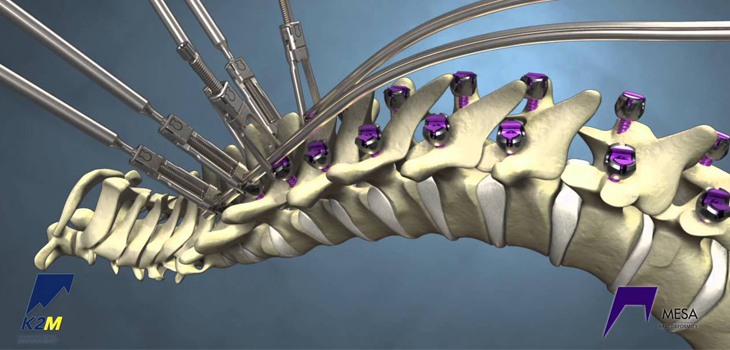
A team of researchers set out to compare complication rates and correction maintenance at the two-year mark following posterior spinal fusion with or without cross-links in individuals with cerebral palsy and scoliosis.
Scoliosis in CP Patients: New Study Examines Implant Hardware
1 min read Premium comments
Secondary#cerebralpalsy#scoliosis
In this retrospective review of a multicenter, prospective database, the authors wrote, “Cross-links are frequently used in posterior spinal fusion to correct scoliosis in patients with cerebral palsy because they are thought to increase the stiffness and torsional rigidity of the construct.”
Their study, The Role of Cross-Links in Posterior Spinal Fusion for Cerebral Palsy–Related Scoliosis,” appears in the November 1, 2019 edition of Spine.
Co-author Paul Sponseller M.D., M.B.A., chief of the Division of Pediatric Orthopaedics at Johns Hopkins in Baltimore explained the genesis of this study to OTW, “We noticed that cross-links added extra bulk to the instrumentation and added expense. We also had the clinical impression that it didn’t seem to be adding much benefit—so we decided to study it formally.”
The authors described their study’s methodology saying, “We reviewed the records of patients with cerebral palsy who underwent primary posterior spinal fusion with or without cross-links between August 2008 and April 2015.”
For the study, patients were followed for a minimum of two years and the research team collected complications data (implant failure, surgical site infection, revision) and pre- and postoperative measurements of the major curve (measured using the Cobb method).
The team enrolled 256 with a mean age of 14.1 ± 2.7 years. Ninety-four patients had cross-links (57% using one cross-link; 43% using two cross-links) and 162 patients did not have cross-links.
Dr. Sponseller summarized the study’s conclusions to OTW, “In this setting of children with cerebral palsy having long fusions, the cross-link did not add any benefit in maintaining curve correction. Surgeons can feel free to omit cross-links as long as they are confident in the strength of their anchors.”
Author
React:
Discussion
This is a fascinating development. In my practice we've seen similar outcomes with the revised protocol. The key differentiator seems to be patient selection criteria. Has anyone else noticed the correlation with BMI thresholds?
Great point. I'd push back slightly on the conclusion, the sample size in the cited study is too small to draw population-level inferences. That said, the directional signal is compelling and worth a larger RCT.
We implemented a similar approach last year. Early results are promising but we're still gathering 12-month follow-up data. Happy to share our protocol if anyone is interested.
Join the conversation
Orthopedic professionals are discussing this. Sign in and upgrade to read every comment and add your voice.