
NuVasive, Inc.’s CoRoent Small Interlock system can now be used for “multiple contiguous levels from C2-T1 for anterior cervical discectomy and fusion (ACDF) procedures,” after receiving 510(k) clearance from the FDA on November 13, 2019.
NuVasive CoRoent Cleared for Multiple Contiguous Cervical Levels
1 min read Premium comments
#nuvasive#fdaSecondary#neckpain#clearance
The FDA previous cleared the system in September 2016 for only one level.
The company stated in a November 21, 2019 press release that the new indication differentiates the system “compared to other systems on the market cleared for only one- or two-level use.” It took the agency a little less than two months to grant the clearance.
The system, according to company and FDA documents, is an anterior cervical interbody fusion system “indicated for use in adult patients with cervical disc degeneration and/or cervical spinal instability.”
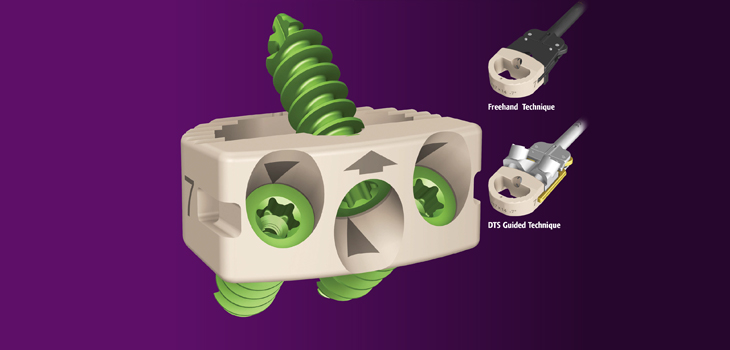
The system is a “no-profile interfixated device that is implanted entirely within the confines of the vertebral disc space and features a zero-step locking mechanism, a large fusion aperture, angled instrumentation for implantation in difficult anatomical locations and a three-screw implant design allowing for versatile interbody placement.”
The original clearance states the system consists of a PEEK (polyetheretherketone) implant cage with titanium alloy and tantalum radiographic markers, titanium alloy washers, and three titanium alloy bone fixation screws. The devices are manufactured from PEEK-Optima LT-1.
Leonel Hunt, M.D., an orthopedic spine surgeon at Hunt Spine in Los Angeles, California, said a zero-profile interbody implant that can be used in more than two contiguous levels, enables the surgeon “to avoid supplemental fixation which can ultimately reduce operative time.”
Company President Matt Link said, “This first-of-its-kind clearance reflects NuVasive’s efforts to further penetrate the cervical market and deliver solutions that address a broader range of spine care.”
Author
React:
Discussion
This is a fascinating development. In my practice we've seen similar outcomes with the revised protocol. The key differentiator seems to be patient selection criteria. Has anyone else noticed the correlation with BMI thresholds?
Great point. I'd push back slightly on the conclusion, the sample size in the cited study is too small to draw population-level inferences. That said, the directional signal is compelling and worth a larger RCT.
We implemented a similar approach last year. Early results are promising but we're still gathering 12-month follow-up data. Happy to share our protocol if anyone is interested.
Join the conversation
Orthopedic professionals are discussing this. Sign in and upgrade to read every comment and add your voice.