
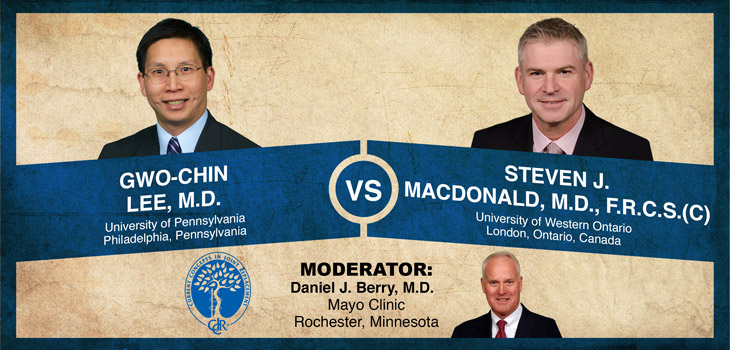
This week’s Orthopaedic Crossfire® debate was part of the 19th Annual Current Concepts in Joint Replacement® (CCJR®), Spring meeting, which took place in Las Vegas. This week’s topic is “Ceramic-Ceramic: Articulations of Longevity for the Young Active Patient.” For is Gwo-Chin Lee, M.D. – University of Pennsylvania, Philadelphia, Pennsylvania. Opposing is Steven J. MacDonald, M.D., F.R.C.S.(C) – University of Western Ontario, London, Ontario, Canada. Moderating is Daniel J. Berry, M.D. – Mayo Clinic, Rochester, Minnesota.
Lee v. MacDonald: Ceramic-Ceramic: Pricey Longevity for the Young Active Patient?
9 min read Premium comments
#gwochinleeGreat Debates#danielberry#ceramicceramic#longevity#stevenmacdonald
Dr. Lee: I recommend and will discuss the use of ceramic-on-ceramic in patients if they are under the age of 55. I believe ceramic-on-ceramic properties are optimized for larger heads in active patient populations.
A fear of instability and dislocations has driven the use of larger heads. Data from the American Joint Replacement Registry (AJRR Annual Report-2014) shows that the 36mm ball heads have been used in greater than 50% of the patients undergoing total hip arthroplasty. And that number has since increased.
Patients under age 55 are at significantly greater risk of revision—because of wear and osteolysis—as shown on the Australian Registry (AOANJRR Annual Report 2017)—with a revision rate of about 10% at 16 years.
The data on crosslinked polyethylene is great, but only if you use 28 and 32mm ball heads. And that’s not really what’s going in young patients in 2018. Instead many receive 50mm, 52mm, 54mm cups.
And there’s data that supports that the use of large heads and thin poly can potentially exceed the 0.1mm per year osteolysis threshold (Selvarajah, et al., Bone Joint J, 2015).
Crosslinked polyethylene wears over time (Snir, et al, JOA, 2014). The concern is volumetric wear, which accelerates in large head sizes (Lachiewicz, et al., Clin Orthop Relat Res, 2016). Small osteolytic lesions are visible at 10 to 12 years.
The question really is; can these bearings last 20, 30, even 40 years in a young patient?
The Australian Registry, albeit non-crosslinked polyethylene, shows a higher revision rate in patients with heads larger than 32mm.
Younger (under 55) female revision rates are highest probably because they receive thinner poly, larger heads and smaller shaped cups.
You may see information from my opponent which shows that ceramic-on-polyethylene, or even metal-on-crosslinked polyethylene implants have lower revision rates compared to ceramic-on-ceramic.
But if you delve into the data, ceramic-on-ceramic patients actually have a 7.3% revision rate which is lower than the cumulative 10% for that patient population—and these are young patients, not all comers.
We all agree that wear characteristics are important (Sentuerk, et al., Bone Joint J, 2016). Ceramic-on-ceramic wear characteristics are actually optimized with the use of large heads. Fracture rates decrease and lubrication rises as head size increases.
Ceramic-on-ceramic total hip clinical results have been excellent worldwide. Excellent survivorship in the very young patient (Kim, et al., JBJS, 2012).
If the question is whether ceramic-on-ceramic will outperform conventional bearings at 10 years (Beaupre, et al., JOA, 2016), I think I’ll lose that argument every single time, but this is not the debate. Patients who are 55 or under expect their hips to last more than 20-30 years.
But even in studies that show no significant difference in revision rates comparing ceramic-on-crosslinked polyethylene and ceramic-on-ceramic bearing surfaces, a different mode of failure in ceramic-on-ceramic total hip arthroplasties is reported (Epinette, et al., JOA, 2014). Ceramic-on-ceramic simply does not wear or loosen compared to conventional bearings.
A recent randomized trial showed no revisions for polyethylene wear and osteolysis in ceramic-on-ceramic patients at 15 years (Atrey, et al., JOA, 2017).
Even in patients with very small heads—28mm heads on highly crosslinked polyethylene—have higher rates of osteolysis compared to ceramic-on-ceramic articulations (Higuchi Y, et al., JOA, 2016).
Meta-analysis of the results out there in the literature shows that if you use longevity and durability as a potential endpoint, ceramic-on-ceramic wins this argument every single time (Hu, et al., J Orthop Surg Res, 2015).
So, why not in everybody? In my opinion it’s probably the risk of squeaking and cost. Head fractures are rare. Liner chips and fractures during insertion are a problem, but better instrumentation is coming online (Lee, et al., JOA, 2016). If you look at squeaking, if you basically exclude certain manufacturer’s designs the overall rate of squeaking is actually relatively low and certainly even lower revisions for overall squeaking (Owen, et al., Bone Joint J, 2014).
If you want to do conventional bearings on highly crosslinked polyethylene, use 28mm ball heads. That is supported by the literature (Garvin, et al., Clin Orthop Relat Res, 2014). If you’re going to use larger ball heads, you should consider ceramic-on-ceramic.
In the United States we haven’t really adopted the use of ceramic-on-ceramic, maybe because of the reasons mentioned previously (Heckmann, et al., JOA, 2018). But in countries like Korea where they treat a lot of young patients (Yoon, et al., Clin in Orthop Surg, 2016) with avascular necrosis, the use of ceramic-on-ceramics is actually almost 80% of total hips.
In summary, in a young and active patient where a ball head greater than 32mm on thin polyethylene is planned, ceramic-on-ceramic is the best guarantee against wear and osteolysis.
Dr. MacDonald: I will actually agree and concede that it is your articulation of choice for the young patient…IF you want a bearing with higher failure rates, a substantial price premium and unique and unresolved complications.
Let’s face it. There is no perfect bearing, and I think we all agree with that. I believe, however, that the best choice for the young patient is a ceramic head on a highly crosslinked polyethylene insert.
Regarding longevity, we need to look at large numbers and that’s the beauty of registry data.
The Australian Registry captured data for more than 300,000 total hips. And the data is presented in a very easy and reproducible manner. The 15-year cumulative revision rate – all comers to begin with. What’s the best performing bearing? It’s ceramic-on-highly crosslinked polyethylene with a 5.1%, 15-year cumulative revision rate.
What do you think is second? That’s actually cobalt chrome-on-highly crosslinked polyethylene with 1 percentage point more, 6.3%. And then coming in third is ceramic-on-ceramic. So, that’s all comers. That’s 7.2%. We could debate whether that’s relevant or not. But I think once you get 2-3% it becomes relevant.
Ceramic-on-ceramic is definitely NOT the bearing of choice if you plan on living 15 years or more. Ceramic-on-highly crosslinked polyethylene is. That’s the Australian Registry.
In the New Zealand Joint Registry recently published data—106,139 primary hips. What’s their conclusion? Ceramic-on-highly crosslinked polyethylene couples have the lowest all cause revision rate. And ceramic-on-highly crosslinked polyethylene was the most durable and successful coupling used in primary hip, irrespective of age, gender, and head size (Sharplin, et al., Hip Int, 2018).
When we’re saying ceramic, of course, we’re talking about the Delta ceramic. When you look at relative cost…and it is institutional…so, rather than putting a price we can give a percentage—on average ceramic-on-ceramic is a significant price bump at about a 120% price premium.
Ceramic-on-ceramic also has unique complications. Squeaking. It is a serious complication that negatively affects patient outcomes. Let me take you through some papers on this.
The first one looked at 140 ceramic-on-ceramics; 30% of which—and this is current generation implants—30% were aware of the noise production, and they had lower satisfaction, lower Harris Hip Scores and lower SF-12 scores. (Gillespie, et al., J Orthop, 2016).
A 5-center study of young total hips, cobalt chrome reported increased instances of grinding, popping and clicking. Noise generation was associated with increased pain and stiffness (Nam, et al., Clin Orthop Relat Res, 2016).
Lastly, 336 ceramic-on-ceramic heads, 17% incidence of noise. This is not a rare, rare outcome at all (Salo, et al., JBJS, 2017). And again, lower outcome scores for these patients.
What about ceramic fractures?
A paper from the UK National Joint Registry, over 100,000 primary ceramic-on-ceramic total hips Howard, et al., Bone Joint J, 2017). The head fracture rate is 1 in 11,000, but the liner is 1 in 893. That’s a frequent complication.
They conclude in this article from last year from the Registry, “Previous studies have underestimated the risk of fracture…and Delta ceramic has greatly reduced the risk of head, but not liner fracture.” And that’s not even counting the insertional chipping that’s occurring that is dealt with in the operating room. And certain designs are hard to engage the taper.
So my friend, you got it half right. Ceramic-on-highly crosslinked polyethylene is a bearing for young patients. Adding a ceramic liner increases your failure rate; increases the cost, noise, other complications; decreases satisfaction and decreases outcome. That is what the data in 2018 is telling us.
Moderator Berry: Would both of you agree that the biggest problems with the ceramic-ceramic bearing remain a risk of fracture of the liner, probably usually due to impingement or mal-seating, and risk of squeak?
Dr. Lee: Yes, I would. Fracture of the liner is probably mal-seating and occurs at surgery.
Moderator Berry: Mal-seating or impingement due to mal-positioning of the cup?
Dr. Lee: Yes.
Moderator Berry: Steve, would you agree with those 2 points?
Dr. MacDonald: I agree those are 2 drivers. I think cost, honestly, is a pretty significant driver.
Moderator Berry: I’m just talking about failure reasons, not drivers of use. There’s agreement on that. Secondly, what are the potential benefits of ceramic-on-ceramic? Gwo has shown that ceramic-on-ceramic is not, right now, beating ceramic-on-crosslinked polyethylene in most registries at 15 years. Do you agree with that point? Do you want to rearticulate your argument?
Dr. Lee: I would agree in part with those statements. I don’t agree that at 15 years ceramic-on-polyethylene is beating ceramic-on-ceramic. The Australian Registry for patients under 55, at 16 years the cumulative revision rate is actually 10%, whereas for that population ceramic-on-ceramic it is only 7.7%.
Moderator Berry: Steve, is the data you presented slightly biased by having all comers rather than looking at a very young population?
Dr. MacDonald: It could be. Really, whether the patient is 65 or 40, you’re still 15 years out. So, we could debate that back and forth. As the registries get longer out, we have more patients, we’ll be able to make better conclusions.
Moderator Berry: Steve, what’s going to happen in 20, 30, 40 years for the really ultra-young patient. Do you feel that you have confidence that crosslinked polyethylene is going to keep performing well out to that length of time? Or do you think that eventually you’re going to see the curves cross over?
Dr. MacDonald: Well, if you look at the behavior of polyethylene, you get a linear wear over time and cumulative and that’s a burden. We’re not seeing that with highly crosslinked polyethylene. It’s not like at 15 years we’re now seeing a 10% or 15% wear or lysis, so we’re really sort of still at ground zero at 15 years. We’d have to have a very strange behavior to all of a sudden start falling apart at 20-25 years.
Moderator Berry: Before we close, let’s go back to this question about squeaking. So, Gwo has this problem gone away or is it still there and we just don’t want to talk about it?
Dr. Lee: It’s not gone away. It’s something I discuss with my patients when I offer a ceramic-on-ceramic bearing. I tell them that I have no idea what causes it. They have to weigh the potential for squeaking against the potential for excellent durable and longevity.
Moderator Berry: Steve, can I just come back with a quick closing question. If you knew that it would never impinge and was perfectly positioned would you think that ceramic-on-ceramic would outperform crosslinked polyethylene?
Dr. MacDonald: In my heart of hearts I don’t believe that. A number of papers have looked at squeaking and cup position and they’re not predictive. Even if we know the target, we’re not eliminating the complication.
Moderator Berry: Ladies and gentlemen, please join me in thanking the two speakers for an excellent session.
Please visit www.CCJR.com to register for the 2019 CCJR Winter Meeting, – December 11 – 14 in Orlando.
React:
Discussion
This is a fascinating development. In my practice we've seen similar outcomes with the revised protocol. The key differentiator seems to be patient selection criteria. Has anyone else noticed the correlation with BMI thresholds?
Great point. I'd push back slightly on the conclusion, the sample size in the cited study is too small to draw population-level inferences. That said, the directional signal is compelling and worth a larger RCT.
We implemented a similar approach last year. Early results are promising but we're still gathering 12-month follow-up data. Happy to share our protocol if anyone is interested.
Join the conversation
Orthopedic professionals are discussing this. Sign in and upgrade to read every comment and add your voice.