
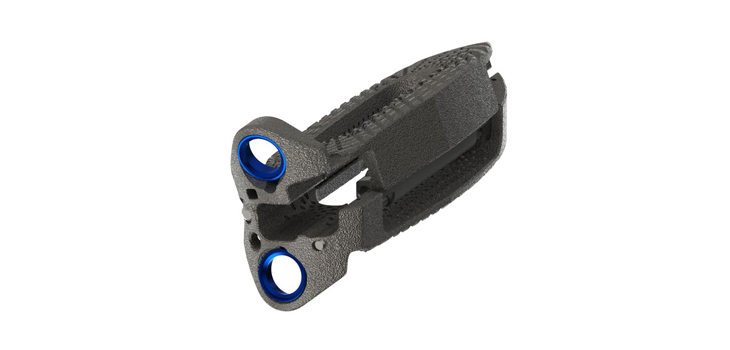
Stryker Corporation has received 510(k) clearance for its Sahara Lateral 3D Expandable Interbody System featuring Lamellar 3D Titanium Technology. The system came to Stryker with its acquisition of K2M, Inc.
FDA Clears Stryker 3D Expandable Interbody System
2 min read Premium comments
#510clearance#strykerSecondary#spinefusion
First Ever 3D-Printed Lateral Expandable Device
In a November 1, 2019 press release, the company stated the device is the “first ever 3D-printed lateral expandable fusion device and features passive expansion capabilities that are designed to allow surgeons to achieve up to 30 degrees of sagittal spinal correction in skeletally mature patients.”
The implant, according to the company, utilizes a passive expansion mechanism. “The implant can either be adjusted from a lateral approach intraoperatively or can adjust passively in a staged posterior approach following osteotomy.”
According to the October 3, 2019 FDA clearance document, Sahara implants are indicated “for use with autograft and/or allogenic bone graft comprised of cancellous and/or corticancellous bone graft when used as an adjunct to fusion in patients with degenerative disc disease at one level or two contiguous levels from L2 to S1.”
“The implants can also be used as an adjunct to fusion in patients diagnosed with degenerative scoliosis.”
“Hyperlordotic and Lateral implants must be used with supplemental fixation cleared for use in the lumbar spine, in addition to the provided bone screws.”
The company added that the Sahara Lateral “complements the Sahara Anterior Lumbar Expandable Stabilization System, a lordotic expandable device with integrated screw fixation.” The device is available in a variety of footprints, heights and lordotic offerings “designed to more precisely match a patient’s anatomy.”
Lamellar 3D Titanium
Lamellar 3D Titanium Technology uses a 3D printing method that starts with a titanium powder. The implants are grown through the selective application of a high-energy laser beam, incorporating complex internal geometries and a roughened surface architecture. Roughened titanium surfaces, according to the company, have been shown to demonstrate increased protein expression in contrast to smooth titanium surfaces.
Eric Major, K2M’s co-founder and current President of Stryker’s Spine Division, said the Sahara Lateral “provides surgeons and hospital systems with a 3D-printed solution for complex posterior correction maneuvers, all while reinforcing our commitment to excellence in medical innovation and improving quality of life for people with spinal deformities.”
Author
React:
Discussion
This is a fascinating development. In my practice we've seen similar outcomes with the revised protocol. The key differentiator seems to be patient selection criteria. Has anyone else noticed the correlation with BMI thresholds?
Great point. I'd push back slightly on the conclusion, the sample size in the cited study is too small to draw population-level inferences. That said, the directional signal is compelling and worth a larger RCT.
We implemented a similar approach last year. Early results are promising but we're still gathering 12-month follow-up data. Happy to share our protocol if anyone is interested.
Join the conversation
Orthopedic professionals are discussing this. Sign in and upgrade to read every comment and add your voice.