
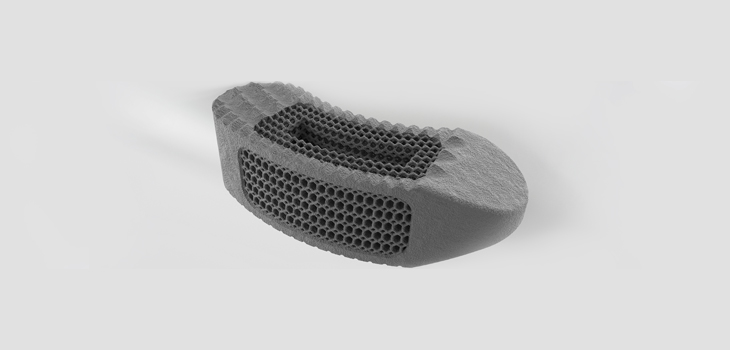
Warsaw, Indiana-based Zimmer Biomet, a global leader in musculoskeletal healthcare, has launched the TrellOss-TC—Transforaminal Lumbar Interbody Fusion—(TLIF) Porous Titanium Interbody Platform.
Zimmer Biomet Launches TrellOss-TC TLIF Platform
1 min read Premium comments
#zimmerbiometSecondary#poroustitaniuminterbody#trelloss
TrellOss-TC, along with TrellOss-C (cervical) and TrellOss-TS (TLIF straight) that were launched in August 2019, marks Zimmer Biomet Spine’s first porous titanium implant platform manufactured through a 3D printing, additive manufacturing process. The company plans to extend the TrellOss platform with a series of lateral, anterior and stand-alone devices in 2020.
“We are very excited to announce the launch of the TrellOss Platform,” commented Jim Cloar, president of Zimmer Biomet Spine. “3D printing allows us to create a 7-micron surface roughness over the entire implant rather than on the endplates alone. Combined with varying pore sizes of 300, 500 and 700 microns, this surface technology creates an amicable environment for bone ingrowth.”
Jay Eaton, senior product manager, Posterior Interbody Solutions at Zimmer Biomet Spine, told OTW, “We chose pore sizes similar to that of bone (300, 500 and 700 microns) and that the various pores provide additional surface area on the implant. The 7-micron surface texturing creates an environment for potential cellular adhesion. We chose this implant design because of its combination of structured porosity and cellular relative surface texturing; this combination truly makes it a new foundation for growth.”
Author
React:
Discussion
This is a fascinating development. In my practice we've seen similar outcomes with the revised protocol. The key differentiator seems to be patient selection criteria. Has anyone else noticed the correlation with BMI thresholds?
Great point. I'd push back slightly on the conclusion, the sample size in the cited study is too small to draw population-level inferences. That said, the directional signal is compelling and worth a larger RCT.
We implemented a similar approach last year. Early results are promising but we're still gathering 12-month follow-up data. Happy to share our protocol if anyone is interested.
Join the conversation
Orthopedic professionals are discussing this. Sign in and upgrade to read every comment and add your voice.