
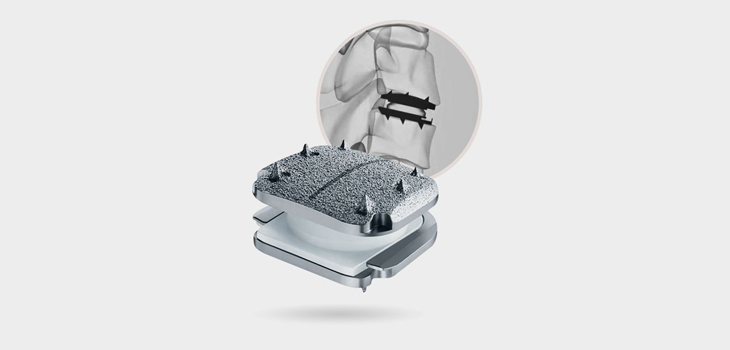
In looking at 18 consecutive patients, researchers from Austria, Turkey, Switzerland, and Germany have determined that cervical total disc replacement (cTDR) using the ProDisc C Vivo (Centinel Spine, Inc., West Chester, Pennsylvania) yielded good clinical and radiographic outcomes.
New Data on ProDisc C Vivo
2 min read Premium comments
Secondary#prodisccvivo#certicaltotaldiscreplacement#intervertebraldisc
Their study, “Clinical and Radiographic Outcome of Patients With Cervical Spondylotic Myelopathy Undergoing Total Disc Replacement,” was published in the October 15, 2019 edition of Spine.
Co-author Christoph Mehren, M.D., head of Department at the Spine Center Munich in Germany described the study to OTW, “For several years now I have been working scientifically with the so-called non-fusion technology of total disc replacement in the cervical spine (ProDisc Vivo). Since the beginning of the introduction of this technology, the range of indications has naturally widened with the surgeons’ increasing experience and positive results. Of course, results cannot be arbitrarily transferred from different pathologies.”
“Cervical myelopathy is one of the most challenging diseases in surgical treatment. In most cases, the surgical procedures used are accompanied by long-distance and also mostly stiffening procedures. The aim of this work was to scientifically process the results of a specially selected patient cohort which was treated with a total disc prosthesis (ProDisc C Vivo) in the case of clinically and radiologically proven myelopathy.”
The authors used the following clinical outcome scores to assess patient outcomes: the Neck Disability Index, Visual Analogue Scale, arm and neck pain assessment questionnaires, the Nurick grade and the Japanese Orthopaedic Association score. They also collected radiological data for range of motion, segmental and global C2-C7 lordosis, and the occurrence of heterotopic ossifications.
Dr. Mehren summarized the results of the ProDisc C Vivo study to OTW, “The most important result is that the clinical symptoms of cervical myelopathy can also provide good and lasting results (2-year follow-up) by decompression and implantation of an intervertebral disc prosthesis, taking into account a number of contraindications. The hope of this motion-preserving technology to reduce the rate of adjacent segment degenerations by physiological force introduction into the nearby segments is thus also given for this special pathology.”
“It is crucial to at least consider the possibility of motion-preserving surgery in myelopathic patients and to check the indications—but above all the contraindications. In the literature, the results condense, that especially the reoperation rate after implantation of an intervertebral disc prosthesis is reduced compared to fusion.”
“A cervical myelopathy which exists mainly due to a discogenic cause or moderately pronounced dorsal bony spurs can be treated with a disc prosthesis with good results. Of course, certain exclusion factors such as an ossification of the posterior longitudinal ligament (OPLL) or a fixed dysbalance of the cervical spine (which is unfortunately quite often associated with this clinical picture) must be excluded.”
Author
React:
Discussion
This is a fascinating development. In my practice we've seen similar outcomes with the revised protocol. The key differentiator seems to be patient selection criteria. Has anyone else noticed the correlation with BMI thresholds?
Great point. I'd push back slightly on the conclusion, the sample size in the cited study is too small to draw population-level inferences. That said, the directional signal is compelling and worth a larger RCT.
We implemented a similar approach last year. Early results are promising but we're still gathering 12-month follow-up data. Happy to share our protocol if anyone is interested.
Join the conversation
Orthopedic professionals are discussing this. Sign in and upgrade to read every comment and add your voice.