
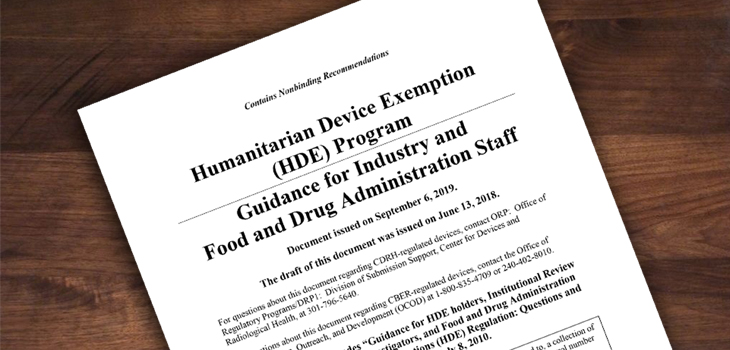
The FDA has issued a Final Guidance on the Humanitarian Device Exemption (HDE) program.
Humanitarian Device Exemption FDA Guidance Finalized
2 min read Premium comments
Secondary
The September 6, 2019 guidance reflects changes required by the 21st Century Cures Act and further explains the criteria to determine “probable benefit” related to agency’s decision-making process for humanitarian use devices (HUD).
HUDs are medical devices that treat no more than 8,000 individuals in the U.S. per year. The Cures Act required that number to rise from 4,000. Applicants must demonstrate that no similar device exists and that there is no other way to bring the device to market.
Think of it as a Premarket Approval application (PMA) without the requirement to demonstrate effectiveness.
For an applicant to receive approval the FDA must find, among other things, “that the device will not expose patients to an unreasonable or significant risk of illness or injury and the probable benefit to health from the use of the device outweighs the risk of injury or illness from its use, taking into account the probable risks and benefits of currently available device[s] or alternative forms of treatment.”
Probable Benefit
In the section on “Assessing Probable Benefit and Risk in an HDE Application,” the agency adds a sentence that clarifies, “The types of evidence that may be used to support approval of an HDE application include investigations using laboratory animals, investigations involving human subjects, nonclinical investigations, and analytical studies for in vitro diagnostics.”
The agency also clarifies when an HDE can be suspended or withdrawn, noting, “We intend to discuss the regulatory options with the HDE holder before revoking a HUD designation.”
the Cures Act removed the requirement that institutional review committees (IRB) that supervise the clinical testing of devices or approve the use of HUDs be local
Humanitarian Device Exemption
The FDA says 76 medical devices have been approved through the HDE regulatory pathway. The approvals range from a device that allows patients with certain spinal cord injuries to breathe without the aid of a mechanical ventilator to the most recently approved HDE for a device to correct idiopathic scoliosis.
The final guidance includes a filing checklist to clarify the required information for the agency to consider the application ready for substantive review, plus tools to assist application review staff in consistent decision-making.
The 57-page guidance can be accessed here. — WE
Author
React:
Discussion
This is a fascinating development. In my practice we've seen similar outcomes with the revised protocol. The key differentiator seems to be patient selection criteria. Has anyone else noticed the correlation with BMI thresholds?
Great point. I'd push back slightly on the conclusion, the sample size in the cited study is too small to draw population-level inferences. That said, the directional signal is compelling and worth a larger RCT.
We implemented a similar approach last year. Early results are promising but we're still gathering 12-month follow-up data. Happy to share our protocol if anyone is interested.
Join the conversation
Orthopedic professionals are discussing this. Sign in and upgrade to read every comment and add your voice.