
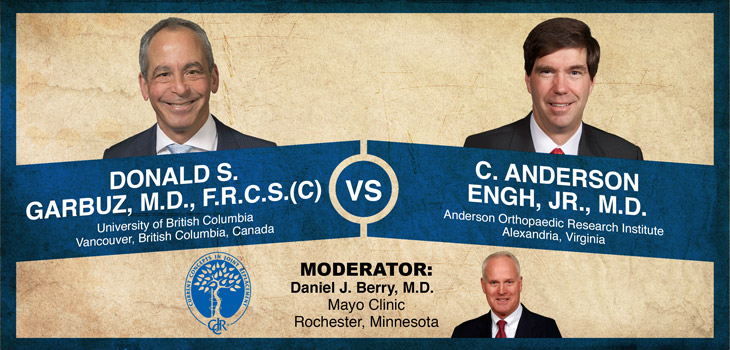
This week’s Orthopaedic Crossfire® debate was part of the 19th Annual Current Concepts in Joint Replacement® (CCJR®), Spring meeting, which took place in Las Vegas. This week’s topic is “Ceramic Heads Should Be Used in All Patients.” For is Donald S. Garbuz, M.D., F.R.C.S.(C) – University of British Columbia, Vancouver, British Columbia, Canada. Opposing is C. Anderson Engh, Jr., M.D. – Anderson Orthopaedic Research Institute, Alexandria, Virginia. Moderating is Daniel J. Berry, M.D. – Mayo Clinic, Rochester, Minnesota.
Garbuz v. Engh: Ceramic Heads Should Be Used in All Patients
9 min read Premium comments
Great Debates#candersonenghjr#ccjr#ceramicheads#donaldgarbuz
Dr. Garbuz: Full disclosure—I use ceramic heads in 100% of my patients. Most of you know Andy Engh, third generation orthopedic surgeon, won many awards for his research including the John Charnley award. And he has at least 80 peer-reviewed publications.
However, I find it surprising that a really smart guy like Andy is not using ceramic heads all the time. But Andy’s kind of an old-fashioned guy. It takes him a little while to take up new technology.
But I think even Andy will notice that there is a difference between ceramic heads and cobalt chrome. But you’ve got to look at wear and corrosion. And you’ve got to look beyond the first decade.
We’re talking about wear and subsequent osteolysis, aseptic loosening, and corrosion.
While there are not a lot of good robust comparative studies, there are a couple of cohort studies which basically show survival of 98% versus 96% in favor of ceramic-on-poly (Topolovac, et al., J Arthroplasty, 2014). Not a significant difference. Similar findings in this study (Meftah, et al., JBJS-Am, 2013), so a minor, if any, benefit for ceramic-on-poly.
From the UK registry, we’re getting out to 12 years and there is an advantage for ceramic-on-poly with a failure rate of 4.1 versus 5.4 for metal-on-poly. That is probably clinically and statistically significant.
When you look through all the literature—cohort studies, case series, registries—ceramic-on-poly is at least as good, maybe slightly better than metal-on-poly. Certainly the registries in the second decade are starting to diverge.
In 2012 the Rush Group published a paper (Cooper, et al., JBJS, 2012) showing corrosion can happen in metal-on-polyethylene. Ten cases I’ll acknowledge. Metal-on-poly pseudo-tumors were thought to be due to trunnion corrosion. This is fairly recent that patients present with pain, swelling, instability, and it’s not just large heads. These occur for 28, 32, and 36mm heads. All of us who do a high volume of cases have seen these.
We’ve published on delayed dislocation (Lash, et a, Bone Joint J, 2016). It is the first presentation of about 10 patients. They had perfect positioning of components and then all of a sudden, after about 5 years, they dislocate.
Why is this happening now? We’ve been doing metal-on-poly since the 1960s and this didn’t seem to be a problem until recently. Well, there’s been a change in the trunnion. They’re shorter and smaller. The surface has changed on the trunnion to accept ceramic heads. There is a trend for increasing head size. I think we’ll all acknowledge with smaller incisions we’re not preparing the trunnion quite as well as we used to. And how hard we hit it. We don’t all hit it consistently.
I agree it’s uncommon. And there is some literature indicating it may be stem dependent. So, depending on the stem you use, you may only see a few of these cases and you may see a lot of these cases.
The issue is I cannot predict which patient will get it. You can have an 85-year-old lady and she can end up with a pseudotumor even with a 28 or 32mm head.
So, what would I say is the state of the art? Well, this is what we want our bearing couple to do. We want low wear. Low corrosion potential. I want to have a head size—I like to get up to 36mm, if I can. You want it generalizable, easy to insert and easy to take out down the line. Versatile. A lot of intra-operative flexibility. Familiar to us. Biocompatible. Revisable. Relatively cheap and safe.
So, for me the ceramic-on-poly total hip fulfills all the requirements of a modern bearing and that’s why I use it in 100% of my cases.
Dr. Engh: I may be a couple of years more progressive than you give me. I’m going to oppose the concept that ceramic heads should be used in all patients.
First, the increased use of ceramic-on-polyethylene in my opinion is a reaction to what remains a poorly understood and rare problem. That problem is mechanically assisted crevice corrosion, which subsequently leads to an adverse local tissue reaction. And this has been coined trunnionosis.
Second, for me and I think for many of us, this is still about cost. Ceramic heads cost more. The question I ask is what concerns you more today? The cost of your hospital’s stay or that patient’s 90-day event? Or a long-term cost prediction of what remains a rare and poorly understood problem?
Getting right to the data. The Australian Joint Replacement Registry [AJRR] 2017 Annual Report. In 2016 53% of the bearings were ceramic-on-poly and the trend is increasing.
In that report, the factors that contributed to this growth included the decreased use of metal-on-metal bearings, but also concerns regarding trunnionosis and corrosion.
Looking at the same 2012 article that Don quoted (Cooper, JBJS, 2012), they had 10 cases. Eight out of the 10 cases were from a single vendor. And this represented 2% of their revisions.
Another article with 27 cases (Plummer, JOA, 2016). And although we believe that a titanium stem with a chrome cobalt bearing ball is more common, in this series 70% of the cases were a chrome cobalt-on-chrome cobalt junction. Again, 21 of the 27 were from the same manufacturer. It’s also interesting that most of us use 36mm heads and 20 of the 21 heads in this series were less than 36mm in size.
Again, another article in 2017 (Hussey, JOA, 2017), actually that same single manufacturer, but this happened to be a titanium stem with a chrome cobalt ball. Out of 1,325 cases 3.2% either had elevated metal levels or had been revised. So not all of these were revised. They were being followed.
I think Josh Jacobs knows as much about this topic as just about anybody, so in a symposium from AAHKS (Jacobs, JOA, 2016), “the incidence, etiology and pathogenesis of mechanically assisted crevice corrosion are not well understood”—still in 2016—and I would say still in 2018.
My question is: Why are we reacting to a rare, and poorly understood problem? I’m going to give you my personal experience because I do believe that your choice of implants is a local issue and cost is an important aspect of your individual local issues.
My clinical experience includes a prospective randomized study in which I had metal-on-poly bearings as the control. These were followed out to 2 years. None of these had cobalt levels greater than 1PPB [part per billion] (Engh, CORR, 2009). This is supported from the Rush Group in a cohort that they studied for 10 years (Levine, JBJS, 2013). None of their cobalt levels in their polyethylene bearings were above 1PPB.
I followed chrome cobalton-crosslinked poly out to 16 years (Hopper, CORR, 2018) with no revisions for mechanically assisted crevice corrosion.
I’ve taken 56 postmortem retrievals that had a mean implant time of 11 years and had them analyzed at HSS [Hospital for Special Surgery] (Padgett, 2017 Hip Society Specialty Day). The tapers were pristine with a mean corrosion score based on visual analysis—1.4 out of a possible 96. This is compared to HSS retrievals which were substantially higher.
Looking at my own database, 3,000 primary total hips from 2006-2017, about half of these were titanium stems. Some from me, some from my partners. Two revisions. That ends up being a 0.1% of primaries from our center have been revised for this problem.
I also looked at our most recent 350 revisions. We added 1 other that was sent in from outside, so we’re at 1% of our revisions.
In conclusion, cost is an issue. Ceramic balls at my place cost more. They cost $250 more. Corrosion at the taper junction is poorly understood. It’s rare. I take the same point that my opponent’s colleagues have put into publication in Seth’s Supplement to The Bone and Joint Journal and I support the “judicious use of ceramic heads”.
Moderator Berry: First of all I want to see if we can get some agreement about a couple of topics. Would both of you agree that the main reason we’re talking about this is related to taper corrosion? Is that fair to say, Don?
Dr. Garbuz: I would agree with that.
Dr. Engh: I would agree with that.
Moderator Berry: And would you both also agree that the issue of ceramic fracture, at least of the ceramic femoral head in the modern era is no longer really a big talking point or concerning to you? Don, would you agree with that?
Dr. Garbuz: I would agree with that.
Dr. Engh: I would too.
Moderator Berry: Now we’re going to talk about a couple of things that both of you said. Don, you said taper corrosion is the huge issue. But is it really a huge issue? Are we making a big deal about a 0.5% problem?
Dr. Garbuz: In terms of incidence it’s probably not a high incidence, but for the individual patient the reactions tend to be quite severe. But the problem as I mentioned is it’s unpredictable and from what we can see so far…manufacturer dependent.
Moderator Berry: Fair enough. I think you did a nice job of framing that by saying it’s probably not terribly common for most types of implants, but when it does happen it can be a pretty big deal Andy, will you give him that point or no?
Dr. Engh: It’s a bad problem. But like the problem that we had with metal-on-metal, we have gotten better at recognizing it. What we have to remember is when a patient comes in with pain, we can’t send every patient out saying they’ve got trochanteric bursitis. We probably have to measure metal levels and pick these up before it’s a catastrophic problem. They still need a revision, but it’s not catastrophic anymore.
Moderator Berry: So, Andy maybe Don would say to you, “Well, if every time you’ve got a patient that comes in with pain, you have to check metal levels, if they’ve got a cobalt chrome head, why not just use a ceramic head so you don’t have to check for cobalt chrome levels every time somebody comes in with pain and gets told it’s trochanteric bursitis?”
Dr. Engh: It’s just going to cost more.
Moderator Berry: No doubt about it. Ceramic-on-crosslinked polyethylene is tending to be used in higher demand patients. If you look at the AJRR data, it’s used disproportionately in younger patients more than older patients. Is that driven by logic or is it driven by some misinformation about demand matching. For some types of demand matching we can make the case that the problem is less common in an older patient than a younger patient. Is it true that taper corrosion is less common in old patients? Furthermore, doesn’t taper corrosion, when it happens, happen relatively early? Old patients, in theory, would be just as at risk for it as young patients. Why not just do it in everybody? As Don has decided to do.
Dr. Engh: I agree with those 2 points. You can’t predict who it’s going to be. It’s not age-specific and it’s not demand matching. I do demand matching, again, because my hospital loses money on Medicare patients and they make money on private insurance. It’s not strictly age. And I don’t go strictly by Medicare. It’s individualized. It’s judicious use and for, what in my experience has been a 10th of a percent, you can’t justify the cost at this time.
Moderator Berry: All right, please join me in thanking the panelists for an excellent discussion on a timely topic.
Please visit www.CCJR.com to register for the 2019 CCJR Winter Meeting, – December 11 – 14 in Orlando.
React:
Discussion
This is a fascinating development. In my practice we've seen similar outcomes with the revised protocol. The key differentiator seems to be patient selection criteria. Has anyone else noticed the correlation with BMI thresholds?
Great point. I'd push back slightly on the conclusion, the sample size in the cited study is too small to draw population-level inferences. That said, the directional signal is compelling and worth a larger RCT.
We implemented a similar approach last year. Early results are promising but we're still gathering 12-month follow-up data. Happy to share our protocol if anyone is interested.
Join the conversation
Orthopedic professionals are discussing this. Sign in and upgrade to read every comment and add your voice.